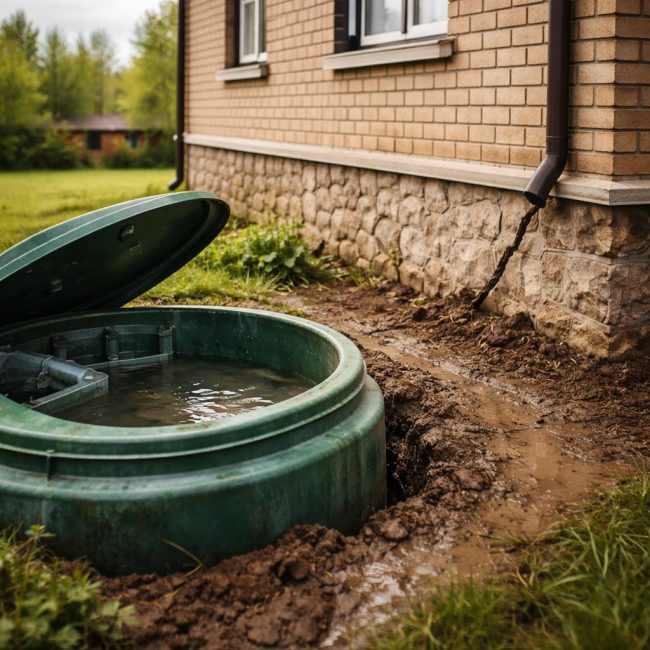
When a property already has a house, a well, paths, and plantings, a septic tank often has to be "fitted" into the remaining space. This is where the main practical question arises:How dangerous is it to place a septic tank too close to a house, and what consequences might this have in real life, not just on paper?This isn't about formally adhering to the figures, but rather about what actually happens to the foundation, the soil, and the house itself if the distance is chosen without understanding the processes involved.
- Why does the proximity of a septic tank begin to affect the house?
- How this manifests itself not immediately, but after several years
- What happens to a foundation when a moisture source is constantly nearby?
- Why the problem isn't limited to the septic tank itself
- How distance affects service and emergencies
- The "my neighbors have it like that, and nothing happens" error
- Why the problem can't be "compensated" by finishing and drainage
- How the understanding of the distance between a septic tank and a house is distorted
- When the question of distance becomes especially critical
- An Expanding View: Distance as an Element of Home Durability
Why does the proximity of a septic tank begin to affect the house?
A septic tank is more than just a wastewater container. It constantly interacts with the soil: through moisture, pressure, micro-movements, and biological processes. A house, in turn, rests on a foundation that is sensitive to changes in the soil properties beneath and around it. When these two systems are too close, they begin to function as a single unit, even if this is not intended.
The main problem is not accidents or leaks, butconstant changes in soil conditionsThe soil near the septic tank becomes wetter, loses its homogeneity, and reacts differently to frost and thaw. For the foundation, this means uneven loads and slow but steady deformations.
How this manifests itself not immediately, but after several years
At first, everything seems normal. The septic tank is working, there are no odors, and the house is standing as before. But gradually, indirect signs appear that are rarely associated with the distance between the septic tank and the house.
At first, it might be increased dampness in the basement or at the bottom of the walls, even if the waterproofing is well-done. Then, small cracks in the finish appear, taking on a life of their own: barely noticeable in summer, then widening in winter. Sometimes, the doors and windows don't work properly, and the house feels slightly warped, but for no apparent reason.
The problem is that these symptoms develop slowly, and by the time a connection with a septic tank becomes obvious, correction already requires serious costs.
What happens to a foundation when a moisture source is constantly nearby?
The foundation is calculated based on specific soil characteristics: density, bearing capacity, and moisture content. A septic tank located too close will alter these parameters locally but continuously.
In the area of influence of the septic tank the soil:
- remains moist longer after precipitation;
- freezes worse in winter and thaws unevenly in spring;
- may settle differently than the rest of the house's foundation.
This does not lead to sudden destruction, but todifference in sedimentOne part of the foundation operates in one mode, while the other operates in another. It is this difference that causes cracks and distortions.
Why the problem isn't limited to the septic tank itself
It's often assumed that if a septic tank is sealed, its proximity to the house is safe. In reality, the impact comes not only from the tank itself, but also from the entire system around it.
Even if it is working properly:
- a zone of modified soil is formed around the septic tank;
- local humidity increases;
- The microclimate of the soil near the house changes.
Add in seasonal fluctuations in groundwater levels, and the effect is amplified. The house begins to perceive the septic tank not as a separate object, but as a factor affecting its foundation.
How distance affects service and emergencies
There's also a more mundane aspect. The closer the septic tank is to the house, the more difficult it is to resolve any emergency situations. Even routine maintenance, not just accidents, can create risks.
Pumping, inspection, and repairs all involve stress on the soil, equipment access, and vibrations. When a septic tank is located next to a house, these impacts are directly transmitted to the foundation. Under normal conditions, this isn't critical, but when combined with already altered soil, the effects are cumulative.
The "my neighbors have it like that, and nothing happens" error
One of the most common arguments is the successful experience of others. But it's important to understand: seemingly identical sites can have completely different conditions.
Even with the same distance between the septic tank and the house, the result will depend on:
- soil type;
- foundation depth;
- the structure of the house itself;
- septic tank usage mode.
What may not cause problems in one area for decades may begin to destroy the foundation in another, simply due to differences in the soil or layout.
Why the problem can't be "compensated" by finishing and drainage
Sometimes people try to solve the problem retroactively: they strengthen the waterproofing, install additional drainage, or change the baseboard finish. This may alleviate the symptoms, but it doesn't eliminate the cause.
If the source of constant soil change remains near the house, the foundation will continue to operate in an unfavorable manner. As a result, the measures become endless maintenance rather than a solution.
How the understanding of the distance between a septic tank and a house is distorted
The main distortion is the attempt to perceive distance as a formality or a “paper requirement.” In reality, it isengineering gap, which allows the soil to remain stable under the house.
Another misconception is to view a septic tank as a neutral object if it doesn't leak. In reality, even a properly functioning system has a constant, not sporadic, impact on the environment.
When the question of distance becomes especially critical
There are situations in which the proximity of the septic tank to the house becomes especially sensitive:
- houses with shallow foundations;
- areas with heaving or water-saturated soils;
- buildings with a basement or ground floor;
- areas with limited natural soil ventilation.
Under such conditions, even a small reduction in distance increases all the negative effects.
An Expanding View: Distance as an Element of Home Durability
If you look at it more broadly, the distance between the septic tank and the house is not about the convenience of placement, but aboutbuilding resourceA house is designed to last for decades, and a septic tank is designed to continuously work with the soil. By separating them with sufficient space, the owner effectively gives the house a chance to age evenly, without hidden stress points in the foundation.
That's why the issue of distance shouldn't be considered secondary. It's directly related not to comfort today, but to how well the home will withstand the changing seasons and years in the future.