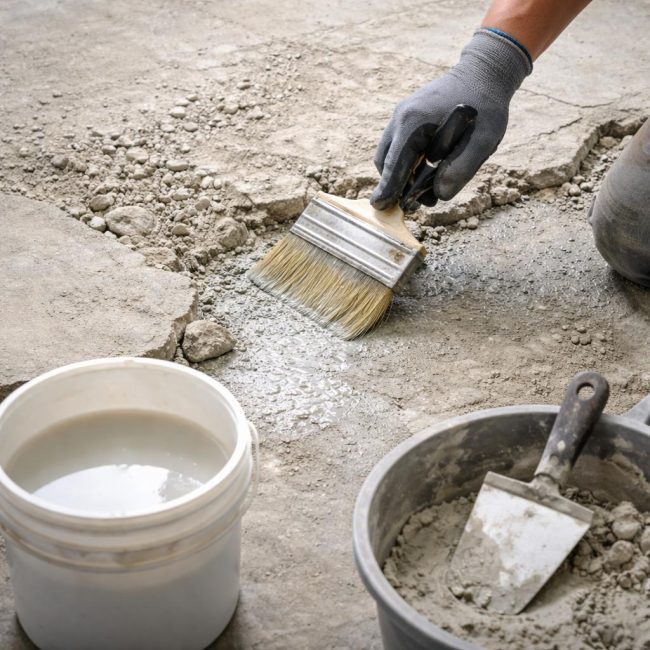
When concrete begins to crumble, dust, and flake from the surface, it's almost always due to a weakened top layer. The practical question in such a situation is whether it's possible to stop the deterioration and strengthen the concrete without completely rebuilding the structure. This article addresses precisely this: what to do if the surface layer of concrete is crumbling, and in which cases such measures actually work.
- In what cases does surface strengthening make sense?
- Why does concrete start to crumble from the top?
- The main objective of restoration
- A sequence of actions for strengthening crumbling concrete
- Step 1: Removing the damaged layer
- Step 2: Dedusting and cleaning
- Step 3. Assessing the absorbency of the substrate
- Step 4. Applying the strengthening composition
- Step 5. Leveling restoration (if necessary)
- Step 6. Protecting the restored surface
- Common mistakes when trying to restore crumbling concrete
- Superficial "smearing"
- Ignoring cleaning
- Insufficient saturation with impregnation
- Trying to build up a thick layer
- Lack of protection after repair
- When the described scheme is not suitable
- Deep destruction of concrete
- Structural cracks
- Detachment of large fragments
- Exposure to aggressive environments
- How to evaluate the result after strengthening
- The final principle of working with weak concrete
In what cases does surface strengthening make sense?
Before taking action, it is important to understand whether the situation is suitable for superficial restoration.
Practice shows that strengthening is possible if:
- only the top layer, a few millimeters thick, is destroyed;
- the concrete does not have deep cracks;
- no movement of the foundation is observed;
- shedding is accompanied by dusting and peeling, and not through chips;
- the base under the concrete remains stable.
Under such conditions, destruction is usually associated with improper concrete maintenance, over-wetting, over-drying, poor compaction, or cement leaching from the surface.
If the concrete crumbles deeply, peels off in layers, or “rings” when tapped, surface strengthening will be ineffective.
Why does concrete start to crumble from the top?
Understanding the cause directly influences the choice of actions.
In practice, the following situations are most often encountered:
- the surface dried out in the first days after pouring;
- there was too much water in the top layer;
- the cement laitance was washed away by the rain;
- the surface was subjected to stress early;
- a weak or contaminated mixture was used;
- The concrete was left in a humid environment for a long time without protection.
In all these cases, a loose, porous layer with low strength is formed, which gradually collapses.
The main objective of restoration
The goal of all further actions is to remove the fragile layer and create in its place a dense, cohesive structure that:
- does not produce dust;
- does not absorb water excessively;
- does not peel off;
- distributes the load evenly.
This is not about “repairing for the sake of appearance”, but about restoring the functional surface.
A sequence of actions for strengthening crumbling concrete
Below is an algorithm based on proven practice for repairing weak concrete surfaces.
Step 1: Removing the damaged layer
The first step is to completely remove all fragile material.
Usually they act like this:
- scrape off the crumbling layer with a hard brush, spatula or sanding attachment;
- remove all areas that easily crumble;
- do not leave “transition” zones with questionable strength.
The goal is to achieve dense, dust-free concrete.
If the surface continues to crumble actively after cleaning, this means the damage is deeper, and further strengthening will be of limited effectiveness.
Step 2: Dedusting and cleaning
After mechanical cleaning, the surface always contains fine dust, which interferes with adhesion.
Practical applications:
- thorough sweeping;
- cleaning with a construction vacuum cleaner;
- rinsing with water and then drying.
The surface must be clean, without any loose concrete residue.
Step 3. Assessing the absorbency of the substrate
Before strengthening, it is important to understand how much moisture the concrete absorbs.
Usually this is checked simply:
- a little water is applied to the surface;
- observe how quickly it is absorbed.
If the water drains almost immediately, the concrete is highly porous and requires deep impregnation. If it lingers, surface strengthening is sufficient.
This step helps to choose the right processing scheme.
Step 4. Applying the strengthening composition
For weak concrete, special impregnating compounds are used that penetrate the pores and bind the structure.
Sustainable practice involves:
- strengthening impregnations;
- mineral strengthening solutions;
- deep penetration cement-polymer primers.
Regardless of the type of product, the logic of use is similar:
- the composition is applied evenly;
- do not allow dry areas;
- allow the surface to absorb the maximum amount.
Typically, the treatment is carried out in several passes until saturation.
The task is to fill the pores and bind the concrete particles within the structure.
Step 5. Leveling restoration (if necessary)
If noticeable depressions or unevenness are formed after cleaning, thin-layer restoration is practiced.
For this purpose, use:
- repair cement mixtures;
- fine-grained leveling compounds.
Work on a reinforced and primed base to ensure adhesion.
The layer is made minimal - only to compensate for defects, and not to mask problems.
Step 6. Protecting the restored surface
After strengthening, it is important to prevent re-destruction.
In practice the following are used:
- protective impregnations;
- water repellents;
- wear-resistant coatings.
The choice depends on the operating conditions, but the principle is the same - to reduce water absorption and abrasion.
Without a protective layer, weak concrete may begin to deteriorate again.
Common mistakes when trying to restore crumbling concrete
Most failures are due to a violation of the basic logic of repair.
The most common errors are the following.
Superficial "smearing"
A common practice is to apply a thin layer of mortar directly onto dusty concrete.
As a result:
- the new layer does not adhere;
- delamination appears;
- the destruction continues.
Without removing the weak base, the repair will not work.
Ignoring cleaning
Even a high-quality strengthening compound does not work on a dirty surface.
Dust acts as a separating layer and reduces adhesion.
Insufficient saturation with impregnation
If the composition is applied formally, without impregnation, it does not strengthen the structure, but only creates a thin film.
This film quickly deteriorates.
Trying to build up a thick layer
A thick leveling layer on a weak base will cause peeling.
The base must be stronger than the material being applied, otherwise the repair will not hold.
Lack of protection after repair
Without additional protection, the surface remains vulnerable to moisture and abrasion.
As a result, the problem returns.
When the described scheme is not suitable
There are situations in which surface reinforcement does not solve the problem.
Practice shows the limitations of the method.
Deep destruction of concrete
If concrete crumbles centimeters deep, the cause is usually related to the composition of the mixture or the destruction of the base.
In such cases, strengthening the surface provides a temporary effect.
Structural cracks
Cracks running through a slab or structure indicate deformations.
Surface repair does not remove the source of stress.
Detachment of large fragments
If the concrete comes off in layers, this is a sign of weak adhesion of the entire layer.
More serious restoration is required here.
Exposure to aggressive environments
Constant contact with chemically active moisture, salts or acids accelerates destruction.
Without eliminating the external factor, strengthening is ineffective.
How to evaluate the result after strengthening
After some time after treatment, the surface should:
- stop making dust;
- does not crumble when rubbed;
- have a uniform density;
- does not darken instantly from water;
- maintain integrity under normal loads.
If these signs are present, then the recovery was performed correctly.
The final principle of working with weak concrete
Experience shows that successful strengthening of a crumbling surface is always based on the same logic:
- Completely remove the weak layer.
- Clean and dust the base.
- Impregnate the concrete with a strengthening compound until it is saturated.
- If necessary, level out any defects.
- Protect the surface from moisture and wear.
Skipping any stage reduces the result.
In the case of superficial deterioration, this approach can significantly extend the service life of concrete without complete rework. However, if the deterioration is deep-seated or systemic, superficial measures are only a temporary solution.