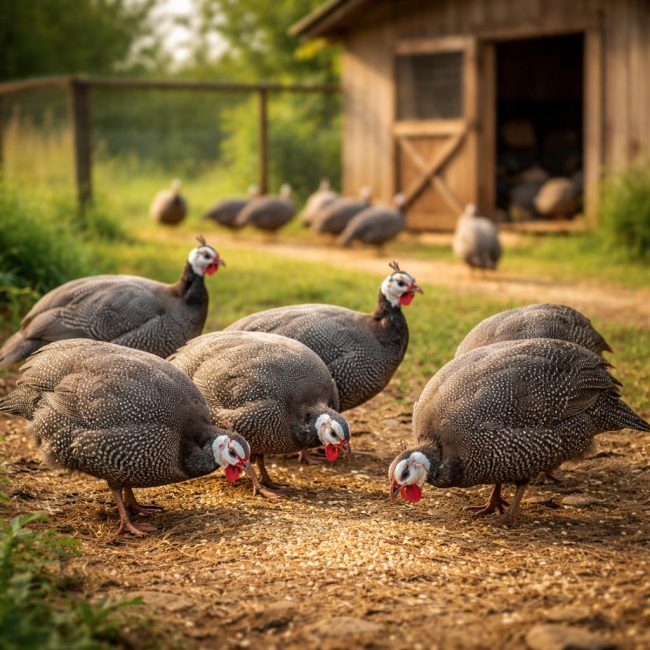
Interest in guinea fowl is usually not born out of idle curiosity. These birds attract those who are already familiar with common poultry and are looking for a more robust, "self-sufficient" option for the backyard. Guinea fowl seem unpretentious, almost wild, and it is this combination—their resilience and their distinctive character—that raises the most questions. In conversation, they are often described as "the chicken without problems," but in practice, everything turns out to be significantly more complex and interesting.
Breeding guinea fowl is less about technique and more about understanding the logic behind the birds' behavior. What's important here isn't "how to do it," but rather why some approaches work while others lead to disappointment. Without this, guinea fowl quickly transform from a promising farm resource into a source of constant noise and inconvenience.
The nature of guinea fowl and its influence on the content
Guinea fowl are neither ornamental nor "domestic" in the traditional sense. Unlike chickens, they retain distinct traits of their semi-wild form: caution, a collective response to threats, and a strong territorial and group orientation. This determines almost everything related to their upkeep.
On paper, guinea fowl appear versatile: they tolerate cold well, rarely get sick, and actively consume insects. In reality, these qualities only manifest when conditions don't interfere with their natural mechanisms. Where the hen adapts, the guinea fowl more often "protests"—by vocalizing, running away, or by refusing to lay eggs.
It's important to understand that for guinea fowl, the environment is more important than the routine. They are sensitive not so much to temperature or the type of housing, but to stability: a familiar location, a consistent group, a predictable environment. Any sudden changes are perceived as a threat.
Space and sense of territory
One of the key characteristics of guinea fowl is their sensitivity to space. These birds do not tolerate cramped and confined conditions well, especially if they were raised free-range. Trying to keep them like chickens—compact and without access to open space—often results in stress and aggressive behavior within the flock.
Guinea fowl don't need a lot of space, but rather the ability to navigate. Visual landmarks, familiar routes, and the ability to stay in a group are essential. This is why, when suddenly changing their habitat or being relocated, birds may become lost, fly away, or refuse to return to their shelter.
In practical terms, this means that guinea fowl thrive best in areas where the same plot has been in use for a long time and without frequent renovations. They adapt less well to a "live" farm with constant work, noise, and moving objects.
Group behavior and hierarchy
Guinea fowl are highly social birds. Being kept alone is unnatural for them and quickly leads to anxious behavior. In a group, however, they act in unison, reacting to danger simultaneously and loudly.
Guinea fowl do have a hierarchy, but it's less rigid than that of chickens. Conflicts often manifest themselves not in fights, but in demonstrative noise and the distancing of individuals. However, the group always acts as a unit: if one bird is alarmed, it instantly spreads to the others.
This characteristic is often underestimated. From a domestic perspective, guinea fowl may seem overly noisy, especially near a residential building. However, noise isn't a characteristic, but a survival mechanism. The bird warns the flock and deters a potential threat, be it a predator or an unfamiliar object in the area.
Reproduction and instincts
Guinea fowl breeding is associated with another peculiarity: a weak brooding instinct, typical of domestic birds. In the wild, guinea fowl lay eggs secretly, choosing secluded spots, and abandon the clutch at the slightest threat.
In a farm setting, this leads to a paradox: eggs are present, but there's no controlled hatching process. Guinea fowl may change their nesting site, abandon it, or return to it irregularly. This isn't a husbandry error, but a reflection of a natural survival strategy transferred to an artificial environment.
Therefore, in breeding practice, the main focus is not on “stimulating” the bird, but on creating conditions in which its natural behavior patterns do not conflict with the owner’s expectations.
Climate resilience and real limits
Guinea fowl are often called frost-resistant, and this is generally true. They do tolerate cold better than dampness and drafts. However, there's an important nuance: resistance doesn't equal comfort. While a bird can survive in unfavorable conditions, this almost always affects its behavior and productivity.
In reality, guinea fowl thrive in a dry, well-ventilated space without sudden changes in temperature. However, excessive insulation and confinement are often more harmful than moderate coolness. For this bird, warmth is not as important as a sense of security and the ability to huddle together.
Common misconceptions about guinea fowl
One of the most common misconceptions is the idea that guinea fowl are "problematic." More often than not, problems arise not from the bird itself, but from attempts to treat it like a chicken. Expectations of quiet behavior, consistent egg production, and complete compliance lead to disappointment.
Another misconception concerns versatility. Guinea fowl can indeed perform a variety of functions on the farm, but they are ill-suited for situations where maximum predictability is essential. This is a bird for those willing to embrace its character rather than suppress it.
Finally, their "independence" is often overestimated. Yes, guinea fowl are active and find food, but that doesn't mean they don't require attention. This attention simply isn't expressed in constant activity, but in a well-organized environment.
Why Guinea Fowl Are Not for Everyone, but for the Long Run
Guinea fowl breeding is rarely a spontaneous hobby. More often, it's a conscious decision, following experience with other birds or a desire to build a more sustainable, less dependent on details, farming system. Guinea fowl aren't about quick results or complete control.
This is precisely why they fit so seamlessly into farms that value sustainability and balance over maximum output "here and now." With a proper understanding of their nature, guinea fowl cease to be exotic and become a logical element of a vibrant, thriving farm that operates according to its own rules, not a set pattern.