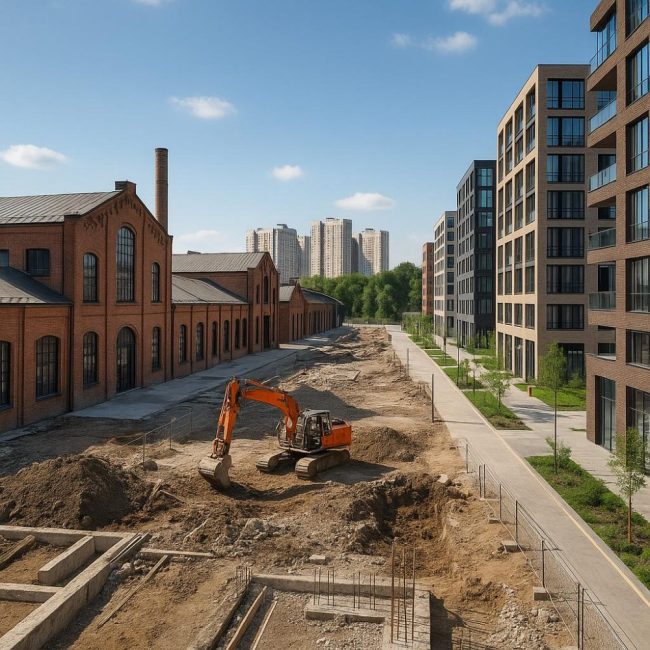
Many large cities, including the Russian capital, inherited significant areas of industrial land formed in the 19th and 20th centuries. Factories, plants, and warehouses defined the life of entire neighborhoods for decades, but with changing economic realities, these structures began to lose their relevance. Today, cities face the important task of transforming these areas into comfortable and modern spaces while preserving their cultural and historical significance.
Historical context
Industrial zones emerged during periods of active industrialization, when the primary goal was the rapid construction of production facilities. At that time, aesthetics and integration into the urban fabric were largely neglected. As a result, many enterprises occupied vast areas near transportation hubs, often isolating entire neighborhoods from full-fledged development. With the collapse of traditional production chains, a significant portion of these facilities were abandoned or underutilized.
Modern challenges
Today, cities cannot afford to neglect industrial areas. This is due to several factors:
- Land shortage. In megacities, there are fewer and fewer available plots of land for new construction.
- Environmental safety. Abandoned factories often become a source of soil and air pollution.
- Social request. Residents want to see well-maintained spaces for living, working, and relaxing in place of crumbling buildings.
- Redevelopment of industrial zones allows us to address these challenges comprehensively, transforming problematic areas into drivers of urban development.
The role of specialists
When transforming large sites, professional work on the architectural and urban planning concept is essential. Therefore, teams that develop projects at all stages—from research to implementation—play a key role. In such cases, an architectural firm in Moscow with experience working with projects of various scales and an understanding of the specificities of the capital's environment is in demand.
Urban transformation tools
The reconstruction process is impossible to imagine without a comprehensive site analysis. Here, the site planning project is of paramount importance. This document allows for the following considerations:
- transport links and accessibility of the area;
- placement of residential areas, business centers and social infrastructure facilities;
- preservation or adaptation of historic buildings;
- creation of new public spaces.
Only with such a well-developed base can we talk about balanced development.
Russian and international experience
The topic of transforming industrial zones has long since transcended local initiatives. In many countries, former factory districts have become symbols of a new urban style. For example:
- In Germany, the site of the former Zollverein industrial complex in Essen has been transformed into a museum and cultural centre.
- In the United States, the High Line Park was built on the site of an abandoned railway line in New York City, becoming one of the city's main attractions.
- In Moscow, well-known examples include the transformation of the Red October factory into an art cluster and the development of areas around former industrial plants in the east of the capital.
These projects demonstrate that integrating industrial heritage into modern life is possible and produces tangible results.
Architectural approaches
Converting factory buildings into residential or commercial complexes requires a delicate approach. It's important to preserve the buildings' unique appearance, highlighting their industrial aesthetics while still providing modern comfort. Various techniques are used:
- preservation of facades during complete reconstruction of the interior space;
- integration of new buildings into the historical complex;
- the use of characteristic materials - brick, metal, concrete - to maintain the style.
This approach allows us to preserve the “memory of place,” which is especially important for cities with a rich history.
Economic effect
Redeveloping industrial zones is beneficial not only from a public amenities perspective. It stimulates economic development, attracts investment, and creates jobs. New districts become hubs of business activity, cultural life, and education. Furthermore, property values in the redeveloped areas rise, which also positively impacts the city's economy.
Social significance
The social aspect is no less important. Parks, cultural centers, and educational institutions are emerging on the sites of former factories. This creates new scenarios for urban life, allows residents to spend more time in open spaces, and develops local communities. Thus, the reconstruction of industrial zones becomes a factor in strengthening social cohesion.
Development prospects
The future of such projects is directly linked to the development of sustainable city technologies and concepts. Green solutions are increasingly being applied, energy-efficient buildings are being created, and smart infrastructure management systems are being integrated. In the coming years, the redevelopment of industrial zones will remain a key topic in urban development policy.
Conclusion
Transforming industrial areas is a complex, multi-stage process that requires a professional approach, strategic planning, and the participation of multiple stakeholders—from government and investors to city residents. When properly organized, it can transform abandoned neighborhoods into vibrant living and working areas, reclaim lost space, and provide new development opportunities.