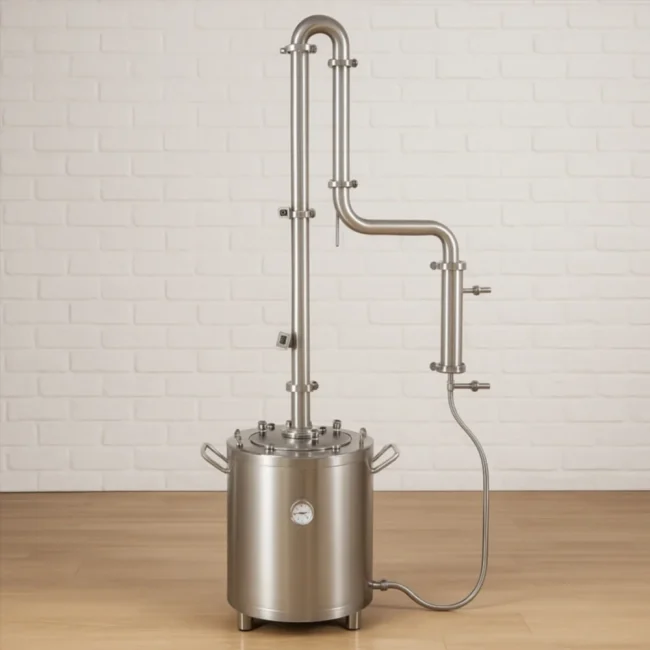
A distillation column is one of the most important elements in the process of producing highly purified alcohol. It is used not only in industrial facilities but also at home, especially by moonshiners seeking a high-quality product with minimal impurities. In this article, we will examine in detail the structure of a distillation column, its operating principle, design features, selection criteria, as well as operating tips and potential errors.
What is a distillation column?
A distillation column is a device designed to separate a liquid mixture into fractions with different boiling points. Its primary use is to separate ethyl alcohol from water and impurities contained in the mash. Its operating principle is based on repeated evaporation and condensation, which achieves a high degree of product purification.
Difference from a regular moonshine still
In a moonshine still, the distillation process occurs once or twice, which separates the alcohol from the water but does not remove all impurities, such as fusel oils, aldehydes, and methanol. A rectification column, unlike a conventional still, is capable of separating fractions much more precisely, resulting in highly purified alcohol (up to 96.6%).
Construction of a distillation column
The distillation column consists of several mandatory elements:
- Distillation still– a container into which the mash is poured. It is usually made of stainless steel and equipped with heating elements or connected to an external heat source.
- Column– a vertical pipe installed on the still. Packing (regular or irregular) is located inside the column, providing a large contact area between the steam and condensate.
- Dephlegmator– a heat exchanger in which some of the steam is condensed and returned to the column. This prevents heavier fractions from entering the final product.
- Fridge– an element in which the purified alcohol is finally condensed and flows into a receiving container.
- Thermometers– an important component for controlling temperatures in different zones of the column, which is critical for accurate separation of fractions.
- Heads and tails selection– a system of taps or valves that allows the removal of fractions with a lower or higher boiling point (harmful impurities).
The operating principle of a distillation column
- Heating the mash– the mash in the distillation cube is heated to boiling point, the alcohol begins to evaporate.
- Raising vapors into the column– alcohol vapors rise up the column, meeting with packing and flowing condensate.
- Rectification– when vapors and liquid come into contact, mass exchange occurs: light fractions continue to rise upward, heavy ones return downward.
- CondensationThe vapors reach the dephlegmator, where they partially condense. The purest vapors pass through the condenser and become the finished product.
- Selection of fractions– the “heads” (the first fractions with a low boiling point) are collected separately, then comes the main raw alcohol, after which comes the “tail” – the heavy residues, which are also separated.
Types of nozzles
Various packings can be installed inside the column, affecting the efficiency of rectification:
- Regular attachments– Panchenkov meshes, Raschig rings, and spiral-prismatic elements (SPS). These ensure high efficiency due to uniform liquid distribution.
- Irregular– metal scraps, wire, and shavings. These are used less frequently and are less effective, but cheaper.
Advantages of a distillation column
- High degree of purification – the product reaches a strength of 95–96.6%.
- Possibility of precise control of fractions.
- Minimization of harmful impurities.
- Can be used not only for ethanol, but also for other types of alcohol.
- Suitable for home and small commercial production.
Criteria for selecting a distillation column
When purchasing a distillation column, it is important to consider:
- Material of manufacture– stainless steel is preferred, as it is resistant to aggressive environments and temperature changes.
- Column diameter– the performance depends on this parameter: the wider the pipe, the more steam passes and the higher the output volume.
- Column height– affects the efficiency of fraction separation. The optimal height is from 1.2 m to 2 m.
- Type and volume of nozzles– are selected based on the desired degree of purification.
- The presence of a dephlegmator and a system for collecting heads and tails– are required for full rectification.
- Thermometer accuracy and automation– modern columns can be equipped with automation systems to simplify process control.
Operating tips
- Calibration of thermometers– Before starting, it is important to ensure the accuracy of the sensors.
- Slow acceleration– do not overheat the mash to avoid the tails breaking through into pure alcohol.
- Temperature control in the column– temperature gradient is important for efficient rectification.
- Regular cleaning of attachments– especially when using sugar mash, clogging can reduce the efficiency of the operation.
- Washing after each distillation– avoid accumulation of fusel oils and contaminants.
Common mistakes
- Heating speed too high– leads to heavy fractions passing into the product.
- Incorrect selection of goals– may result in methanol entering the final product.
- Use of low-quality materials– especially aluminum or brass, which may react with ethanol.
- Lack of cooling system– overheating of the column sharply reduces the quality of the distillate.
Home use
Modern distillation columns make it easy to install and operate at home. Many manufacturers offer compact systems with user-friendly interfaces, automatic temperature controllers, and built-in safety features. This makes the alcohol production process more accessible and safer for users without specialized knowledge.
Conclusion
A distillation column is a high-tech device that produces highly pure and potent alcohol. When properly configured and operated, it ensures maximum removal of harmful impurities and guarantees consistent product quality. This apparatus is an indispensable tool for both experienced moonshiners and novices seeking the best results. When choosing a distillation column, consider its design features, materials, ease of use, and the presence of control systems. A competent approach to distillation is the key to high-quality and safe alcohol.