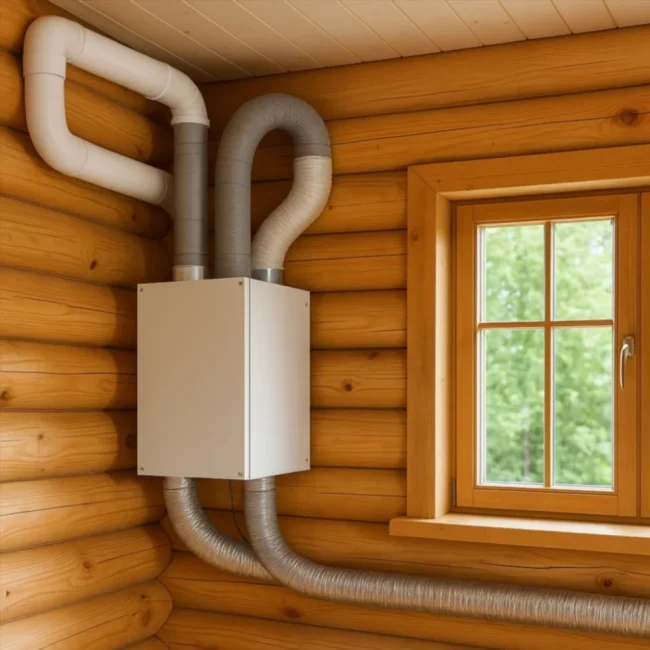
Timber houses made from logs offer not only aesthetic appeal, comfort, and environmental friendliness, but also specific requirements for microclimate and ventilation. Although wood naturally "breathes," modern construction and insulation technologies make such houses quite airtight. This improves thermal insulation, but creates a challenge with air exchange. This is why installing a heat recovery unit in a timber house is becoming increasingly important. In this article, we'll take a detailed look at the purpose of a heat recovery unit, how it works, the different types available, and how to choose and install one correctly in a timber house.
- What is a recuperator and why is it needed in a timber house?
- The operating principle of the recuperator
- Types of recuperators suitable for a wooden house
- Plate recuperator
- Rotary recuperator
- Enthalpy (membrane) recuperator
- Recuperators with ceramic heat exchanger (intermittent action)
- Features of installing a heat recovery unit in a timber house
- Maintaining tightness and thermal insulation
- Effect on wood moisture content
- Aesthetics and integration into the interior
- Power supply and control
- How to choose a heat recovery unit for a timber house
- Examples of ventilation layouts with heat recovery in a wooden house
- Care and maintenance
- Conclusion
What is a recuperator and why is it needed in a timber house?
A recuperator is a device that provides ventilation with partial or full heat recovery. Its main purpose is to remove stale air (containing high humidity, carbon dioxide, and odors) from a room while simultaneously supplying fresh air from outside without losing heat (and in summer, preventing overheating).
In wooden houses, especially those made from laminated or profiled timber, the exterior walls are more airtight than one might think, especially after installing modern windows and insulating the floors. As a result:
- natural air exchange is disrupted;
- there is excess moisture in the rooms (especially in bathrooms, kitchens, and bedrooms);
- the risk of mold and mildew formation increases;
- The residents' health deteriorates due to a lack of oxygen and excess CO₂.
Installing a recuperator solves these problems and at the same time allows you to save on heating by returning up to 95% of the heat contained in the exhaust air.
The operating principle of the recuperator
The heart of any recuperator is a heat exchanger. It combines warm exhaust air from inside the home with cold incoming air from outside. They don't mix directly, but heat is transferred through the heat-conducting walls. Thus, the incoming air is heated without the need for an additional energy source.
There are models that also recover moisture—this is important in winter, when the air outside is too dry, and when ventilated, the room can lose not only heat but also moisture.
Types of recuperators suitable for a wooden house
There are several types of recuperators, differing in design, operating principle, and cost. Let's look at the main ones:
Plate recuperator
One of the most common and simple types. Heat exchanger plates (usually aluminum or plastic) are installed inside, between which warm and cold air passes. These units have no moving parts in the heat exchanger, making them reliable and inexpensive.
Pros:
- Low cost;
- Simplicity of design;
- High efficiency (up to 90%).
Cons:
- Possibility of condensation formation;
- No moisture recovery;
- May freeze in severe frosts.
Rotary recuperator
It has a rotating drum (rotor) that alternately comes into contact with warm and cold air, transferring heat and moisture.
Pros:
- Recovery of both heat and moisture;
- High efficiency;
- Less risk of freezing.
Cons:
- Higher cost;
- Moving parts require maintenance;
- Not suitable for bedrooms and children's rooms (due to possible odor transfer).
Enthalpy (membrane) recuperator
It is an advanced plate heat exchanger with a semi-permeable membrane capable of transferring moisture.
Pros:
- Humidification of incoming air;
- High efficiency;
- No mixing of flows.
Cons:
- More expensive;
- Sensitive to contamination of filters and membranes.
Recuperators with ceramic heat exchanger (intermittent action)
Compact devices that operate in alternating cycles: first, air is released and heats the ceramic, then fresh air is supplied and is heated by it.
Pros:
- Can be mounted into walls without air ducts;
- Well suited for spot ventilation of individual rooms.
Cons:
- For effective work, use in pairs;
- Air exchange is less constant.
Features of installing a heat recovery unit in a timber house
Installing a recuperator in a wooden house requires taking into account a number of features:
Maintaining tightness and thermal insulation
When installing air ducts, it's important to minimize heat loss and carefully seal any penetrations through exterior walls. This is especially important when passing through timber beams.
Effect on wood moisture content
Wood is sensitive to changes in humidity. A recuperator should not only provide airflow but also maintain an optimal humidity level in the home (40-60%). Models with a humidifying effect (enthalpy or rotary) are preferable.
Aesthetics and integration into the interior
In wooden houses, aesthetics are important. All visible ventilation elements should be carefully designed. It's best to plan for the heat recovery unit when designing the house.
Power supply and control
Most recuperators require a power connection. Consider the connection location, cable routing, and installation of the control unit (panel or remote control).
How to choose a heat recovery unit for a timber house
When choosing a recuperator, it is important to consider:
- Area and volume of the house.Based on this data, the required performance (m³/h) is calculated.
- Purpose of premises.For bedrooms and children's rooms, it is better to use models without mixing air flows.
- Climate of the region.In cold areas, it is important to choose models with heating or an anti-freeze system.
- Noise level.Quiet models are a priority for residential areas.
- Energy consumption.Modern energy-efficient models allow you to save significant amounts of electricity.
- Availability of filters.Air filtration is especially important in homes located near roads or factories.
Examples of ventilation layouts with heat recovery in a wooden house
- Centralized system with air ducts.The recuperator is installed in a utility room or attic, and the air is distributed throughout the house through a network of air ducts. This option is optimal for homes over 100 m².
- Decentralized system with wall-mounted recuperators.Installing individual recuperators in living rooms simplifies installation and is suitable for existing homes.
- Hybrid system.Ventilation with heat recovery in living areas, and an exhaust hood with a separate fan in the kitchen and bathrooms.
Care and maintenance
The recuperator requires regular maintenance:
- Cleaning filters— once every 2-3 months;
- Replacing filters— 1-2 times a year;
- Checking the condition of the heat exchanger- annually;
- Removing condensate and cleaning the drainage system- if available.
Timely maintenance extends the life of the device and maintains the efficiency of ventilation.
Conclusion
A heat recovery unit in a timber-framed home is more than just a useful device; it's an essential element that ensures comfort, the health of residents, and the longevity of the building itself. It helps retain heat, prevents mold, improves the indoor climate, and saves on heating costs. When chosen wisely and installed correctly, a heat recovery unit will last for decades, ensuring an eco-friendly and energy-efficient home.