In recent decades, industry has undergone a true transformation: digitalization, automation, and technology integration have completely redefined production. One of the key elements of this process has been CNC milling centers, a catalog of which can be found here. These high-precision machines are capable of performing the most complex tasks with minimal human intervention. Their presence in modern metalworking is not just desirable, but vital.
Where complex parts once required hours of manual labor, the work can now be completed in minutes, with incredible precision. This isn't just a time saver—it's a new manufacturing philosophy where consistency, efficiency, and repeatability are paramount.
- What are CNC milling machining centers?
- Why CNC milling centers have become the core of the modern workshop
- Examples of industries where CNC milling has become standard
- What characteristics determine the quality of a CNC machining center?
- Digitalization: A New Level of Control and Integration
- Economic feasibility
- Prospects: a vector towards autonomy
- Conclusion
What are CNC milling machining centers?
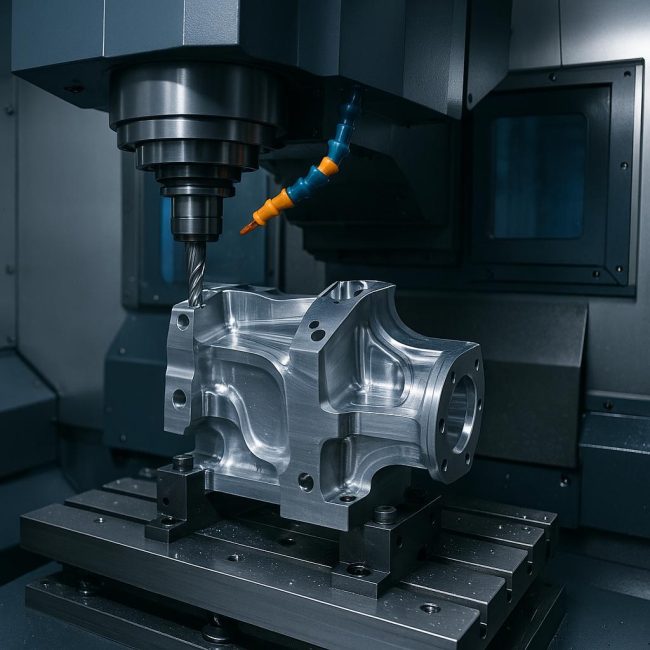
Computer numerical control (CNC) milling machining centers are multi-axis machines capable of machining metal, plastic, or composite workpieces with extreme precision according to a specified program. They are equipped with automatic tool changes, cooling systems, measurement sensors, and often automatic workpiece feed.
Such a center is essentially a mini-factory: it can drill, mill, bore, cut threads, and perform other operations that previously required several separate machines and manual intervention.
Why CNC milling centers have become the core of the modern workshop
Metalworking is the foundation of mechanical engineering, aircraft manufacturing, the defense industry, and even medical instrumentation. Where maximum precision, minimal tolerances, and consistent quality are required, manual labor takes a back seat.
The main reasons for the popularity of CNC milling machining centers are:
- High processing precision.
Modern machining centers achieve accuracy down to 0.005 mm. This is critical when manufacturing engine components, casting molds, gears, and more. - Versatility.
A single machine can replace several pieces of equipment: CNC milling can produce both simple and highly complex parts. - Automation.
CNC centers are easily integrated into automated production lines and can also operate in "lights-out" mode—without operator intervention—at night. - Reducing the influence of the human factor.
Errors during manual adjustment and processing are eliminated: all actions are carried out in strict accordance with the digital project. - Increased productivity.
Due to the high processing speed, minimal changeover time and the possibility of continuous operation, productivity increases significantly.
Examples of industries where CNC milling has become standard
- Aircraft manufacturing. Manufacturing of turbine blades, sensor housings, brackets, and other components critical to weight and strength.
- Automotive industry. Parts of transmission, brake systems, crankcases and cylinder heads.
- Medicine. Production of prostheses, surgical instruments, and implants from titanium alloys.
- Microelectronics. Processing of housings for high-precision boards and sensors.
- Energy. Milling of components for generators, pumps, turbines.
What characteristics determine the quality of a CNC machining center?
When choosing a milling machining center, engineers and technologists pay attention to the following parameters:
- Number of axles. Three-axis is the standard, but for complex processing, 4- and 5-axis centers are used.
- Working area and table size. Defines the maximum dimensions of the workpiece.
- Spindle power and speed. Affects the ability to process hard materials and the quality of the finishing surface.
- Type of guides. Linear guides provide high speed and accuracy.
- Availability of automatic tool change (ATC). A key element for continuous operation.
- Software. An intuitive interface, support for CAM systems and diagnostics all contribute to ease of use.
Digitalization: A New Level of Control and Integration
CNC milling machining centers are increasingly becoming part of integrated solutions—"smart" workshops, where equipment data is transmitted to cloud-based ERP and MES systems. This enables:
- Monitor machine loading in real time;
- Analyze performance;
- Prevent downtime with predictive diagnostics;
- Maintain a digital twin of a part throughout its entire life cycle.
This integration is especially important in serial or mass production, where every minute of equipment downtime translates into financial losses.
Economic feasibility
Despite the high initial cost, investing in CNC milling machining centers quickly pays for itself due to:
- Increasing production output without expanding staff;
- Improving quality and reducing defects;
- Ability to accept high value added orders;
- Minimizing the time required for personnel retraining: knowledge of CAM basics and an understanding of the technology are sufficient.
Prospects: a vector towards autonomy
The future of CNC milling centers lies in the development of:
- AI control systems, automatically selecting processing modes;
- Integration with robots, which perform loading and unloading of parts;
- Improved sensor systems, allowing you to process products “in one touch”;
- Hybrid machines, combining milling, 3D printing and laser processing.
Conclusion
CNC milling machining centers are more than just modern equipment; they are the foundation of a new manufacturing mindset. They enable companies to be competitive, flexibly respond to market demands, and produce world-class products. These technologies are shaping the industry of the future—precise, fast, and digital.
If your business operates in the metalworking industry, ignoring the potential of CNC milling means falling behind. And integrating modern centers into production processes is no longer an advantage, but a requirement of the times.