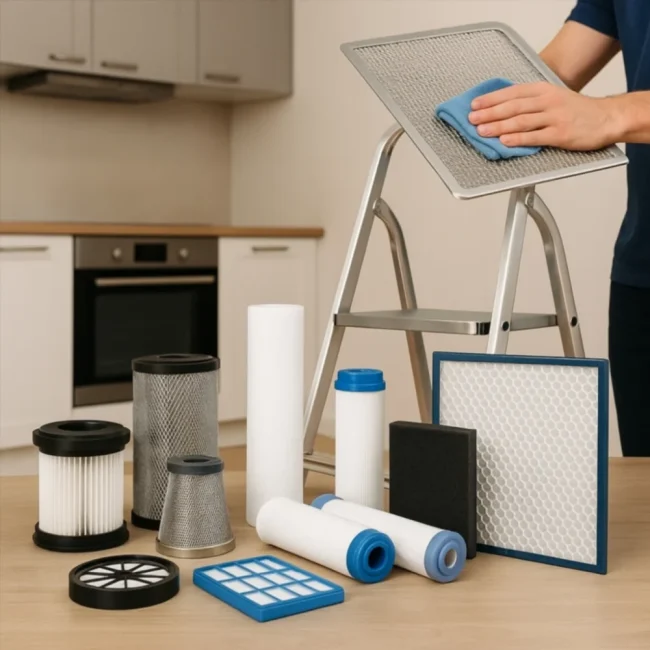
Filters are an indispensable element in the design and operation of living spaces. They protect household appliances, ventilation, water supply, and heating systems from contamination, extend their service life, and improve efficiency. However, like any operating element, filters require regular maintenance. Failure to clean or replace them on time can lead to reduced equipment performance, deterioration of air or water quality, and, in some cases, costly repairs.
In this article, we'll look at the filters used in the home, their functions, and, most importantly, how often they should be cleaned or replaced. This article covers ventilation, air conditioning, water supply, heating systems, household appliances, and even car filters if they're stored in a garage.
- Why is it important to maintain filters on time?
- Air filters: ventilation, air conditioners, air purifiers
- Filters in the ventilation system
- Air conditioners
- Air purifiers and humidifiers
- Water filters: drinking water, washing machines, dishwashers
- Filters for drinking water purification
- Filters at the entrance to the house (mud traps)
- Mesh filters in household appliances
- Filters in heating systems
- Gas and electric boilers
- Heated floors and radiators
- Kitchen hoods
- Vacuum cleaners
- Signs that cleaning is needed
- Care and replacement tips
- Conclusion
Why is it important to maintain filters on time?
Filters act as a barrier, trapping dust, sand, hair, chemical impurities, bacteria, and other contaminants. When a filter becomes dirty, its throughput capacity decreases. This leads to the following consequences:
- Rising energy consumption— the equipment begins to operate under increased load.
- Decreasing air and water quality— contaminated streams circulate in the room or system.
- Equipment wear and tear— especially critical for pumps, compressors and heat exchangers.
- The appearance of unpleasant odors and mold- especially in ventilation ducts.
Regular maintenance is not only a matter of hygiene, but also a way to save on repairs and replacement of expensive components.
Air filters: ventilation, air conditioners, air purifiers
Filters in the ventilation system
Ventilation filters (in the supply or exhaust system) purify the air from dust, insects, soot, and allergens. Types:
- Coarse cleaning (G1-G4)- retain large particles.
- Fine cleaning (F5-F9)— for dust, allergens.
- HEPA/ULPA- in high-tech premises.
Cleaning frequency:
- G-class filters— Once every 2–3 months.
- F-class— Once every 3–6 months.
- HEPA— Once every 6–12 months (or replacement).
It is important to consider the level of environmental pollution: if the house is located near a road or industrial area, maintenance should be carried out more frequently.
Air conditioners
Air conditioners most often use coarse and medium filters, sometimes carbon or photocatalytic ones.
Periodicity:
- Rough cleaning- wash every 2-4 weeks during the season.
- Additional filters (carbon, antibacterial)— replace every 3–6 months.
If the air conditioner is not used regularly, the filters still need to be cleaned before the start of each season.
Air purifiers and humidifiers
Modern devices contain several levels of filtration: from pre-screens to HEPA and carbon filters.
Periodicity:
- Pre-filter— 1–2 times a month.
- HEPA filter— replacement every 6–12 months.
- Carbon filter— replacement after 3–6 months.
With heavy use, filters may require more frequent replacement.
Water filters: drinking water, washing machines, dishwashers
Filters for drinking water purification
Depending on the configuration (pitcher, flow-through filter, reverse osmosis system), the cartridge life varies.
Periodicity:
- Jugs— replacement once a month.
- Flow filters (3 stages)— each stage is replaced from 1 to 6 months depending on the contamination.
- Osmosis— pre-filters are changed every 3–6 months, the membrane – once every 1–2 years, the post-filter – once a year.
An indicator of contamination may be a decrease in filtration rate or a change in the taste of the water.
Filters at the entrance to the house (mud traps)
They protect heating systems, water heaters and household appliances from sand, silt and rust.
Periodicity: Inspect and clean every 1–3 months. More often if water is very hard.
Mesh filters in household appliances
- Washing machines— the filter in front of the inlet valve is checked 1–2 times a year.
- Dishwashers— the drain filter is cleaned every 1–2 weeks.
In case of intensive use and use of hard water, more frequent cleaning may be necessary.
Filters in heating systems
Gas and electric boilers
Often equipped with coarse water filters and air filters.
Periodicity:
- Water filters- check and flush every 3-6 months.
- Air filters(if any) - 1-2 times per season.
Heated floors and radiators
If there are filters on the heating circuits (magnetic, mesh), they should be cleaned 2-3 times a year, especially before the start and at the end of the heating season.
Kitchen hoods
Hoods are equipped with grease filters and, sometimes, carbon filters.
Periodicity:
- Metal grease filter- wash every 3-4 weeks.
- Carbon filter— replacement every 3–6 months if used in recirculation mode.
Uncleaned filters reduce draft, cause unpleasant odors and even pose a fire risk.
Vacuum cleaners
Modern models can have several levels of filtration: from motor to HEPA.
Periodicity:
- Dust bags/containers- cleaning after each use.
- Motor and blower filters— Once every 1–3 months.
- HEPA filters— Once every 6–12 months (sometimes you can rinse it).
Signs that cleaning is needed
Even if you follow the recommended maintenance schedule, your filters may require unscheduled maintenance. Look for the following signs:
- Deterioration of equipment performance (low pressure, noise, vibration).
- Odors from the air conditioner, hood or taps.
- The appearance of dust in the house despite the ventilation being working.
- Increased electricity consumption.
- The water becomes cloudy or contains sediment.
Care and replacement tips
- Record the date of filter installation.— it makes it easier to keep track of deadlines.
- Use original replacement parts- this is important for the quality of filtration.
- Do not replace cleaning with simple blowing or rinsing., if the manufacturer indicates the need for replacement.
- Follow the instructions- Some filters can be washed, while others can only be replaced.
- Keep spare filters on hand, especially during the heating season.
Conclusion
Regular cleaning and timely filter replacement are essential for the proper operation of any household or utility system. Don't rely solely on eye or "feelings"—each filter has its own service life, dictated by operating conditions and technical specifications. Following recommended maintenance intervals will not only extend the life of the equipment but also create a healthy and safe home environment.
Remember: a clean filter is not only about comfort, but also about caring for your family’s health and your budget.