In modern construction and renovation, self-leveling floors have long established themselves as a versatile and high-tech solution for flooring. However, not all self-leveling mixtures are equally strong and durable. When choosing a base, especially in areas subject to high mechanical loads, it's important to consider not only aesthetics but also strength. In this article, we'll explore in detail which self-leveling floors are considered the most durable, the materials used for their installation, and how to choose the right one based on operating conditions.
- What is a self-leveling floor: a brief overview
- Classification of self-leveling floors by composition
- The most durable self-leveling floor – who is the leader?
- Comparative table of the strength of the main self-leveling floors
- Where is the most durable self-leveling floor needed?
- How to choose a mixture for a durable self-leveling floor?
- Installing a Heavy-Duty Self-Leveling Floor: Step-by-Step
- Possible mistakes and how to avoid them
- Conclusion
What is a self-leveling floor: a brief overview
A self-leveling floor is a self-leveling building mixture that is poured onto a prepared base and, after curing, forms a monolithic, smooth, and often decorative surface. These floors are in demand not only in residential buildings but also in industrial facilities, medical facilities, offices, garages, and warehouses. Key advantages:
- absence of seams and joints;
- high wear resistance;
- possibility of decorative finishing;
- resistance to moisture and chemicals;
- Durability when installed correctly.
Classification of self-leveling floors by composition
To determine which type is the most durable, it is necessary to study the existing varieties of self-leveling floors by composition:
- Cement (mineral)
The base is cement with additives. They are durable, vapor-permeable, and set quickly. They are used primarily as a rough base or finish in spaces that don't require a special design.
- Gypsum
The main component is construction gypsum. They are inexpensive, easy to work with, and dry quickly. Suitable only for dry, low-traffic areas.
- Epoxy
They consist of a two-component epoxy resin and a hardener. They are characterized by excellent strength and resistance to chemicals, moisture, and mechanical impacts. They are suitable for production facilities, laboratories, and garages.
- Polyurethane
Flexible, durable, and impact- and abrasion-resistant, they are ideal for areas subject to dynamic loads, such as gyms, warehouses, and retail spaces.
- Methyl methacrylate (MMA)
The fastest setting time, but expensive and difficult to install. Durable, frost-resistant, suitable for outdoor use and freezing.
The most durable self-leveling floor – who is the leader?
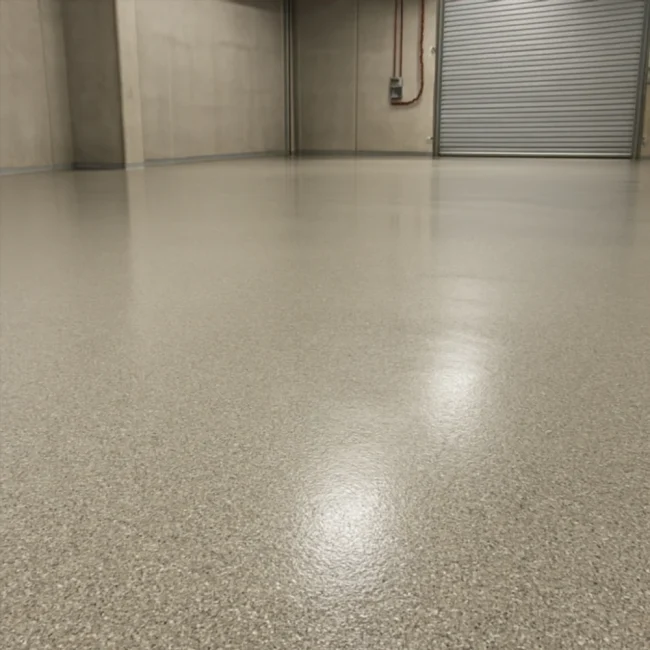
If the goal is to obtain the most durable, wear-resistant and long-lasting coating, then the undisputed leader among all types isepoxy self-leveling floor with quartz sand or corundumin the composition. Let's consider why:
- Compressive strengthreaches 80–100 MPa.
- Wear resistanceat the level of industrial concrete floors.
- Resistance to chemicals, including alkalis, acids, oils.
- Mechanical resistanceAllows to withstand the fall of heavy objects, carts, forklifts.
- Durability– up to 25 years with proper use.
Additional reinforcement with quartz sand or crushed corundum (aluminum oxide) allows for a reinforced coating, often used in industry, auto repair shops, parking lots, and medical facilities.
Comparative table of the strength of the main self-leveling floors
| Floor type | Compressive strength (MPa) | Wear resistance | Chemical resistance | Elasticity | Scope of application |
|---|---|---|---|---|---|
| Cement | 25–35 | Average | Average | Low | Home and office use |
| Gypsum | 10–20 | Low | Low | Low | Bedrooms, offices |
| Epoxy (with sand) | 80–100 | Very high | High | Average | Industry, medicine |
| Polyurethane | 50–70 | High | Average | High | Warehouses, shopping centers |
| Methyl methacrylate | 70–90 | High | High | Average | Outdoor playgrounds, refrigerators |
Where is the most durable self-leveling floor needed?
The use of heavy-duty floors is advisable in the following cases:
- Industrial facilities– where there is high traffic and movement of heavy equipment.
- Parking lots and garages– resistance to chemicals and mechanics is extremely important.
- Industrial premises with chemical processes– resistance to reagents.
- Hospitals and laboratories– sterility, seamlessness, and resistance to disinfection are important.
- Freezers, cold storage facilities– resistance to temperature changes.
How to choose a mixture for a durable self-leveling floor?
When choosing a mixture, it is necessary to take into account several parameters:
- Layer thickness
For industrial conditions, the minimum thickness is 3 mm; for heavy loads, it should be 5 mm or more.
- Filler
To increase strength, quartz sand, corundum or glass sphere are added.
- Strength grade
Choose mixtures with a strength of at least M400 for the finishing coating.
- Temperature range
For frost resistance, it is important that the mixture has the appropriate certification.
- UV and chemical resistance
Especially important for outdoor and industrial premises.
Installing a Heavy-Duty Self-Leveling Floor: Step-by-Step
1. Preparing the base
- Cleaning, dust removal, removal of oil stains.
- Grinding or milling the base.
- Humidity test (no more than 4%).
2. Priming
- Deep penetrating composition based on epoxy or polyurethane.
- 1-2 layers with an interval of 12-24 hours.
3. Construction of a reinforced layer
- Mixing the base component and hardener.
- Adding quartz sand or other filler.
- Application of a base layer with a thickness of 3 to 6 mm.
4. Finishing coating
- In some cases, a protective varnish is applied for UV resistance.
- Decorative additives are possible: chips, glitter, pigments.
Possible mistakes and how to avoid them
- Inappropriate floor type: It is not possible to install polyurethane instead of epoxy in conditions of strong chemicals.
- Incorrect preparation of the base: leads to peeling and cracking.
- Saving on components: reducing the filler reduces strength.
- Violation of application technology: violation of proportions and curing time.
Conclusion
The most durable self-leveling floor to date is recognizedepoxy self-leveling floor with quartz or corundum reinforcementThis industrial solution is designed to withstand extreme loads, yet is perfectly suitable for home use in garages, workshops, or utility areas of the home. Considering the cost, installation complexity, and high performance, these coatings prove their worth over long-term use. If your goal is to create a wear-resistant, durable, and beautiful foundation, choosing a durable self-leveling floor is the best choice.