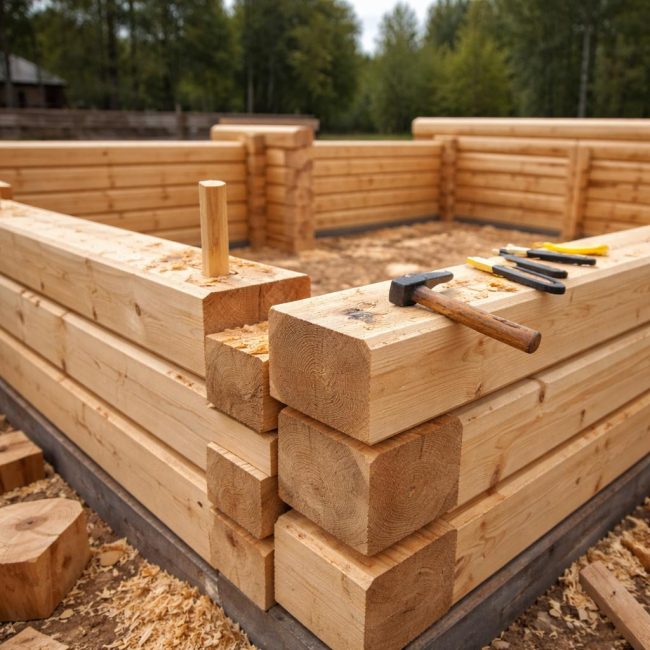
The topic of building a log house almost always arises during the transition from the idea of a wooden house to actual construction. In pictures and advertising descriptions, everything looks simple: neat crowns, straight corners, clean geometry. In practice, however, questions arise during the initial discussions—how does the timber "settle"? Why do some houses warp while others stand without cracks for decades? Where does theory end and the real limitations of the material begin? This is where the main interest in this topic lies: not in step-by-step instructions, but in understanding the logic of the process.
What does it really mean to "build a log house"?
Assembling a log house from timber isn't a mechanical joining of parts, but the creation of a unified spatial structure that will live and change along with the wood. Timber is a living material: it reacts to humidity, temperature, stress, and time. Therefore, a log house isn't a static object, but a system in which the interaction of its elements is crucial.
At the principle level, assembly means aligning successive timber rows so that the load is distributed evenly, the geometry is maintained, and the natural changes in the wood do not disrupt the structure. This is not only about the tightness of the joints, but also their "tolerance" for future movements—shrinkage, micro-distortions, and seasonal fluctuations.
How does a log house structure work?
When viewed as a whole, the log structure functions as a massive wooden "box," with each crown resting on the one below and simultaneously supporting the one above. The vertical load extends across the entire height of the walls, while horizontal stability is ensured by the shape of the joints and the mass of the material itself.
Unlike frame houses, where individual studs play a load-bearing role, the entire wall here functions as a single unit. This creates a sense of solidity, but imposes limitations: any stress or error is distributed throughout the entire structure, not locally. Therefore, it's not a perfect fit "for today" that's important, but rather an understanding of how the log structure will perform in one, three, or five years.
Shrinkage deserves special attention. It's inevitable, even if well-seasoned timber is used. The wood continues to adapt to the conditions, and the log structure gradually decreases in height. The structure should initially "accept" this movement, not resist it.
Practical assembly logic without instructions
In practice, building a log house involves a series of decisions, each of which influences the final result. For example, the orientation of the timbers, the sequence of crown formation, and the handling of corner joints—all of these factors shape the overall behavior of the house.
On paper, it often seems that simply ensuring a tight fit between the elements will ensure a reliable structure. In reality, excessive rigidity can actually be counterproductive: the wood simply has nowhere to go, and the stress begins to seek an outlet through cracks or distortions. Proper assembly always strikes a balance between strength and acceptable movement.
Another important factor is uniformity. Even small deviations, unnoticeable during assembly, can worsen over time. Therefore, it's not speed or a "perfect finish" at the start that's valued, but rather a calm, measured approach to working with the material.
Operational scenarios and their consequences
A log house behaves differently depending on how and when it's used. A house that's heated heavily immediately after construction experiences different stresses than one that spends its first season in a more gentle mode. These scenarios aren't "good" or "bad" in themselves, but each has its own consequences.
It's important to understand that assembly is only the beginning of a log house's life cycle. Many processes initiated at this stage manifest themselves later: in the way doors open, how the walls respond to changing seasons, and how stable the openings are. That's why experienced builders think beyond the completion date, but over several years.
Limitations and nuances that are often forgotten
One common oversimplification is to view timber as a uniform building element. In reality, even within a single batch, timber can vary in density, moisture content, and internal stress. A log house is not assembled from abstract "identical timbers," but from specific types of wood with unique characteristics.
Furthermore, log construction is sensitive to seemingly minor details: the storage conditions of the timber before assembly, the weather during construction, and the pauses between stages. These factors aren't always taken into account in theory, but they often explain why two seemingly identical houses look different over time.
There are also architectural limitations. Timber dictates its own logic of shapes and spans. Attempts to "force" a log structure to behave like concrete or metal usually result in additional compensating solutions that complicate the structure and diminish its natural advantages.
Common misconceptions about log house assembly
One of the most persistent misconceptions is the idea that high-quality assembly completely eliminates future adjustments. In fact, good assembly doesn't eliminate shrinkage and movement, but rather makes them manageable and safe.
Another common misconception is that all log house problems are due to "poor material." In reality, even excellent timber can create difficulties if the construction process doesn't take its properties into account. Conversely, a material with average characteristics can produce decent results with the right approach.
Visual neatness is also often confused with structural quality. Even seams and symmetry are important, but they don't always reflect how well a structure will perform in real-world conditions.
More than just technology
Log house construction is a field where engineering thinking is closely intertwined with an understanding of the material. Here, it's important to view the house not as a set of operations, but as a system that will exist for decades, responding to its environment and time.
This is why the topic remains relevant and raises questions even among those who have already encountered construction. Understanding the principles allows us to view log buildings not as "complex objects," but as logical, predictable structures, if we approach them without illusions and oversimplifications.