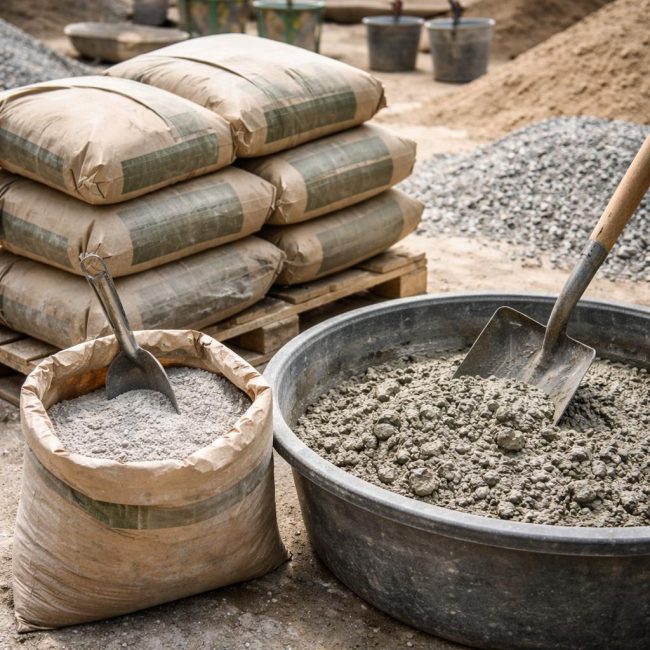
Cement is the basis of most construction work, from erecting walls to pouring foundations. One of the most common questions that arises when preparing for such work is: how many bags of cement are needed to make one cubic meter of concrete? The answer to this question depends on many factors, including the mixing proportions, the type of cement, and other conditions. In this article, we'll discuss how to correctly calculate the required amount of cement and what nuances should be considered.
What you need to know about calculating cement for concrete
To understand how much cement is needed to make concrete, it's important to understand its composition. Concrete is a mixture of cement, water, sand, and gravel or crushed stone. Each construction project may require its own proportions of these materials. For example, for a foundation, which requires high strength, the proportions will differ from those used for floor screeds or decorative structures.
The basic proportions for making concrete are generally: 1 part cement, 2 parts sand, and 3 parts crushed stone or gravel. Proportions may vary depending on the required strength and the type of work.
How it works in practice
To calculate the amount of cement required for a cubic meter of concrete, consider that one cubic meter of concrete weighs approximately 2.4 tons. Since the density of cement is approximately 1.5 tons per cubic meter, approximately 350–400 kg of cement will be required per cubic meter of concrete.
If a standard bag of cement weighs 50 kg, then for one cubic meter of concrete you will need:
- 350 kg of cement ÷ 50 kg (weight of one bag) = 7 bags of cement (minimum)
- 400 kg cement ÷ 50 kg (weight of one bag) = 8 bags of cement (maximum)
Thus, for every cubic meter of concrete you need approximately 7-8 bags of cement, depending on its grade and the expected strength of the concrete.
Limitations and nuances in calculation
- Type of cementThere are different grades of cement, from M100 to M500, and the choice of grade directly affects the strength of concrete. The higher the cement grade, the stronger the concrete will be, but its cost also increases. The grade of cement used for concrete depends on the specific application: for example, M400 or M500 cement is most often used for foundations.
- Type of concreteConcrete can be of different grades, depending on the required strength characteristics. If high-strength concrete is required, the component proportions will be adjusted to include a higher cement content.
- Losses during mixingWhen preparing concrete, some materials may be lost during mixing or due to uneven distribution. Therefore, it is recommended to slightly increase the calculated amount of cement, especially if the work is being carried out in conditions where precision is essential.
- Humidity and dryingMoisture present in sand or gravel can affect the final consistency of concrete. Therefore, cement calculations must take into account how dry or wet these materials are.
Common misconceptions
- The more cement, the stronger the concrete.Some builders mistakenly believe that increasing the amount of cement in a mix always increases the strength of concrete. In fact, too much cement can lead to cracking, as the concrete will be less flexible and susceptible to temperature changes.
- One bag of cement = one cubic meter of concrete: You can often hear this erroneous formula, but in practice it does not make sense, since the proportions can vary greatly for different types of concrete.
- Using cheaper cement will save moneySkimping on cement for critical structures like foundations can result in concrete that is insufficiently strong. This can lead to future problems such as cracks or subsidence.
Conclusion
Correctly calculating the amount of cement for concrete requires considering many factors, including the type of cement, the required concrete strength, and the precise proportions of the components. On average, one cubic meter of concrete requires 7 to 8 bags of cement, but for a more accurate calculation, it's important to consider the specific conditions and requirements of the construction project.