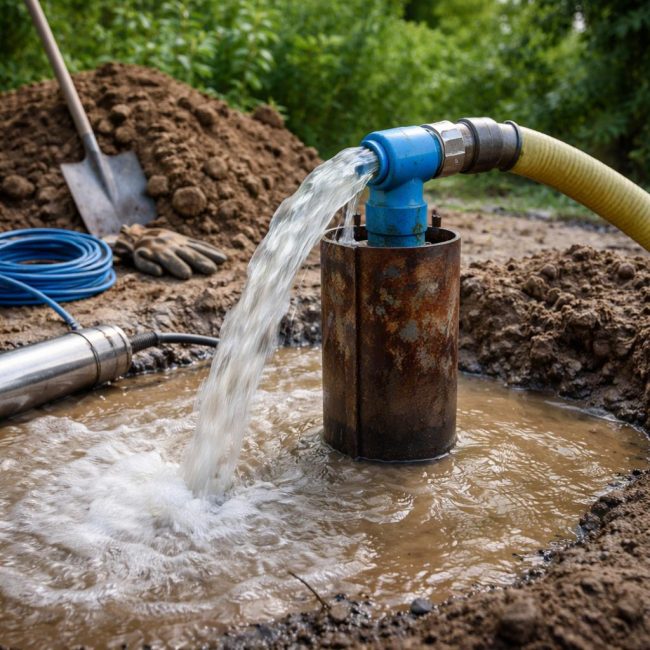
When a new well appears on a property, the joy of long-awaited water is almost always followed by bewilderment: the water is cloudy, sandy, sometimes odorous, and the pump seems to be running "in vain." At this point, the practical question of well pumping arises: how long does it actually take, and what signs indicate that the process is proceeding correctly. The problem isn't the owners' impatience, but rather that expectations are often formed by simplistic advice that doesn't take into account the actual structure of groundwater or the well's operating logic.
The topic of pumping is not related to equipment maintenance, but to the stage of "bringing the source into working order." This is an important distinction: it's not about pump adjustments or sanitary regulations, but about how a stable water flow from the aquifer is established after drilling and initial startup.
- What does it really mean to "pump a well"?
- Why can't you tell me the exact time for the upgrade in advance?
- What does the pumping process look like in reality?
- What determines the duration of pumping?
- What is considered a sign of completion of pumping?
- Why rushing can be harmful
- Common misconceptions about pumping
- What is important to understand in the end?
What does it really mean to "pump a well"?
In everyday terms, pumping refers to the period when water is pumped from a well until it is visibly clear. But in engineering terms, it's a different process. After drilling, disturbed soil remains around the filter and in the water inflow zone: fine particles, drill cuttings, and clay and sand residue. Until this zone stabilizes, water quality will inevitably be uneven.
Pumping isn't necessary to "drive out dirt," but to restore natural filtration. The water flow gradually washes away unstable particles, forms a dense backfill layer, and creates stable inflow channels. Only then does the well begin to function as it will in the future.
It's important to understand that this process doesn't have a fixed duration. It's not directly tied to hours or days—it depends on the behavior of the aquifer and the extent to which drilling has disturbed its structure.
Why can't you tell me the exact time for the upgrade in advance?
One of the most common sources of disappointment is the expectation of a specific deadline. In reality, wells of the same depth, drilled in adjacent areas, can mature at completely different rates. This is because underground conditions are not uniform, even over short distances.
The duration of pumping depends on the type of aquifer. Sandy horizons typically take longer to stabilize: small particles are easily carried by the water flow and take a long time to settle. Denser structures, on the other hand, more quickly establish stable filtration, but deviations are still possible.
The drilling technology itself also plays a role. The more intensive the soil intervention, the longer it takes to restore the natural balance. Even carefully executed work doesn't change the fact that the aquifer has been exposed and temporarily destabilized.
Finally, the initial start-up schedule is also important. The well "gets used" to the operation: sudden and chaotic start-ups can delay the stabilization process, while more uniform water extraction promotes a stable inflow.
What does the pumping process look like in reality?
In practice, pumping rarely follows a linear pattern of "first dirty, then immediately clear." More often, water quality fluctuates in waves. After the first few hours or days, the water may clear noticeably, then become cloudy again, and then the process repeats.
This is normal. The water flow gradually reaches new areas around the filter, flushing out residual particles from each one. Therefore, a temporary improvement does not indicate the completion of the pumping process, just as a temporary deterioration does not indicate a problem.
Over time, these fluctuations smooth out. The water becomes more predictable, and turbidity disappears gradually rather than suddenly. This stability, rather than a one-time visual effect, is a sign that the well has reached operating conditions.
What determines the duration of pumping?
The duration of the process is determined by a combination of factors, not a single parameter. Depth alone is not decisive: a shallow borehole in difficult soils may take longer to stabilize than a deeper one drilled in a favorable layer.
The grain size of the soil has a significant impact. The more fine particles it contains, the longer it will take for them to wash out. Under these conditions, even visually clear water early on does not guarantee the process will be complete.
Seasonal factors should also be considered. Groundwater levels and their movement fluctuate throughout the year. During periods of active water exchange, a well may stabilize more quickly, while in quieter times, the process is slower but more consistent.
What is considered a sign of completion of pumping?
One common myth is that water clarity is the only factor to consider. In reality, it's not the appearance that matters, but its consistency. If the water remains consistent in quality after several interruptions, without any sudden changes in turbidity, this is a more reliable sign that pumping is complete.
Another indicator is the behavior of the well itself. When the water flow becomes uniform, without characteristic dips or surges, we can talk about a well-established flow pattern. This is felt not as a technical parameter, but as stability: the water flows the same today, tomorrow, and next week.
It's also important to ensure that there are no new inclusions of small particles after pauses. If the water doesn't deteriorate after stopping and restarting, it means the area around the filter is no longer being damaged by the flow.
Why rushing can be harmful
Attempts to speed up pumping often have the opposite effect. Overly aggressive water extraction can disrupt the developing filter layer and reintroduce small particles that have already begun to settle. As a result, the process is prolonged, and the well remains unstable for a longer period.
Another mistake is to consider pumping complete immediately after the water visibly improves. In this case, turbidity may return upon returning to normal operation, and this is perceived as a malfunction, although in fact the process simply wasn't completed.
Pumping is not a race or a test of equipment endurance. It's a period during which the well "tunes" itself, and interventions must take this logic into account.
Common misconceptions about pumping
One of the most persistent misconceptions is the idea of a universal deadline. In reality, it doesn't exist, and any promises of a "precise time" don't take into account the geology of a specific site.
An equally widespread myth is that turbid water always indicates faulty drilling. In the early stages, this is a natural consequence of tapping the aquifer, not an indicator of drilling quality.
It's also often assumed that pumping is a one-time procedure. In fact, elements of this process can manifest themselves later, for example, after extended periods of downtime or changes in water consumption patterns. This doesn't mean the well has "broken," but merely reflects groundwater dynamics.
What is important to understand in the end?
Well pumping isn't a formality or a technical detail, but a stage in shaping its future performance. The time it takes is determined not by the calendar, but by the behavior of the water and soil. Monitoring stability, rather than immediate results, provides a more accurate understanding of the source's current state.
Understanding this logic alleviates much of the anxiety. A well is a living system, and its recovery to a stable state is always individual. The calmer and more attentive this period is, the more predictable and reliable the water will be in the future.