A common situation in an apartment or house is to add another outlet next to an existing one without having to open up half the walls or run a new cable from the electrical panel. This is where the main practical question arises:What exactly happens to the electrical line when sockets are connected "to each other," and what restrictions does this impose on further operation?It's important to understand this in advance, as errors don't manifest themselves immediately, but rather through overheating, unstable operation, or unexpected shutdowns.
- Why are sockets generally connected in a chain, and not each one separately?
- How is the load transmitted over a line with multiple outlets?
- Where exactly do the real limitations arise with this type of connection?
- How does this manifest itself in everyday use?
- Why adding another outlet increases risks, rather than simply "sharing the load"
- Common mistakes in understanding how to connect sockets together
- Why is this connection "tolerable" in one room, but problematic in another?
- What is important to understand before making any change to an existing line
Why are sockets generally connected in a chain, and not each one separately?
In household electrical systems, outlets rarely exist as isolated points. They are often combined into a single line, fed from a common circuit breaker. This solution is dictated not by "lazy installation," but by the logic of load distribution and resource conservation: less cable, fewer connections in the panel, and simpler routing.
When people say that sockets are connected "together," they usually mean that the cable runs in series from one point to another, with the sockets themselves connected in parallel to the line. Electrically, each socket receives the same voltage, butmechanically and thermally the entire line becomes a single system, where a weak spot affects everything else.
How is the load transmitted over a line with multiple outlets?
A key point that's often overlooked: the load in such a line isn't "divided equally" between the outlets. The current flowing through the cable is the total amount consumed by all connected devices at the same time.
This means that:
- the section of cable up to the first socket bears the load of all subsequent points;
- each intermediate socket becomes not only a consumer, but also a transit node;
- any deterioration in contact at one point is reflected throughout the entire chain further down the line.
In practice, this is especially noticeable in older apartments, where the line was originally designed for lamps, radios, and televisions, but over time, kettles, microwaves, and heaters were added to the same sockets.
Where exactly do the real limitations arise with this type of connection?
Limitations are not expressed at the level of “possible or not possible”, but at the level ofstability and load reserve.
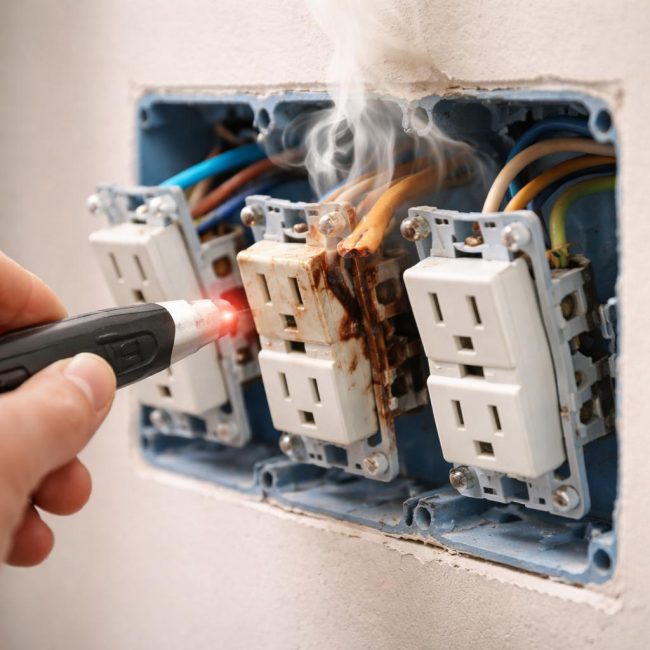
First, the quality of the connections becomes a limitation. The socket contacts, which carry the current, become hotter than if they were only connected to the power source. Over time, this leads to a weakening of the connection, an increase in contact resistance, and even greater heating—a vicious cycle.
Secondly, the line's length and branching are limiting. The more outlets connected in series, the more connections and potential points of failure. Even with the same cable cross-section, line reliability declines not because of the wire itself, but because of the contact blocks.
Third, the line becomes sensitive to the nature of the load. Several devices with pulsed power consumption or high inrush currents can create short-term overloads that aren't always noticeable on the circuit breaker but accelerate contact degradation.
How does this manifest itself in everyday use?
Problems rarely appear as "everything suddenly stopped working." More often, they accumulate:
- the socket starts to heat up slightly under normal load;
- a smell of heated plastic appears for no apparent reason;
- devices connected further down the line begin to switch off or work erratically;
- The circuit breaker in the panel trips "without any apparent logic," especially when several devices are turned on at the same time.
It is important to understand that the source of these symptoms may not be in the outlet where they appear, but in the previous one in the chain.
Why adding another outlet increases risks, rather than simply "sharing the load"
A common misconception is that an additional outlet "relieves" the existing one. In reality, it adds another connection point and another connection to the circuit. If a powerful device is connected to the new outlet, the load on the previous sections of the line only increases.
Thus, each new branch:
- increases the total current in the line;
- increases the quality requirements for all previous contacts;
- reduces the heating reserve even without exceeding the nominal values.
This is especially critical when the new outlet is used for stationary equipment, and the line was not originally designed for such use.
Common mistakes in understanding how to connect sockets together
The most common mistake is to view a power outlet as a "passive point" that has no effect on the rest of the line. In reality, each outlet is a fully-fledged component with its own mechanical and thermal resources.
The second mistake is relying solely on the cable cross-section, ignoring the condition of the contacts. The cable may have some slack, but a weak clamp in one outlet will negate that slack.
The third mistake is to assume that if the circuit breaker doesn't trip, everything is fine. A circuit breaker protects against severe overloads and short circuits, but it doesn't respond to localized contact overheating, which can persist for years.
Why is this connection "tolerable" in one room, but problematic in another?
The difference is almost always in the usage scenario. In the bedroom, outlets are often loaded with chargers and lamps, and the line operates smoothly for decades. In the kitchen or workshop, the same connection principles are pushed to their limits due to the constant high load.
This is where paradoxical situations arise, where identically executed lines behave completely differently – not because of the editing, but because of how they are used.
What is important to understand before making any change to an existing line
Connecting outlets together isn't a mistake or a "bad practice" per se. It's a common and acceptable design, but it requires understanding its limitations. Any interference with such a line alters its balance: current, heat, and reliability.
The sooner this awareness arises—before adding another outlet or connecting a new appliance—the less likely it is that an electrical problem will appear suddenly and in the most inconvenient place.