Modern renovations aren't just about style and aesthetics, they're also about a rational approach to choosing materials. Today, people are increasingly looking for solutions that are durable, practical, and beautiful. That's why, even at the first stages of finishing, the question arises: which material to choose for decorative elements? For example, Duropolymer baseboards, whose catalog you can view here, are becoming increasingly popular thanks to their characteristics, which distinguish them from wood, plastic, or MDF.
In recent years, this material has firmly established itself in the finishing industry and become a favorite tool among designers. The reason is simple: it combines strength, wear resistance, and aesthetic appeal. Let's explore what makes Duropolymer so special and why it's considered a next-generation material.
What is Duropolymer?
Before discussing the advantages, it's important to understand the term itself. Duropolymer is a high-density polystyrene-based polymer material that has undergone additional processing to increase strength. Essentially, it's a type of modern plastic, but thanks to special technologies, its properties are much closer to those of wood or even stone than those of traditional synthetic products.
Key Features:
- High density — the material is resistant to mechanical impacts.
- Moisture resistance - does not absorb water, does not deform when humidity changes.
- Ease — despite its strength, duropolymer remains lightweight, which simplifies installation.
- Eco-friendliness — does not emit harmful substances and is safe for use in residential premises.
Thanks to these properties, Duropolymer is suitable for a wide variety of decorative elements: baseboards, cornices, moldings and ceiling baguettes.
Why is Duropolymer in demand?
Wear resistance
Unlike wood, which can crack or dry out over time, Duropolymer retains its properties for decades. It is resistant to rot and temperature fluctuations.
Easy to install
The material is lightweight and easy to cut, adjust to size, and attach to walls and ceilings. Installation doesn't require complex tools or the skills of a professional builder.
Universal design
Duropolymer is easily painted with acrylic paints, making it suitable for any interior, from minimalist to classic. Moreover, it can be repainted when updating the interior without replacing the actual pieces.
Durability
The service life of these products is significantly longer than that of MDF or plastic. Even under heavy use, baseboards and moldings made of Duropolymer retain their shape and do not yellow.
Duropolymer in the interior
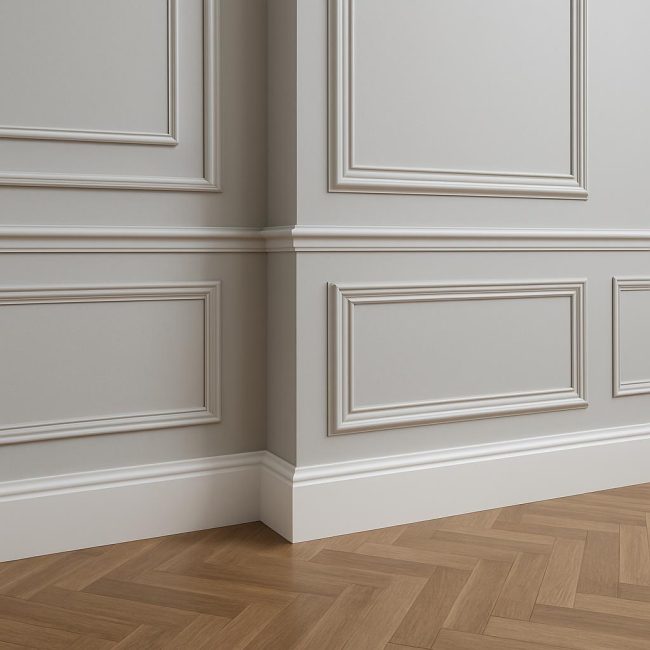
Skirting boards
The most common application is baseboards. They serve several functions:
- close the joint between the floor and the wall;
- protect walls from damage during cleaning;
- serve as a decorative accent, completing the design.
Duropolymer baseboards retain their shape well and are moisture-resistant, making them suitable for bedrooms, bathrooms, and kitchens. They can be matched to any flooring type: parquet, laminate, or tile.
Cornices and baguettes
Duropolymer cornices allow you to conceal ceiling imperfections and even use hidden lighting. Their durability gives them a solid look while remaining easy to install.
Moldings
Moldings and decorative panels help zone spaces, create accents, and add volume to interiors. Duropolymer allows for the creation of complex shapes and textures that retain their original appearance for a long time.
Comparison with other materials
To understand why Duropolymer is gaining so much popularity, let's compare it with traditional materials.
| Material | Strength | Moisture resistance | Durability | Price | Peculiarities |
|---|---|---|---|---|---|
| Tree | High | Low | Average | High | Natural, but requires care |
| MDF | Average | Low | Low | Low | Accessible but sensitive to moisture |
| Plastic | Average | High | Average | Low | Lightweight, but less aesthetically pleasing |
| Duropolymer | High | High | High | Average | Optimal combination of price and quality |
The table shows that Duropolymer occupies the golden mean: it is strong, moisture-resistant, durable, and at the same time affordable.
Where is Duropolymer especially relevant?
- Bathrooms and kitchens - high humidity will not damage the product.
- Country houses — temperature changes will not affect the appearance.
- Apartments in a modern style — fits easily into minimalism or high-tech.
- Classic interiors - thanks to the ability to create exquisite decor.
Care and operation
Maintenance of Duropolymer elements doesn't require any special products. Simply wipe them with a soft cloth to remove dust and use neutral cleaning solutions. They are also resistant to damp cleaning, which is especially important for baseboards, which are often exposed to water when washing floors.
Development prospects
Today, Duropolymer is gradually replacing wood and MDF as decorative elements. Manufacturers are increasingly experimenting with shapes and textures, offering products with designs ranging from simple to complex. In the coming years, we can expect an expansion of the product range, making this material even more versatile.
Conclusion
Modern trends in renovation and interior design dictate new requirements for materials: they must be durable, easy to use, safe, and aesthetically pleasing. Products made from Duropolymer perfectly combine all these qualities. This is why Duropolymer baseboards, as well as cornices and moldings made from this material, are becoming increasingly popular and are confidently taking their place among the best interior design solutions.