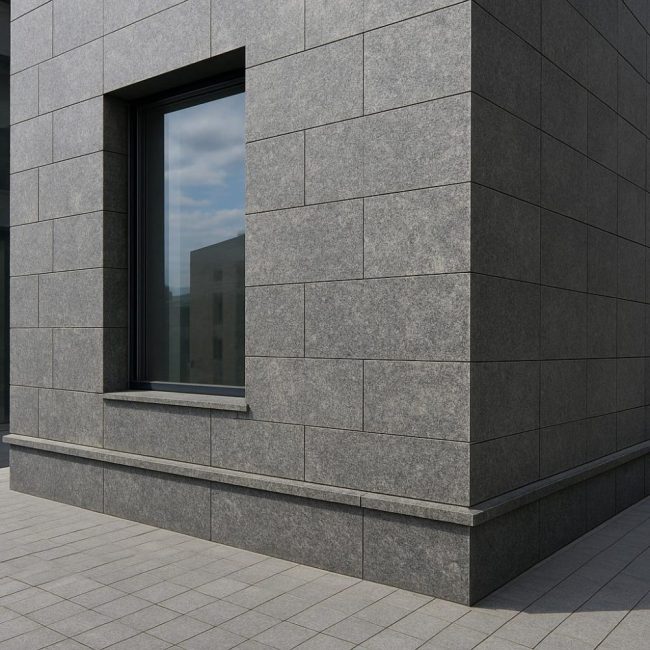
Selecting façade finishing materials is a crucial step in the construction or renovation of a building. It determines not only the building's appearance but also its durability, resistance to external influences, and level of thermal insulation. Granite tiles, which seamlessly combine natural beauty, high strength, and resistance to harsh climatic conditions, have remained among the most popular options in recent years. However, modern technologies offer alternatives that can compete with natural stone in a number of ways.
Why the facade?
The façade is the "face" of a building. It creates the first impression and serves an important protective function. The material used for its cladding must meet several requirements:
- strength and resistance to mechanical damage;
- resistance to temperature changes and exposure to ultraviolet radiation;
- moisture resistance;
- decorativeness and compliance with the architectural style of the building;
- minimal care requirements;
- long service life.
Among the entire range of materials, granite tiles have long established themselves as one of the most versatile options, suitable for both private homes and administrative or commercial buildings.
Advantages of granite tiles for facades
Granite is one of the most durable natural stones. When properly processed, it can be used as façade tiles, which not only lend a building a solid appearance but also provide a high level of protection.
Key advantages of granite tiles:
- Durability. The service life can exceed 50 years without loss of appearance.
- Frost resistance. Granite does not deteriorate under the influence of sub-zero temperatures, especially if the installation technology is followed.
- Moisture resistance. The material does not absorb water, which prevents its destruction during alternating freezing and thawing.
- Fire resistance. Granite does not support combustion and does not deform when heated.
- Aesthetics. A wide selection of colors, textures (polished, heat treated, brushed) and formats allows you to realize any design ideas.
Alternatives to granite: what to look for?
Despite all its advantages, granite tiles also have their drawbacks: high cost, significant weight (requiring a reinforced base), and difficulty in installation. Therefore, the market offers a number of alternatives—both natural and artificial materials.
Porcelain tiles
This is an artificial material that can be indistinguishable from natural granite in appearance. It is produced by pressing and firing a mixture of clay, quartz, feldspar, and dyes.
Pros:
- more affordable cost;
- richness of textures and colors;
- resistance to abrasion and moisture;
- lighter weight compared to granite.
Cons:
- artificial origin;
- not such a prestigious appearance.
Clinker tiles
Made from a special clay with additives and fired at high temperatures, it is widely used for cladding basements and facades.
Advantages:
- excellent performance characteristics;
- moisture and UV resistance;
- availability.
Flaws:
- limited color range;
- less expressive relief.
3. Fiber cement panels
A relatively new solution, which is a slab made of fibre-reinforced cement.
Pros:
- ease of installation;
- resistance to fungus, mold, moisture;
- a wide selection of decors, including imitation stone.
Cons:
- brittleness upon impact;
- Color loss may occur over time.
Artificial stone
Made from a mixture of cement, sand, and dyes, it is often used to imitate natural stone such as slate, limestone, and granite.
Pros:
- light weight;
- reasonable price;
- ease of installation.
- Cons:
- service life is shorter than that of granite;
- requires regular treatment with water-repellent agents.
How to choose a material for a specific facade?
The choice of cladding depends on several factors:
- Building type. For administrative and representative buildings, it makes sense to use more expensive and durable materials (granite tiles, natural stone). For private homes, more affordable solutions are also suitable if they complement the overall architecture.
- Climate. In areas with harsh winters, it is important to choose materials with high frost resistance.
- Features of the foundation. Heavy materials require a strong supporting structure.
- Budget. It remains an important factor, especially if you plan to cover a large area.
Technological features of granite tile installation
If you do decide to go with granite, keep in mind that installation is one of the most critical stages. If installed incorrectly, even such a durable material can begin to deteriorate over time.
Key points:
- The base must be level and stable;
- Special adhesive compounds or mechanical fastening (ventilated facades) are used;
- The seams must be filled to prevent moisture from getting in;
- For durability, it is recommended to use water repellents.
Conclusion
Granite tiles are a durable, reliable, and attractive material that justifies its cost in harsh urban environments or challenging climates. However, the market also offers other options—man-made materials and lightweight alternatives—that are suitable for situations where a compromise between price, appearance, and performance is necessary. Properly selected cladding will not only protect the façade but also give the building a finished, distinctive appearance.
If you're deciding which material to use for your façade, consider all the pros and cons, paying attention not only to appearance but also to the practical aspects of use.