When it comes to installing a fence, every homeowner or business owner strives to find a balance between aesthetics, reliability, and cost. There are plenty of materials for building fences today: wood, brick, metal, concrete slabs, and even composites. However, in recent years, metal structures based on profile pipesThis seemingly discreet material has become the basis for modern and practical fencing for private homes, cottages, commercial properties, and industrial areas.
One of the factors behind their popularity is their versatility. Profile pipes, whose catalog you can view, are used not only in fencing, but also in architecture, furniture manufacturing, and agriculture. Their affordability and durability have made them the basis for lightweight yet durable metal structures that retain their appearance for years to come.
Why is the choice increasingly falling on profile pipes?
Easy to install.
A frame made of profile pipes is essentially a prefabricated construction kit. Their rectangular or square cross-sections make them easy to connect at various angles. This makes the material easy to work with, even for DIY installation.
Strength with light weight.
Wall thickness and cross-section dimensions allow for the optimal balance between structural rigidity and weight. This is especially important when installing fences on soft soils or when using lightweight foundations.
Aesthetics and versatility.
The metal frame easily adapts to various types of infill: corrugated sheets, picket fencing, mesh, and wrought iron. Visually, it looks neat and modern without overloading the property's façade.
Resistance to external influences.
A properly painted or galvanized pipe is resistant to corrosion and is not affected by temperature changes, humidity, or ultraviolet radiation.
What pipes are used for fencing: important parameters
The selection of the appropriate profile pipe depends on the expected load, fence height, and finishing type. Key parameters:
- Section: 40x40 mm, 50x50 mm and 60x30 mm are the most common.
- Wall thickness: 1.5–2 mm for household fencing, 2–3 mm for industrial fencing.
- Length: The standard length is 6 meters, but custom cutting is possible.
For posts and supports, heavier pipes are selected, which are concreted into the ground or secured to embedded elements. Lintels are made of thinner profiles.
Comparison with other materials
| Material | Strength | Difficulty of installation | Sustainability | Price | Care |
|---|---|---|---|---|---|
| Wood (picket fence) | Average | Simple | Low | Average | High |
| Brick | High | Complex | High | High | Short |
| Concrete slabs | Very high | Complex | Very high | Average | Short |
| Chain-link fencing | Low | Simple | Average | Low | Short |
| Profile pipes | High | Average | High | Average | Short |
Thus, at a reasonable price and availability the profile pipe wins most competitors in terms of the combination of characteristics.
Types of fences based on profile pipes
- With corrugated sheets — the most cost-effective and practical option. Provides complete visual protection for the area.
- With metal picket fence — a "living" fence effect with gaps. Suitable for summer cottages and cottages.
- With forging or decorative panels — ideal for ceremonial facades.
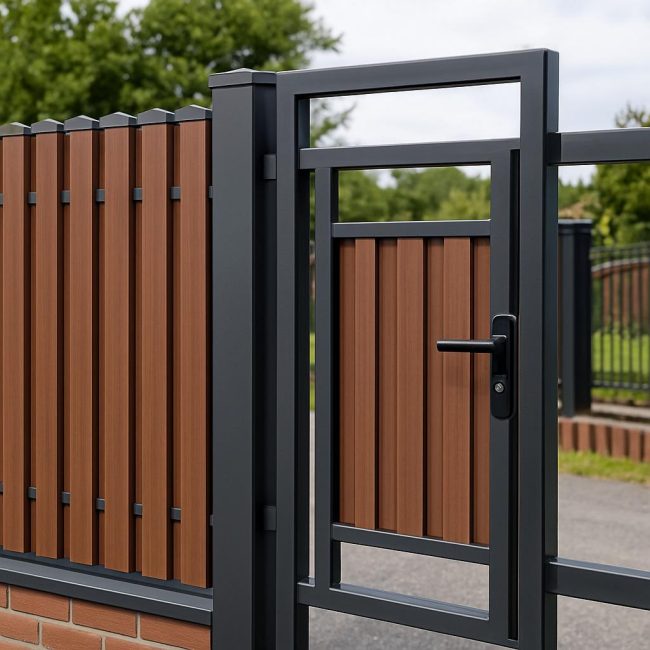
- With wooden planks — a successful symbiosis of metal and natural materials.
- Combined options - when the lower part is made of stone, and the upper part is made of pipe and mesh.
Installation and maintenance features
Installation The process begins with marking out the area and installing support posts to which horizontal crossbars are attached. Semiautomatic welding is most often used to weld the elements together, but bolted assembly is also possible.
Treatment and care The main focus is corrosion protection. Priming, powder coating, and galvanizing are used. If the paint layer is damaged, localized touch-ups are sufficient.
Tips for choosing
- If the site is located on a slope, consider the possibility of installing sections at an angle.
- For private property, don't skimp on wall thickness—it's better to choose 2 mm than to have to deal with repairs later.
- In areas with strong winds, choose smaller spans between supports and a wider pipe cross-section.
- It is better to immediately provide elements for attaching the gate or wicket to the frame.
Trends: Fences should be beautiful
Today, a fence is not only a protective element but also a design element. Manufacturers offer ready-made modules made of profiled tubing, painted in RAL colors, with decorative inserts, forged details, and laser-cut details. This approach eliminates the need for heavy concrete and brick structures without sacrificing expressiveness.
Conclusion
Usage profile pipes in fence construction — is a rational choice for those who value strength, durability, and a neat appearance. At the same time, these structures remain affordable and easily adaptable to any architectural requirements. Whether you're designing a summer cottage, a private cottage, or an industrial site, a metal frame based on a profile pipe will ensure the necessary rigidity and reliability for years to come.
If you need to calculate the volume of material or select specific pipe parameters, many rolled metal suppliers, including regional services, offer convenient online calculators and expert assistance.