Ensuring sanitary safety in production is not just a requirement of regulatory authorities, but the foundation of product quality and a company's reputation. The installation of modern disinfection systems is increasingly being considered at the early stages of sanitary system design, and one of the key components is an ultraviolet germicidal system, which effectively combats microbiological contamination of air and surfaces in production facilities.
With increasing quality requirements, particularly in the food, pharmaceutical, and medical technology industries, the issue of sanitary safety is becoming increasingly important. The use of advanced technologies helps manufacturers minimize the risk of contamination, reduce losses due to defective products, and ensure process stability.
- Why Sanitary Safety Has Become Critical
- The main sources of microbiological contamination in production
- The role of modern technologies in the sanitary safety system
- Ultraviolet germicidal units
- Water purification and disinfection systems
- Multi-stage air filtration systems
- Automated sanitary stations
- Antimicrobial coatings and consumables
- Monitoring and control systems
- How to implement a comprehensive sanitary safety system
- Requirements of regulatory authorities
- The Future of Sanitation Safety: Trends and Innovations
- Conclusion
Why Sanitary Safety Has Become Critical
Modern production is a complex system where violation of sanitary standards can lead to serious consequences:
- contamination of products and threats to consumer health;
- recall of goods and financial losses;
- fines and sanctions from Rospotrebnadzor and other authorities;
- deterioration of reputation and loss of trust of partners;
- risk of production stoppage.
The issue is particularly acute in facilities handling animal and plant-based raw materials, sterile medications, drinking water, and food products. Compromises are unacceptable here, and any hygiene error can lead to a chain of problems.
The main sources of microbiological contamination in production
To effectively ensure sanitary control, it's important to understand the sources of contamination. Most businesses encounter the following sources:
| Source | Potential danger |
|---|---|
| Staff | Transfer of bacteria, viruses, and mold on clothing, skin, and hands |
| Raw materials and semi-finished products | Primary contamination of products |
| Equipment and surfaces | Microorganism proliferation due to untimely cleaning |
| Air and ventilation | Spread of germs throughout workshops and warehouse areas |
| Containers and packaging | Introduction of contaminants at the final stages of production |
| Water | Bacterial contamination of water due to insufficient filtration and disinfection |
Understanding these factors helps to develop a comprehensive approach rather than limiting ourselves to partial measures.
The role of modern technologies in the sanitary safety system
Technological solutions enable cleanliness to be maintained without constant human intervention, reducing the risk of errors and increasing the effectiveness of sanitation measures.
Key systems include:
Ultraviolet germicidal units
They are used to disinfect air and surfaces. UV radiation destroys the DNA structure of microbes, preventing their further reproduction. Such installations can be:
- closed-type recirculators - safe in the presence of people;
- open germicidal lamps — used in the absence of personnel;
- built-in ventilation systems — to disinfect air flows throughout the building.
Water purification and disinfection systems
The system may include mechanical filters, sorption purifiers, ozonizers, and UV water disinfection. This is especially important for dairy plants, bakeries, meat processing plants, and beverage manufacturers.
Multi-stage air filtration systems
A combination of coarse, fine and HEPA filtration reduces the concentration of dust particles and biological contaminants in the air.
Automated sanitary stations
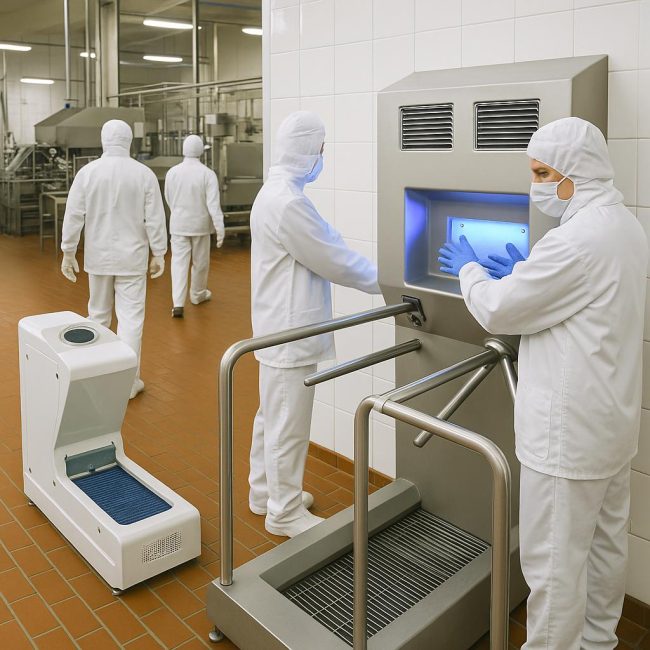
They allow for monitoring the sanitization of employees' hands, shoes, and workwear. Modern stations record the sanitization process and are prepared to block access if regulations are violated.
Antimicrobial coatings and consumables
They are used on work surfaces, transport containers, and packaging. They inhibit the growth of bacteria and mold and improve stain resistance.
Monitoring and control systems
Modern sensors, laboratory analyzers, and indicator tests allow you to monitor environmental parameters and cleanliness in real time.
How to implement a comprehensive sanitary safety system
For technology to work effectively, it is important not just to install equipment, but to build a system at the process level.
Audit of the current situation
Identification of weaknesses, risk analysis, identification of problem areas.
Development of a sanitary protection program
Creation of an action plan for various production areas.
Selection of equipment and technologies
The choice of solutions depends on the type of activity, area and level of risk of infection.
Staff training and compliance monitoring
Even modern equipment won't help if employees don't understand hygiene rules.
Periodic upgrades and performance testing
Monitoring, testing, bacteriological analysis, process adjustments.
Requirements of regulatory authorities
Rospotrebnadzor and other regulatory agencies impose strict requirements for the cleanliness of premises, air quality, water quality, and product quality. Different industries have their own regulations, but in general, the following are important:
- compliance with sanitary rules and regulations;
- regular sanitization and disinfection;
- documentation of events;
- confirmation of the effectiveness of the measures taken.
Modern technologies make it possible not only to meet these requirements but also to create a transparent control system, which is important during inspections.
The Future of Sanitation Safety: Trends and Innovations
The world of technology is changing rapidly, and in the coming years we will see the following trends:
using artificial intelligence to automate control;
integration of disinfection systems into building ventilation;
contactless technologies for hygiene and personnel control;
expanding the use of antibacterial materials;
development of robotic disinfection systems.
Taken together, this will enable enterprises to ensure a high level of security and reduce the dependence of processes on the human factor.
Conclusion
Sanitary safety is a key factor in a successful and sustainable business. By investing in modern technologies such as ultraviolet germicidal systems, filtration systems, and automated sanitary systems, the company not only meets regulatory requirements but also enhances its competitiveness.
A comprehensive approach, including technological solutions, monitoring, staff training, and regular performance testing, makes a sanitation system truly reliable. A production facility that prioritizes cleanliness builds consumer confidence, reduces costs, and improves product quality.