Construction equipment is the backbone of any construction project, from low-rise construction to large-scale infrastructure projects. Excavators, truck cranes, bulldozers, and other specialized equipment operate under heavy loads, so their reliability directly impacts construction timelines and quality. Today, simply operating machines until they fail is no longer sufficient—modern standards require a systematic approach to their monitoring. This is where construction equipment maintenance plays a key role, and thanks to new technologies, it has become much more precise, convenient, and cost-effective.
- Why is modern diagnostics of special equipment necessary?
- Diagnostics based on digital technologies
- Computer diagnostics
- Telematics and online monitoring
- Vibration diagnostics
- Thermal imaging diagnostics
- Analysis of technical fluids
- How technology is changing customer service
- Examples of technology implementation in construction
- Difficulties and development prospects
- Conclusion
Why is modern diagnostics of special equipment necessary?
Traditionally, diagnostics have been limited to a visual inspection, checking oil levels, and a quick listen to the engine. But these methods only reveal obvious faults. In reality, failures begin unnoticed: bearings wear out, hydraulics lose pressure, and electronic systems detect faults that are impossible to detect without specialized equipment.
Modern approaches to diagnostics solve several key problems:
- Prevention of accidents and downtime. Early detection of problems allows them to be eliminated before the equipment fails.
- Cost optimization. Scheduled maintenance is cheaper than emergency repairs.
- Increasing the service life of machines. Proper adjustment and timely replacement of consumables extend the service life of components.
- Safety at the construction site. Workers and engineers are less at risk if equipment is in good working order.
Diagnostics based on digital technologies
The construction equipment maintenance industry is actively implementing solutions previously used only in the automotive or industrial sectors. Let's look at the main areas.
Computer diagnostics
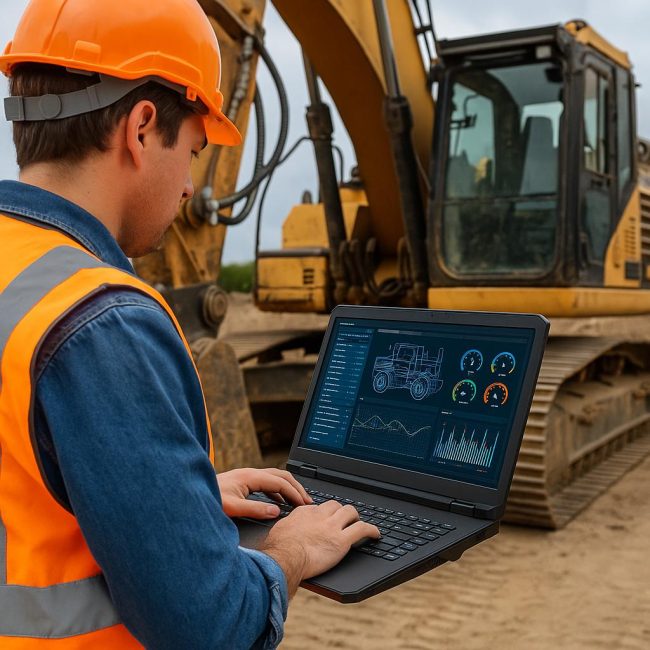
Modern special equipment is equipped with integrated electronic control units (ECUs). These collect data on engine, hydraulic, and fuel system operation and transmit it via dedicated interfaces. Service engineers connect to the ECU and receive:
- error codes,
- pressure and temperature indicators,
- information about engine operating cycles,
- fuel consumption statistics.
Thanks to this, it is possible to understand not only the fact of the malfunction, but also the dynamics of changes.
Telematics and online monitoring
Many manufacturers install telematics modules on their equipment. These operate as a "black box" system, collecting and transmitting data to cloud services:
- location of the car,
- operating mode (load, speed, idle time),
- fuel level and costs,
- failure signals.
This approach allows owners to monitor their fleet remotely and schedule maintenance in a timely manner.
Vibration diagnostics
Machine parts wear out gradually, and the first signs are changes in vibration. Vibration sensors can be used to determine:
- bearing defects,
- rotor imbalance,
- problems in gearboxes or transmission.
The method is used to prevent emergency situations when a part is still working, but is about to fail.
Thermal imaging diagnostics
Thermal imaging cameras help detect overheating in motors, generators, and electrical connections. For example, an overheated bearing or cable can be detected even before failure occurs.
Analysis of technical fluids
Modern laboratories perform spectral analysis of oil, coolant, and hydraulics. The metal content in the fluid can be used to determine the degree of wear of components. This is similar to a "blood test" for humans—information about the condition of the entire system in a single sample.
How technology is changing customer service
Previously, maintenance was carried out according to a "schedule" principle: every 500 or 1000 engine hours, the machine was sent for service, regardless of its actual condition. Now, the concept predictive maintenance - predictive maintenance.
The idea is that equipment is serviced when it's truly needed, but before it breaks down. This is made possible by a combination of sensors, telematics, and artificial intelligence that analyzes accumulated data.
Advantages of the approach:
- no extra costs for replacing serviceable parts;
- the risk of downtime is reduced;
- the service life of the components is predicted;
- the efficiency of using technology increases.
Examples of technology implementation in construction
- Large construction companies They use telematics to optimize their fleet. The dispatcher can see in real time whether one excavator is idle or another is overloaded, and can reassign tasks accordingly.
- Equipment manufacturers Offer customers a digital service subscription: diagnostics, scheduled maintenance notifications, and automatic service center requests.
- Leasing companies Monitor the condition of renters' equipment. This reduces risks, as equipment is returned in working order after rental.
Difficulties and development prospects
Despite the obvious advantages, the implementation of new technologies faces barriers:
- high cost of equipment and service solutions,
- the need for staff training,
- limited access to data from some manufacturers (the “closed systems” problem).
However, the trend is clear: in 5-10 years, most construction equipment will be connected to digital diagnostic systems. This will make the industry more predictable and cost-effective.
Conclusion
Today, construction equipment maintenance is no longer just an oil change and occasional repair. It's evolving into a complex technological process based on data collection and analysis. Computer diagnostics, telematics, thermal imaging cameras, and vibration sensors enable early detection of malfunctions, while predictive models allow for proactive maintenance planning.
These changes make construction safer, equipment more reliable, and businesses more sustainable. In the coming years, the integration of digital technologies into diagnostics will become a key competitive advantage for companies operating in the construction industry.