Forklifts are indispensable tools in warehouses, logistics centers, and industrial facilities. Their performance depends directly on many factors: their technical condition, operating conditions, and, of course, the type of tires installed. Forklift tires are more than just consumables; they are a vital component that impacts the safety, performance, and service life of the equipment itself. In this article, we'll examine the three main types of tires in detail: solid, pneumatic, and superelastic, so you can choose the optimal option for your specific operating conditions.
General classification of tires for forklifts
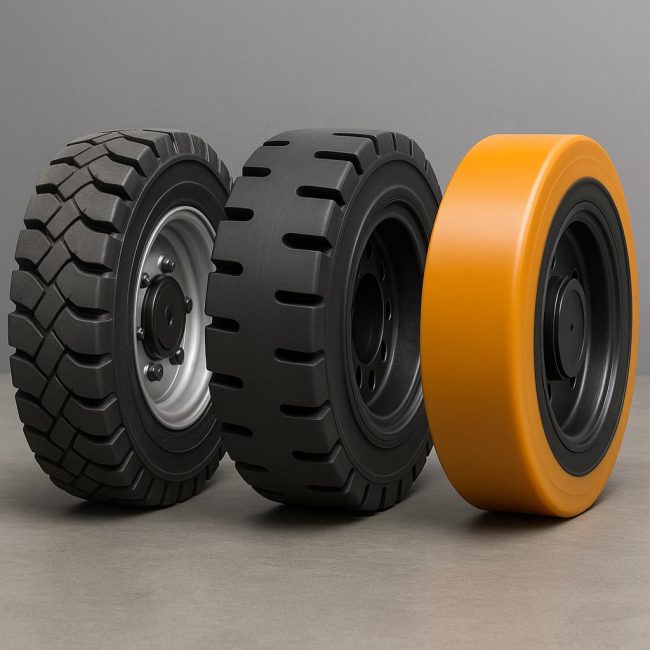
Before we get into the comparison, it's worth pointing out which types of tires are most commonly used on forklifts:
- Pneumatic (air) — resemble car tires, have an internal chamber or a tubeless design.
- Massive solid — made entirely of rubber, have no cavities.
- Superelastic — a type of solid tire with a multi-layer structure for better shock absorption.
Each type has its own advantages and limitations, which are critical depending on the operating conditions of the equipment.
Pneumatic tires: soft and versatile
Description:
Pneumatic tires are hollow rubber casings filled with air under pressure. They can be tubed or tubeless.
Advantages:
- Riding comfort. Due to the air cushion, pneumatic tires provide excellent shock absorption, reducing vibrations on the operator and the load.
- High cross-country ability. Works well on uneven surfaces, including open areas with gravel or uneven asphalt.
- Lower price compared to super elastic.
Flaws:
- Risk of punctures. Especially in production with metal shavings, nails, and fragments.
- The need for regular blood pressure monitoring.
- Shorter service life compared to solid cast ones.
Ideal operating conditions:
Open warehouse areas, loading docks, construction sites where maneuverability and smooth operation are important.
Solid tires: reliability and wear resistance
Description:
Solid tires are made from solid rubber without air pockets. They are one of the most durable and wear-resistant tire types.
Advantages:
- Highest resistance to mechanical damage. They cannot be pierced.
- Minimum operating costs. They do not require pumping, do not lose shape, and last a long time.
- Stability during movement. Particularly important in narrow aisles and for precise load positioning.
Flaws:
- Hard move. They transmit vibrations to the body and the operator's seat.
- Limited cross-country ability. Not suitable for rough or loose terrain.
- Increased load on suspension elements.
Ideal operating conditions:
Dry, level concrete or asphalt warehouses, closed production facilities where precision and reliability are important.
Superelastic: a balance between durability and comfort
Description:
A superelastic tire is a hybrid type of tire. It also lacks a cavity but consists of several layers: a rigid inner base, an elastic intermediate zone, and a wear-resistant outer surface.
Advantages:
- A compromise between comfort and durability. Softer than solid tires, but not as puncture-prone as pneumatic tires.
- Durability. The service life is higher than that of air tires and comparable to solid tires.
- Stability under load. Do not deform under the weight of heavy loads.
- Flaws:
- Price. The most expensive of all three types.
- More weight. Increases the overall weight of the forklift, which may impact fuel consumption or power consumption (in the case of electric forklifts).
Ideal operating conditions:
Warehouses with variable conditions, mixed routes (partly outdoors, partly indoors), enterprises where both reliability and comfort are important.
Comparison table
| Parameter | Pneumatic | Solid cast | Superelastic |
|---|---|---|---|
| Puncture resistance | Low | High | Very high |
| Depreciation | Excellent | Bad | Average |
| Service resource | Average | High | Very tall |
| Suitable for outdoors | Yes | No | Yes |
| Suitable for indoor use | Yes | Yes | Yes |
| Requires maintenance | Yes (swinging) | No | No |
| Price | Low | Average | High |
How to choose the right type of tires
When choosing forklift tires, consider:
- Surface type. For rooms with level floors, solid or superelastic mats are best. For outdoor use, pneumatic or superelastic mats are best.
- Weight of transported goods. The higher the load, the stronger the tire must be.
- Frequency and intensity of work. For 24-hour use, it is better to choose superelastic.
- Presence of debris, sharp objects, shavings. Under such conditions, pneumatic tires will quickly fail.
Conclusion
Choosing forklift tires is a strategic decision that impacts not only the equipment's service life but also personnel safety, the efficiency of logistics processes, and maintenance costs. Pneumatic tires are suitable for those working outdoors and value a smooth ride. Solid tires are ideal for areas with high reliability requirements. And superelastic tires are a universal choice for those who don't want to compromise on comfort and durability.
If you're unsure about your choice, consider the actual conditions of your warehouse. In some cases, it makes sense to use different types of tires for different areas or machines. The key is to avoid compromising on quality, as properly selected tires are essential for the smooth and safe operation of your equipment.