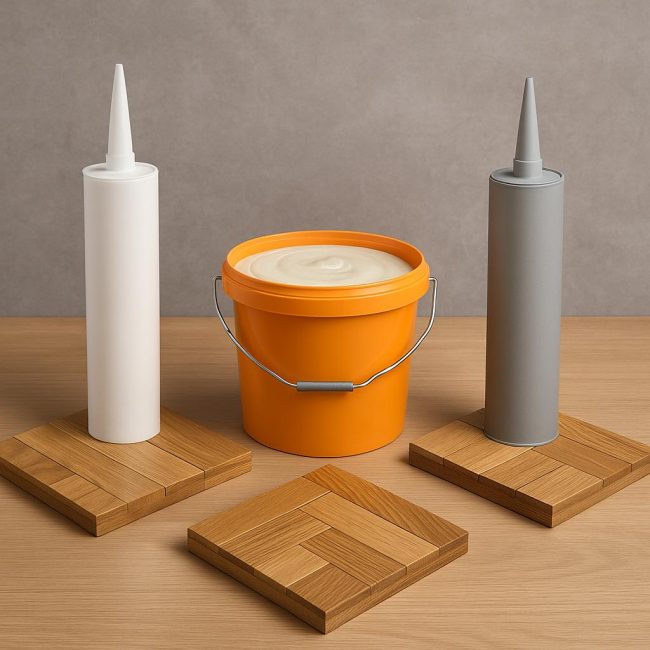
Laying parquet flooring is a task that requires attention to detail, and the choice of parquet adhesive is no less important than the quality of the wood itself. It's a mistake to assume that "any construction adhesive will do." Different types of parquet flooring—engineered wood, solid wood, and block parquet—require individual approaches. In this article, we'll take a detailed look at the three main categories of adhesives: polyurethane, dispersion, and epoxy adhesives, comparing their properties, applications, advantages, and disadvantages.
Why is choosing the right adhesive so important?
Parquet is a living material: it reacts to humidity, temperature, and mechanical stress. The wrong adhesive can cause boards to delaminate, cracks to appear, or even warp the entire flooring. To avoid this, it's important not only to properly prepare the subfloor and select the right parquet flooring, but also to carefully select the adhesive. This process requires considering the type of subfloor, operating conditions, board size, the presence of underfloor heating, and environmental requirements.
Dispersion adhesive: water-based and environmentally friendly
Composition and principle of action:
Dispersion adhesives are water-dispersed mixtures. They contain synthetic resins, fillers, and plasticizers, using water as a solvent. After application, the water evaporates, and the adhesive hardens, bonding the parquet to the subfloor.
Advantages:
- Safety: does not contain solvents, has virtually no odor.
- Easy to use: easy to apply and clean.
- Eco-friendliness: suitable for residential and children's spaces.
- Low price compared to other types of glue.
Flaws:
- Suitable only for stable wood species and small parquet formats.
- Not recommended for solid wood flooring and wet areas.
- Not for use with heated floors: re-softening may occur when heated.
Application area:
Solid parquet, thin parquet boards, and plywood. Ideal for dry living spaces without temperature fluctuations.
Polyurethane adhesive: elasticity and strength
Composition and principle of action:
Polyurethane adhesive is available in one- and two-component forms. It is based on polyurethane resins, which provide excellent adhesion and elasticity after curing. It does not contain water or solvents (depending on the brand), making it versatile.
Advantages:
- High adhesion to many surfaces: concrete, wood, ceramics, cement.
- Elasticity: compensates for the linear expansion of wood.
- Resistance to temperature changes and humidity.
- Suitable for solid wood flooring and underfloor heating systems.
- Fast setting.
Flaws:
- Higher price.
- When working with a two-component version, precise proportions must be observed.
- May have a noticeable odor before polymerization (especially with two-component formulations).
Application area:
Suitable for virtually all types of parquet flooring, including solid wood, decking, and large-format panels. An excellent choice for heated floors and areas with variable humidity.
Epoxy adhesive: strength for decades
Composition and principle of action:
Epoxy adhesives (most commonly epoxy-polyurethane) are two-component compounds based on epoxy resin and a hardener. After mixing, the adhesive quickly hardens, forming an extremely strong and rigid bond.
Advantages:
- Highest strength and resistance to mechanical stress.
- Does not contain water - does not cause swelling of wood.
- It is practically unaffected by changes in temperature and humidity.
- Ideal for unstable foundations.
Flaws:
- Very rigid: does not compensate for wood movement.
- The work requires precision, preparation and time.
- May emit an odor when applied and requires ventilation.
- High price.
Application area:
Parquet flooring, solid wood, and engineered wood flooring—especially suitable for commercial and public spaces with heavy traffic. Ideal for installation on challenging substrates, such as old tiles, marble, and concrete with residual moisture.
Comparison table
| Parameter | Dispersive | Polyurethane | Epoxy |
|---|---|---|---|
| Warp | Water | Polyurethane | Epoxy + hardener |
| Format | One-component | 1K / 2K | Two-component |
| Setting time | Average (up to 24 hours) | Fast (2–8 hours) | Fast (1–4 hours) |
| Elasticity | Average | High | Low |
| Compatibility with underfloor heating | No | Yes | Yes |
| Eco-friendliness | High | Average (depending on brand) | Average |
| Price | Low | Medium / High | High |
| Difficulty in use | Minimum | Average | High |
Which glue to choose: practical advice
- For an apartment with a normal climate and solid parquet flooring — It's smart to use dispersion adhesive. It's inexpensive, safe, and easy to apply.
- If solid wood flooring is being laid or underfloor heating is being used — it is better to give preference to polyurethane compounds.
- For commercial properties, non-standard foundations or high-traffic areas — epoxy glue is optimal.
- For eco-friendly interiors — look for dispersion compositions marked “EC1” or “solvent-free”.
Conclusion
Choosing a parquet adhesive is more than just a technical matter; it's the foundation of a reliable and durable floor. Polyurethane adhesives offer versatility, dispersion adhesives offer eco-friendliness and simplicity, and epoxy adhesives offer unrivaled strength. The key is to consider the operating conditions, subfloor type, and wood format. Only then will your parquet flooring not only be beautiful but also durable.
If you're searching for the best option and aren't sure what's right for your specific situation, it's always worth consulting with a professional. This will help avoid unnecessary costs and rework down the road.