Unplaned dry board — one of the most versatile and sought-after materials in construction. Despite its simplicity and low cost, it performs key functions at various stages of construction: from pouring foundations to constructing temporary structures and subfloors.
This material is often underestimated, considered a "secondary" option. In fact, rough-cut lumber can significantly reduce costs and maintain high quality with the right approach to selection, drying, and application.
- What is unplaned dry board?
- Advantages of rough boards
- Main areas of application
- Formwork
- Rough floors and decks
- Frames and temporary structures
- Roof sheathing
- Fences and barriers
- Material processing and protection
- Common mistakes when using
- When rough boards aren't the best choice
- Cost-effectiveness and rational use
- Conclusion
What is unplaned dry board?
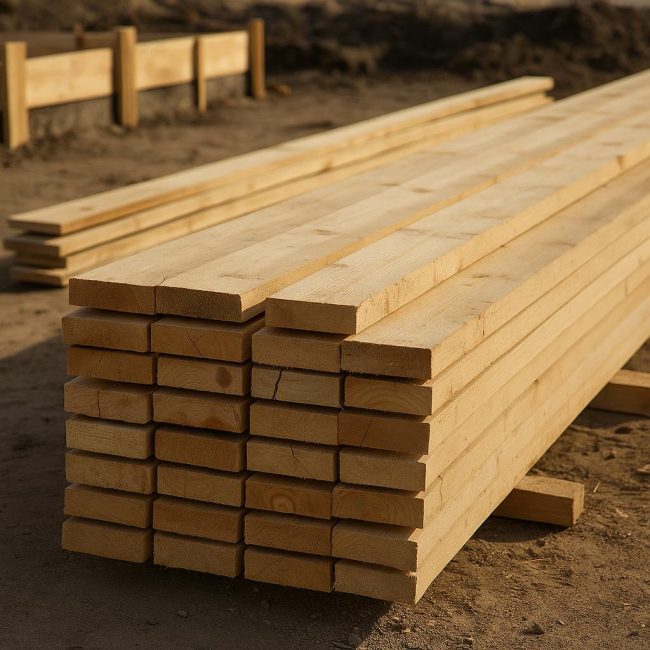
Rough-sawn lumber is lumber obtained by sawing a log lengthwise without subsequent planing. Its surface is rough, with visible saw marks. The main difference from planed lumber is the lack of finishing, making it more affordable and preserving the natural texture of the wood.
The term "dry" This means that the board's moisture content is reduced to no more than 18–20%, and even to 12–14% when kiln-dried. This ensures dimensional stability, strength, and resistance to cracking.
Main characteristics of rough boards:
- thickness - 20-50 mm;
- width - 100-200 mm;
- length - 3-6 m;
- wood species - pine, spruce, larch, less often birch;
- grade - from premium to working (A-C).
Advantages of rough boards
- Cost-effectiveness.
The cost is 20–40% lower than that of planed lumber. This is especially important for high-volume applications, such as formwork or subflooring. - Strength and reliability.
The board retains the natural structure of the fibers, which makes it resistant to loads. - Ease of processing.
If necessary, it can be easily planed, sawed, treated with an antiseptic or coated with a protective compound on site. - Versatility of application.
The material is suitable for both temporary and permanent structures. - Environmentally friendly.
This is natural wood without chemical additives, safe for use in residential construction.
Main areas of application
Formwork
Unplaned dry boards are an ideal material for assembling formwork when concreting foundations, stairs and columns.
Advantages:
- low cost for large volumes of work;
- sufficient strength to hold concrete;
- possibility of repeated use after disassembly;
- ease of cutting and assembly.
To extend their service life, the boards are treated with used oil or covered with polyethylene before use – this prevents moisture absorption and facilitates dismantling after the concrete has set.
Rough floors and decks
For floors, ceilings and subfloors, rough boards are used as a durable base for the finishing coating.
Advantages:
- high load-bearing capacity;
- savings due to invisible installation;
- ease of replacement of individual elements.
The main thing is to ensure that the wood is truly dry, otherwise it may warp over time. Preservative and fire retardant treatment is recommended before installation.
Frames and temporary structures
In construction, temporary structures are often erected—scaffolding, decking, partitions, warehouses, sheds. Rough-planed lumber is ideal for these purposes:
- it is strong enough to support the weight of a person and a tool;
- easy to assemble and disassemble;
- easily replaced if necessary.
This is especially relevant on large construction sites, where it is important to quickly and inexpensively create auxiliary elements.
Roof sheathing
Unplaned boards are often used for lathing and counter-lathing under roofing.
Reasons for popularity:
- reliable holding of screws and nails;
- resistance to mechanical stress;
- natural roughness that prevents materials from slipping.
It's important that the boards are thoroughly dried. Excessive moisture can cause the roofing to warp and sag.
Fences and barriers
For fencing and railings, rough-hewn boards are one of the most affordable options. Once impregnated and stained, they retain their appearance for a long time and are moisture-resistant.
In addition, in site design, such material is often used for decorative elements:
- garden paths;
- flower beds;
- decorative walls;
- recreation areas.
Material processing and protection
To ensure your board lasts as long as possible, it's important to prepare it properly for use.
- Grinding.
Removes burrs and reduces the risk of damage during work. - Antiseptic treatment.
Protects wood from fungi, insects and mold. - Fire retardant treatment.
Increases fire resistance when used indoors. - Coating with oils or paint.
Creates a moisture-resistant barrier and improves appearance in outdoor applications. - Storage.
The material should be stored in a dry, ventilated area or under a canopy. Stacks should be placed on pads and interleaved with slats for ventilation.
Common mistakes when using
- Application of raw board.
Wet wood shrinks after installation, causing cracks and deformation. - Lack of protection.
Without an antiseptic, the board quickly darkens, loses strength and is subject to rotting. - Storage on the ground.
Contact with the soil leads to moisture accumulation and the formation of fungus. - Choosing the wrong breed.
For load-bearing structures, dense wood species such as larch or pine are preferable, and for temporary structures, spruce.
When rough boards aren't the best choice
Although the material is versatile, there are situations where it is better to use planed boards:
- in interior decoration;
- in the manufacture of furniture and stairs;
- in designs requiring precise geometry and smoothness.
In these cases, planed boards provide an aesthetic appearance and precise fit of the elements.
Cost-effectiveness and rational use
In practice, builders often use a combined approach:
- rough board - for hidden and rough work;
- planed - for decorative and open surfaces.
This approach allows for material costs to be reduced by up to 30% without sacrificing reliability. Leftover rough-cut boards can be reused for underlayments, temporary decking, or scaffolding.
Conclusion
Rough-cut dry lumber is a strong, durable, and affordable material, indispensable in construction. It is used for pouring foundations, constructing floors, roofs, fences, and temporary structures.