Wood drying is one of the most important stages in preparing lumber for use. Without proper drying, wood is susceptible to warping, cracking, shrinkage, and rot, significantly reducing the lifespan of the finished product. To prevent such problems, specialized drying systems are widely used in the woodworking and construction industries. This article will cover in detail the basics of wood drying kilns, their classification, design, operating features, and selection criteria.
- Why dry wood: goals and objectives
- Classification of wood drying plants
- Chamber dryers
- Shaft dryers
- Container dryers
- Solar dryers
- The operating principle of the drying unit
- Stages of wood drying
- What to look for when choosing a drying unit
- Tips for Effective Wood Drying
- Development Prospects and Innovations
- Use of dry wood
- Conclusion
Why dry wood: goals and objectives
The natural moisture content of freshly cut wood can reach 80–100%. However, the optimal values for construction and furniture production range from 8–18%, depending on the intended use:
- 8–12%— for furniture, parquet, joinery;
- 15–18%— for external structures, load-bearing elements, house construction.
If excess moisture is not removed, the material may become deformed during use—shrink, crack, or, conversely, rot from the inside. Furthermore, damp wood becomes a breeding ground for fungi, mold, and wood-boring insects.
Thus, the main goal of the drying plant is to reduce the moisture content of wood to the required level while maintaining its structure, strength and appearance.
Classification of wood drying plants
Drying systems can vary by heat source type, design, purpose, and production scale. The most common types are:
Chamber dryers
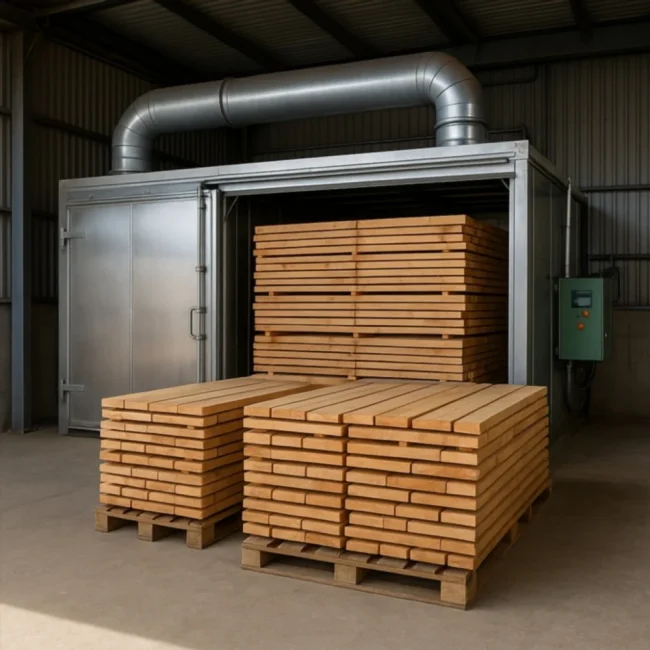
This is the most versatile and common type. It consists of a sealed chamber into which the wood is loaded, after which the controlled drying process begins.
Pros:
- Precise control of parameters (humidity, temperature, time);
- Possibility of drying different types of wood;
- High quality of finished material.
Cons:
- High cost of equipment;
- Energy costs.
Depending on the type of coolant, chamber installations are divided into:
- Convective— the air is heated and circulates throughout the chamber;
- Steam- hot steam is used;
- Vacuum— the process takes place in a rarefied environment, which allows for faster drying;
- Infrared— drying is carried out using infrared radiation;
- Microwaves- the latest technology that ensures uniform drying.
Shaft dryers
The structure is a vertical shaft into which wood is loaded from the top and gradually lowered. It is used primarily for drying firewood or small items.
Advantages:
- High performance;
- Suitable for continuous operation.
Flaws:
- Not suitable for delicate wood species;
- Less control over parameters.
Container dryers
They are modified sea containers equipped with heating and ventilation systems.
Pros:
- Mobility;
- Easy installation;
- Suitable for small and medium businesses.
Cons:
- Limited download volume;
- Less precise control of conditions.
Solar dryers
They utilize solar energy and the greenhouse effect. These are the cheapest systems, but also the slowest.
Advantages:
- Eco-friendliness;
- Minimum operating costs.
Flaws:
- Weather dependent;
- Uneven drying.
The operating principle of the drying unit
Regardless of the type, the drying unit operates on the same general principle:
- Loading timberinto the workspace, laying with gaps between the boards;
- Heating of air or other coolant(water, steam, infrared rays);
- Hot air circulation, which evaporates moisture from the surface of the wood;
- Removing moist airand replacing it with a new, dry one;
- Humidity and temperature controlusing sensors;
- Completing the cycle, unloading of finished products.
Many modern installations are equipped with automation, programmable modes, and remote control, which minimizes human intervention and increases process accuracy.
Stages of wood drying
Drying in the installation is carried out in several stages:
- Warm-up— the wood is heated to the required temperature;
- The main stage of drying— active evaporation of moisture from the pores of the wood;
- Humidity equalization— prevention of internal stress and cracking;
- Conditioning- gradual cooling and stabilization of humidity.
It is especially important to follow the drying regime for deciduous wood species such as oak, beech, and maple, which are prone to warping and cracking.
What to look for when choosing a drying unit
When purchasing or designing a drying system, there are a number of factors to consider:
- Volume of timber produced: the required performance depends on this;
- Wood species: conifers are easier to dry, deciduous ones require precise adjustment;
- Desired degree of automation;
- Energy resources(electricity, gas, solid fuel);
- Availability of space for a dryeror the need for a mobile version;
- Budget.
For small businesses or private use, a container or compact chamber dryer is suitable. Large enterprises may benefit from investing in industrial chamber or shaft dryers.
Tips for Effective Wood Drying
- Lay the material correctly: leave gaps between the boards to allow air circulation;
- Monitor the temperature: for conifers - up to 70°C, for oak - no higher than 50°C;
- Don't force the process.- this will lead to cracking;
- Cooling after dryingimportant for stabilizing the material;
- Humidity controlshould be carried out with a moisture meter - the permissible difference between internal and surface humidity is no more than 2-3%;
- Use anti-stress drying(conditioning mode) - especially for capricious breeds;
- Maintain your installation regularly: cleaning fans, checking seals, calibrating sensors.
Development Prospects and Innovations
Drying technologies are rapidly advancing toward energy efficiency and reduced cycle times. Among the innovations:
- Vacuum-pulse drying- high speed with minimal shrinkage;
- IR dryers with adaptive control;
- Microwave ovenswith control of moisture distribution throughout the board volume;
- Biofuel dryers- economical and environmentally friendly.
Use of dry wood
Dried wood is used in various industries:
- Construction: beams, ceilings, log houses, timber;
- Furniture production;
- Manufacturing of window and door units;
- Carpentry and joinery;
- Finishing materials: lining, parquet, door frames;
- Artwork and carvings.
Conclusion
Wood drying systems are more than just equipment; they are a vital component in ensuring the quality of wood products. Proper drying ensures the strength, durability, and stability of the material under any operating conditions. Modern technologies optimize this process, reduce energy costs, and increase productivity. When choosing the right system, it's important to consider the objectives, volumes, and characteristics of the wood being processed. Properly managed drying is the key to a successful woodworking business and the longevity of any wooden structure.