Monolithic construction is steadily gaining ground in private homebuilding. More and more future homeowners are choosing monolithic construction due to its durability, flexibility in layout, and high energy efficiency. This type of home can be customized to suit any needs: from a compact single-story cottage to a modern home with a second floor and panoramic glazing.
In practice, private developers often face the issue of properly organizing the construction process and selecting equipment. In particular, renting wall formwork from companies like Opora is in high demand, as purchasing a complete set for one-time use during the construction of a private home is often economically impractical. The ability to temporarily use professional formwork makes monolithic construction more accessible and convenient.
- Advantages of monolithic construction for a private home
- What does monolithic technology consist of?
- Preparation and design
- Formwork works
- Reinforcement
- Concreting
- Concrete care and formwork removal
- What types of houses can be built using monolithic technology?
- Pros and cons of monolithic construction for private owners
- ✅ Benefits
- ⚠️ Disadvantages and nuances
- How to reduce costs and speed up the process
- When a monolith is the best choice
- Conclusion
Advantages of monolithic construction for a private home
Monolithic technology offers a number of advantages that are difficult to achieve when building with blocks or bricks:
High strength and durability of the structure.
Monolithic concrete walls form a seamless, seamless structure, ensuring resistance to loads, time, and weather. The lifespan of such a home can be measured in decades, and with proper maintenance, even a century.
Flexibility in architecture.
Monolithic construction allows for the realization of virtually any design: panoramic windows, bay windows, complex shapes, large-span ceilings, and double-height windows. Where brick construction requires reinforcing the masonry with metal or restricting creativity, monolithic construction offers freedom.
Energy efficiency and comfort.
Thick monolithic walls combined with external insulation create a stable microclimate: warm in winter, cool in summer, with minimal thermal bridges. Additional soundproofing makes the home quiet and cozy.
Resistance to external factors.
Monolithic houses are resistant to shrinkage, wind and seismic loads, and also have high fire resistance.
What does monolithic technology consist of?
The monolithic construction process consists of several key stages, each of which requires adherence to technology:
Preparation and design
First, an architectural and structural plan is developed, taking into account loads, soil type, and climatic conditions. At the design stage, it is important to determine the type of flooring, wall thickness, the need for reinforcement, and the insulation method. Mistakes at the outset lead to higher estimates and rework.
Formwork works
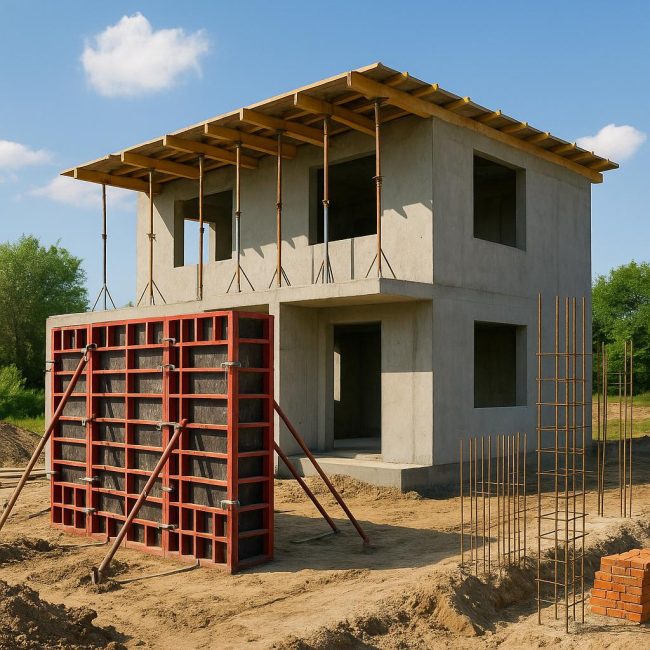
Formwork is a temporary structure into which concrete is poured. In private construction, the following are used:
- Panel formwork - metal or plastic, the most accurate and durable;
- Panel (large-panel) — for large areas;
- Non-removable - polystyrene foam blocks that remain part of the wall and serve as insulation;
- Combined — for complex shapes and elements.
It is at this stage that many private contractors prefer to rent equipment rather than purchase it, as the cost of a high-quality formwork kit is comparable to the budget for the entire construction project.
Reinforcement
Reinforcement strengthens concrete, increasing its strength and stability. A framework of reinforcement is connected to form a spatial structure, taking into account loads and possible deformations. Maintaining a protective layer of concrete is essential to prevent the metal from corroding.
Concreting
The mixture is poured layer by layer, with mandatory vibration to prevent voids from forming in the walls. B20–B25 grade concrete is typically used for private homes. Temperature conditions during pouring are crucial: heating is required in winter, and protection from premature evaporation is essential in summer.
Concrete care and formwork removal
After pouring, the concrete needs to be moistened and protected from drying out. Full strength is achieved in approximately 28 days. Formwork may be removed sooner, depending on the temperature and composition of the mixture.
What types of houses can be built using monolithic technology?
Monolithic construction doesn't limit the developer's architectural choices. The most popular options are:
| Type of house | Features and Benefits |
|---|---|
| One-story cottage | Quick implementation, minimum complex components, ideal for small families |
| Two-story house | Allows you to increase the usable area without expanding the site |
| House with monolithic floors | High strength, long service life and no squeaks |
| House with a second light and panoramic glazing | Freedom of layout, spaciousness and modern aesthetics |
| A house of complex architecture | Irregular shapes, bay windows, curved walls, balconies |
Monolithic construction is compatible with other technologies—for example, you can create a monolithic frame and fill the openings with aerated concrete, which reduces costs and speeds up construction.
Pros and cons of monolithic construction for private owners
✅ Advantages
- Reliability and durability of the design
- Open plan without load-bearing internal walls
- Excellent thermal and sound insulation properties
- Possibility of construction on difficult sites
- Minimal shrinkage of the house
⚠️ Disadvantages and nuances
- Need for skilled workers
- Availability of specialized equipment
- The budget is higher than most block technologies
- The importance of maintaining the correct temperature when pouring
How to reduce costs and speed up the process
Many private owners mistakenly believe monolithic construction is the most expensive option. In practice, the final cost depends on the proper organization of the work. The following solutions can help:
- clear planning of construction stages and supply of materials;
- use of rented rather than purchased formwork;
- selection of the optimal type of insulation (mineral wool, PIR boards, polystyrene foam);
- combination of works (concreting walls and preparing floors simultaneously);
- involvement of an experienced team familiar with the monolith.
Savings are achieved not at the expense of quality, but by eliminating downtime, rework, and unnecessary purchases.
When a monolith is the best choice
A monolithic house is especially justified if:
- the site is located in an area of strong winds or seismic activity;
- the owner is planning a complex architectural project;
- durability and long-term operation are required;
- there is a desire to get the most energy-efficient and warm home;
- Silence, comfort and the absence of interior partitions and load-bearing walls are important.
Conclusion
Monolithic construction is gradually becoming the norm not only in cities but also in the private sector. This technology allows for the creation of strong, warm, and durable homes that last for decades and offer flexibility in layout. With the right approach, timely ordering of materials, and the use of professional tools and equipment, monolithic construction is not as complex or expensive as it might seem at first glance. And modern services and solutions, including the option to use formwork without purchasing it, make monolithic construction accessible even for private construction.