Choosing a flooring solution often begins with a feeling: you want solidity, weight, and visual authenticity. Therefore, when first introduced to the topic, many people automatically gravitate toward the thickest options, believing them to be more reliable and durable. This is especially true when it comes to natural wood and materials like solid wood flooring, where thickness seems to be synonymous with quality.
In practice, things are more complicated. Thickness does affect the coating's properties, but not always as expected. In some conditions, it can be an advantage, while in others, it can cause problems that don't become apparent immediately, but rather after months or even years of use.
- What does the thickness of solid wood boards actually mean?
- Thick board: advantages that don't always work
- Visual and tactile solidity
- Potential for multiple resurfacing
- Stability is not always guaranteed
- When excess thickness becomes a problem
- Increased requirements for the foundation
- Excess weight
- Height restrictions
- Thin solid wood flooring: an underrated option
- Adapts to the microclimate faster
- Easier to install
- More predictable in operation
- Thickness and acoustics: an effect rarely considered
- Compatibility with underfloor heating
- Choice Practice: What to Look at Instead of Numbers
- Bottom line: a reasonable balance instead of the maximum
What does the thickness of solid wood boards actually mean?
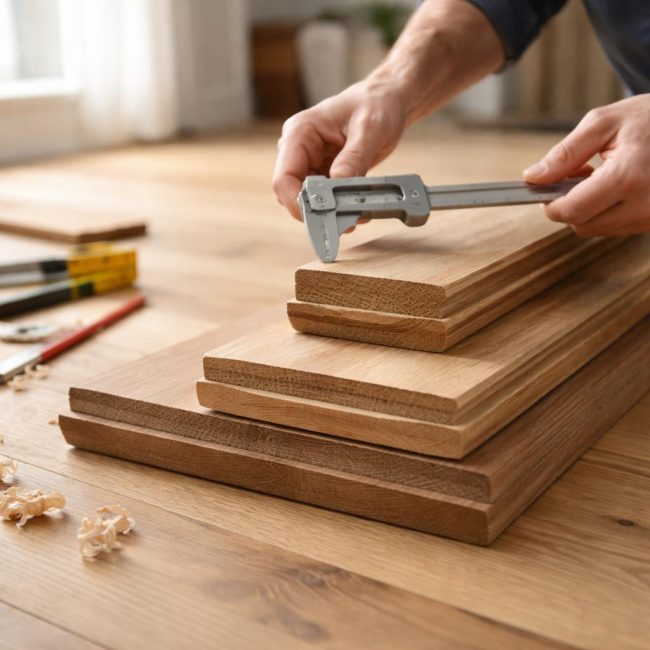
Thickness refers to the full board dimension from the bottom plane to the face layer. Unlike engineered wood, solid wood is made up of solid wood throughout its entire thickness. The most common thicknesses on the market range from 15 to 22 mm, with 25 mm and higher being less common.
At first glance, a difference of a few millimeters seems insignificant. However, in the case of wood, every millimeter affects:
- reaction to humidity and temperature;
- weight of the structure;
- requirements for the foundation;
- acoustic properties of the floor;
- compatibility with other interior elements.
Thick board: advantages that don't always work
Visual and tactile solidity
Thicker planks truly feel more monumental. The steps are muted, the surface appears denser, and the floor itself feels more solid. This can look natural in interiors with high ceilings.
Potential for multiple resurfacing
It's often said that the thicker the board, the more times it can be refinished. While this is technically true, in reality, the number of refinishings required is limited not only by the thickness but also by the condition of the locks, the floor's geometry, and the quality of previous work.
Stability is not always guaranteed
Paradoxically, increasing the thickness of the board doesn't make it less flexible. On the contrary, greater wood mass reacts more actively to changes in the microclimate. In rooms with unstable humidity, this can lead to significant shrinkage or expansion.
When excess thickness becomes a problem
Increased requirements for the foundation
The thicker the board, the stricter the requirements for the evenness and rigidity of the subfloor. Even the slightest differences become visible over time, resulting in micro-movements, creaks, and tension in the adhesive layer.
Excess weight
Thick solid wood flooring places additional stress on the floors. In older houses and apartments with wooden floors, this can be a critical factor, especially when installed over plywood or joists.
Height restrictions
Floor thickness rarely exists in isolation. It's supplemented by underlayments, adhesives, and leveling layers. This ultimately leads to problems with doors, built-in furniture, and differences in height between rooms.
Thin solid wood flooring: an underrated option
A thinner board is often perceived as a compromise, but with the right conditions it can provide more stability.
Adapts to the microclimate faster
A smaller volume of wood reacts more quickly to changes in humidity, but also returns to equilibrium more quickly. This reduces the risk of accumulated internal stress.
Easier to install
Thin solid wood is less demanding on the subfloor and easier to control during installation. This is especially important in apartments where drastic changes to the flooring structure are not possible.
More predictable in operation
With proper installation and care, thin boards behave more calmly, especially in rooms with seasonal temperature fluctuations.
Thickness and acoustics: an effect rarely considered
It's commonly believed that thick flooring is quieter. In reality, sound is affected not only by the plank itself, but also by the installation method, the presence of voids, and the type of subfloor. A thick, solid plank, if imperfectly installed, can increase boominess and resonance, while a thinner, more rigidly installed plank produces a duller and more stable footfall sound.
Compatibility with underfloor heating
The thicker the solid wood, the more difficult it is to handle underfloor heating. Wood is a poor conductor of heat, and increasing thickness reduces the system's efficiency and increases the risk of overdrying. Even if the technical parameters are acceptable, thinner boards usually offer a greater margin of safety.
Choice Practice: What to Look at Instead of Numbers
Thickness is just one parameter. In real-life work with solid wood, the properties of the wood itself and the conditions it will be exposed to are far more important. When choosing flooring in a store, the following are typically specified:
- wood species and its density;
- drying method;
- geometric stability;
- room conditions;
- real operating scenario.
There's no universal thickness solution. Some apartments use 16-18 mm solid wood, while others use 20-22 mm. Everything is determined by the floor's design and operating conditions, not by a formal safety factor.
Bottom line: a reasonable balance instead of the maximum
The thickness of solid wood flooring isn't a matter of mere numbers, but rather a balance between aesthetics, construction, and living conditions. Excessive thickness doesn't guarantee durability and can lead to problems that are difficult to fix without repairing the entire floor.
An informed choice begins not with maximum values, but with an understanding of how exactly the floor will be used: in what climate, with what load, and at what pace. This is where solid wood truly reveals its strengths and performs as expected.