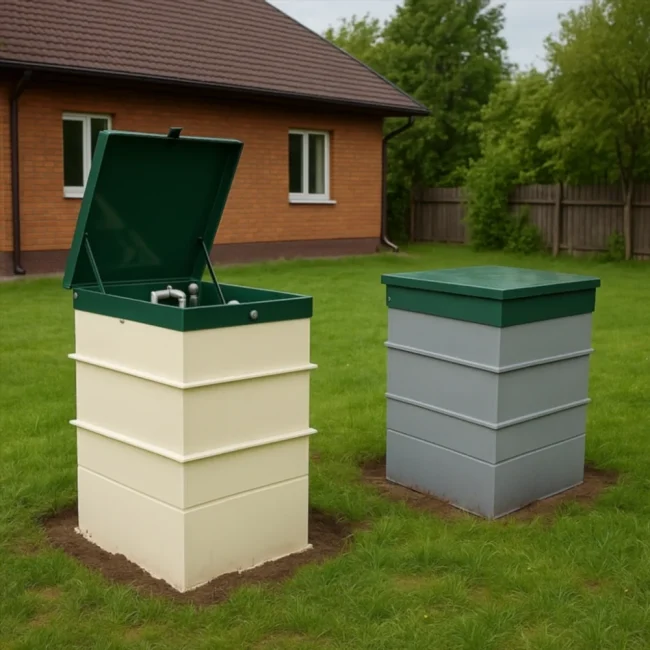
Owners of private properties outside the city sewer system face the need to install a standalone wastewater treatment system. Among the most popular and widely used systems on the Russian market, two brands lead the way:TopasAnd"Poplar"These biological treatment plants operate on similar principles, but differ in design, maintenance, cost, and reliability. In this article, we'll take a detailed look at the differences between Topas and Topol, the conditions under which each system performs best, and what to consider when choosing.
- What are biological treatment plants?
- Common features between Topas and Topol
- Characteristics of the Topas installation
- Characteristics of the Topol installation
- Comparison table: Topas vs. Topol
- When should you choose Topas?
- When is it worth choosing Poplar?
- Service: An Important Factor in Selection
- Installation and assembly
- Conclusion: which is better - Topas or Topol?
What are biological treatment plants?
Deep biological wastewater treatment plants (DBWTPs) are devices designed to treat domestic wastewater in areas without a centralized sewer system. They utilize aerobic bacteria, which require oxygen to survive and break down organic matter.
After passing through such a station, water is purified to 95–98% and can be used for technical purposes, such as irrigation. The stations are completely autonomous, energy-independent in the short term (during a power outage of 1–2 days), environmentally friendly, and require minimal user intervention.
Common features between Topas and Topol
Both plants are local treatment facilities and operate on the principle of aerobic biological treatment using activated sludge. Wastewater undergoes several stages of filtration, mechanical and biological treatment, and tertiary treatment.
Common features:
- Using a compressor to supply air to the bacteria.
- Several chambers for settling and treating wastewater.
- Possibility of reuse of purified water.
- Suitable for installation in private houses, cottages, and summer houses.
However, despite the superficial similarities, there are significant differences that make choosing between these two stations not as easy as it might seem.
Characteristics of the Topas installation
Topas is one of the first brands on the biological treatment plant market in Russia, with production beginning over 20 years ago. Over this time, the technology has been continuously improved, and the brand has gained popularity thanks to its reliability, wide range of models, and build quality.
Key Features:
- Body material: high-density foamed polypropylene, resistant to ultraviolet and frost.
- Number of models: a wide selection from "Topas-5" to "Topas-150", which allows you to choose an installation for both small summer cottages and apartment buildings.
- Energy efficiency: Compressors operate cyclically, which reduces energy consumption.
- Service: requires regular cleaning every 3-4 months, filter replacement and compressor check.
- Cleaning level: up to 98%.
Advantages:
- Reliable reputation of the manufacturer.
- Simple and clear operating principle.
- High degree of purification.
- Large selection of modifications.
- Suitable for all types of soil.
Flaws:
- Higher price compared to Topol.
- Requires regular service.
- Dependence on electricity supply.
Characteristics of the Topol installation
Topol is a newer brand, launched in the early 2010s. The manufacturer focused on simplifying the design, reducing production costs, and lowering operating expenses.
Key Features:
- Body material: sheet polypropylene with additional stiffening ribs.
- Design: lightweight, with fewer elements.
- Stations: models from "Topol-5" to "Topol-100" are presented, there are also specialized versions with a pump compartment.
- Service: simple, does not require professional maintenance more than 1-2 times a year.
- Cleaning level: up to 95–96%.
Advantages:
- More affordable price.
- Easy to install.
- Reduced power consumption.
- Less requirements for service frequency.
Flaws:
- Less high degree of purification.
- Shorter warranty (compared to Topas).
- Vulnerable structure in conditions of high groundwater.
Comparison table: Topas vs. Topol
| Parameter | Topas | Poplar |
|---|---|---|
| Country of origin | Russia | Russia |
| Body material | Foamed polypropylene | Polypropylene sheets |
| Cleaning depth | Up to 98% | Up to 95–96% |
| Price | Above average | Affordable |
| Reliability | Time-tested | Depends on the model |
| Number of models | Very wide selection | Wide, but narrower |
| Frequency of service | 3-4 times a year | 1-2 times a year |
| Electrodependence | Eat | Yes, slightly lower consumption |
| Noise level | Short | Very low |
| Possibility of customization for non-standard conditions | High | Average |
| Installation in areas with high groundwater levels | Fits | It doesn't always fit |
When should you choose Topas?
Topas station is the ideal choice for those looking for:
- Maximum degree of water purification, so you don't have to worry about odor or the need for additional filtration.
- Durable system, proven by time and thousands of installations throughout Russia.
- Flexible system, which can be adapted to the specific characteristics of the site (soil type, number of users, seasonality).
If your site is located in an area with a high water table, heavy soils (loam, clay), and periodic maintenance is possible, Topas will be a reliable solution.
When is it worth choosing Poplar?
"Topol" will be preferable in the following situations:
- Limited budget: You want a quality station, but are not ready to spend large sums.
- Seasonal accommodation: a dacha that you only visit during the warm season.
- Easy to operate: the installation operates stably and does not require frequent intervention or maintenance.
- Low groundwater: the site is located on a hill or in sandy soil.
This station is not overloaded with complex electronics, which makes it attractive for those who do not want to regularly contact specialists.
Service: An Important Factor in Selection
Although both stations require maintenance, Topas requires it slightly more frequently. This is due to its more complex design, which requires periodic cleaning, removal of excess sludge, and compressor maintenance. Meanwhile, Topol has a simpler modular design and is easier to maintain, although slightly less effective in terms of cleaning.
It is also worth considering that for both stations, regular removal of excess activated sludge (every 3–6 months) is critical, as its accumulation reduces the effectiveness of treatment and can cause system malfunctions.
Installation and assembly
Both Topas and Topol require qualified installation, taking into account:
- groundwater level;
- freezing depth;
- distance from a residential building;
- electricity on site;
- volume of wastewater.
The stations are installed on a specially prepared foundation (usually concrete or sand and gravel) and connected to the sewer and power lines. If necessary, drainage pumps or infiltrators are used.
Conclusion: which is better - Topas or Topol?
There is no single answerBoth options are worthy solutions for stand-alone sewerage systems, but the choice depends on your specific conditions, priorities, and budget.
ChooseTopas, If:
- You live in the house all year round.
- We are ready to provide regular service to the station.
- The highest degree of purification is required.
- An area with high groundwater levels.
Choose"Poplar", If:
- We need to save money without compromising quality.
- The installation is planned at a summer house or seasonal housing.
- Easy installation and maintenance take priority over cleaning depth.
- A site with sandy soil and low groundwater levels.
In any case, before purchasing, it's worth consulting with a specialist who can assess your site's parameters and recommend the optimal model. This is the only way to guarantee trouble-free operation of the station and comfortable sewer system for many years to come.