In recent years, the Moscow region has seen a veritable renaissance in wooden housing construction. Tired of concrete walls and monotonous high-rises, more and more people are seeking a life closer to nature—one where a home isn't just a dwelling, but part of the landscape, where the air smells of resin and the walls "breathe."
Thanks to the availability of lumber in Moscow and the surrounding region, more and more private developers are returning to wooden houses, saunas, and timber-frame buildings. This process is not driven by nostalgia, but by a conscious choice: modern wood is no longer an "old" material, but a technologically advanced, energy-efficient, and environmentally friendly component of the future of housing.
New wood processing technologies, architectural ideas, and a commitment to sustainable living are making timber construction in the Moscow region one of the most dynamically developing sectors of private construction.
- Why timber construction is experiencing a new boom
- Ecology as a conscious choice
- Speed of construction and energy efficiency
- Key trends in wooden construction in the Moscow region
- Minimalism and Scandinavian motifs
- New generation frame construction
- Combined materials and hybrid projects
- Smart Homes and Automation
- Energy-efficient solutions
- Geography and architecture of the Moscow region: how the environment influences
- Technologies that changed the market
- Social aspect: who chooses wooden houses
- Economic trends and the lumber market
- The future of timber construction
- Conclusion
Why timber construction is experiencing a new boom
Ecology as a conscious choice
Modern city dwellers are tired of concrete, glass, and artificial materials. For many, moving to the countryside is a way to return to a natural environment, where a home "breathes" and doesn't emit harmful substances. Wood regulates humidity, creates a comfortable microclimate, and fills the room with a natural scent.
In this sense, wooden houses are becoming part of a global trend sustainable development And eco-friendly lifestyle, when a person strives to live in harmony with nature, and not in spite of it.
Speed of construction and energy efficiency
Modern technologies make it possible to build a timber house in a matter of months, sometimes even weeks. Frame and laminated timber houses are assembled almost like a construction set—precisely, quickly, and without wet processes.
Furthermore, wood has low thermal conductivity, making these homes energy efficient. They warm up faster in winter and stay cooler longer in summer, reducing heating and air conditioning costs.
Key trends in wooden construction in the Moscow region
Minimalism and Scandinavian motifs
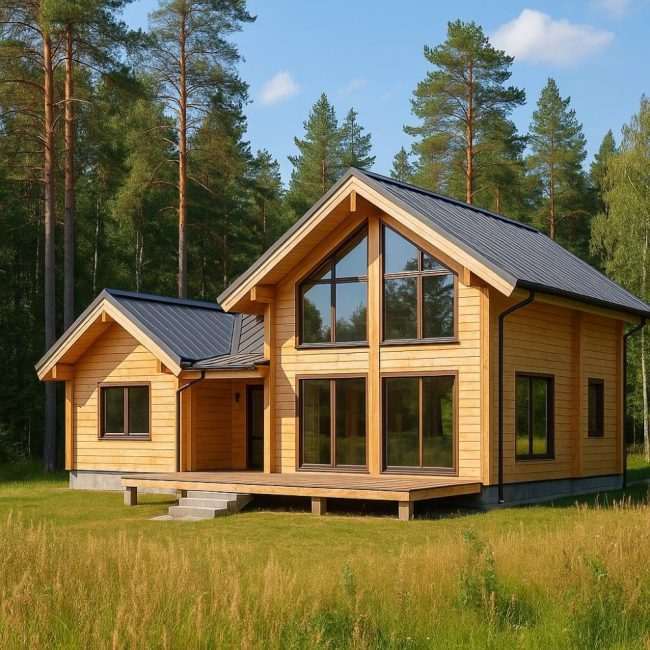
If earlier wooden houses were associated with carved frames and heavy finishing, today laconic formsSimple geometric volumes, large windows, light facades, and natural textures emphasize the aesthetics of tranquility and simplicity.
The Moscow region is actively adopting the Northern European style - Scandinavian functionalism, where the combination of natural light, wood and air is valued.
New generation frame construction
Frame technologies are undergoing a quantum leap. While in the early 2000s, frame houses were considered a temporary solution, today they are fully-fledged, energy-efficient structures with high thermal insulation standards.
Modern panels and insulation materials allow for minimal heat loss, while the use of dry lumber ensures the durability of the structure and stable wall geometry.
Combined materials and hybrid projects
More and more houses are being built using the "smart combination" principle: the ground floor is made of brick or monolithic concrete, and the upper floor is made of wood. This approach combines reliability and comfort.
Wood is often used for ceilings, roof structures and façade elements, creating visual warmth and reducing stress on the foundation.
Smart Homes and Automation
Modern wooden cottages integrate smart home technologies: climate control systems, automatic underfloor heating, lighting control, and even humidity control.
This dispels the myth that a wooden house is an outdated option. On the contrary, such buildings are becoming high-tech facilities, where natural materials are combined with digital solutions.
Energy-efficient solutions
Of particular interest is the use renewable energy sourcesSolar panels, heat pumps, and heat recovery systems are often installed on the roofs of wooden houses.
This not only saves resources, but also fully integrates into the concept of “smart suburban housing.”
Geography and architecture of the Moscow region: how the environment influences
Each district of the Moscow region develops its own preferences in wooden housing construction.
- In the western and north-western directions (Novorizhskoe, Volokolamskoe highways) are popular modern cottages with panoramic glazing and laconic facades.
- In the south and east of the region they are more common traditional wooden houses — with verandas, decorative elements and warm colors.
- In coastal and forested areas, demand is growing eco-villages — projects with limited development density, where wood becomes part of the overall natural concept.
This is how it is formed new architectural culture of the Moscow region, in which the house is not opposed to the landscape, but fits organically into it.
Technologies that changed the market
- Glued laminated timber — resistant to cracking and deformation, which is especially important in the changeable climate of the Moscow region.
- Chamber drying - increases the strength and durability of wood.
- Antiseptic and fire-bioprotective properties — makes wooden structures safe and durable.
- CNC machines And precise geometry of parts — allow you to assemble a house with high precision without any on-site adjustments.
These technologies have led to a qualitative leap in the perception of timber construction – it is no longer a handicraft, but an industry with precise standards.
Social aspect: who chooses wooden houses
Today's clients include not only owners of country houses, but also young families seeking to combine the comforts of the city with a natural atmosphere.
They choose compact but functional houses of 100–150 m², where everything is thought out down to the last detail: energy-efficient windows, natural materials, and a minimalist layout.
Many projects are implemented in the format modular housing construction — when house parts are manufactured in a factory, and only assembly takes place on-site. This reduces costs and construction time.
Economic trends and the lumber market
The timber and lumber market in the Moscow region is showing steady growth.
The reasons are simple:
- active individual construction in the Moscow region;
- the emergence of large suppliers guaranteeing quality and certification;
- interest in local products produced in Central Russia.
Buyers are increasingly choosing kiln-dried lumber And planed board, even if it costs a little more, it is an investment in the longevity of your home.
The future of timber construction
Experts predict that over the next 10 years, wooden housing construction will take up to 40% of the private housing segment in the Moscow region.
This is facilitated not only by the popularization of environmentally friendly solutions, but also by government programs for the development of low-rise construction.
In addition, there is a growing interest in architecture made of CLT panels (cross-laminated timber) — is a new type of material that combines the properties of concrete and wood, but weighs several times less and allows for the construction of buildings up to 5–6 stories high.
Conclusion
Wooden construction in the Moscow region has evolved from country houses to modern energy-efficient cottages.
Today, lumber is not just a construction resource, but a reflection of a new housing philosophy that values ecology, functionality and aesthetics of simplicity.
Trends indicate that wood will long remain a symbol of comfort and harmony in the architecture of the near future.