Simplicity, minimalism, and functionality: Scandinavian style
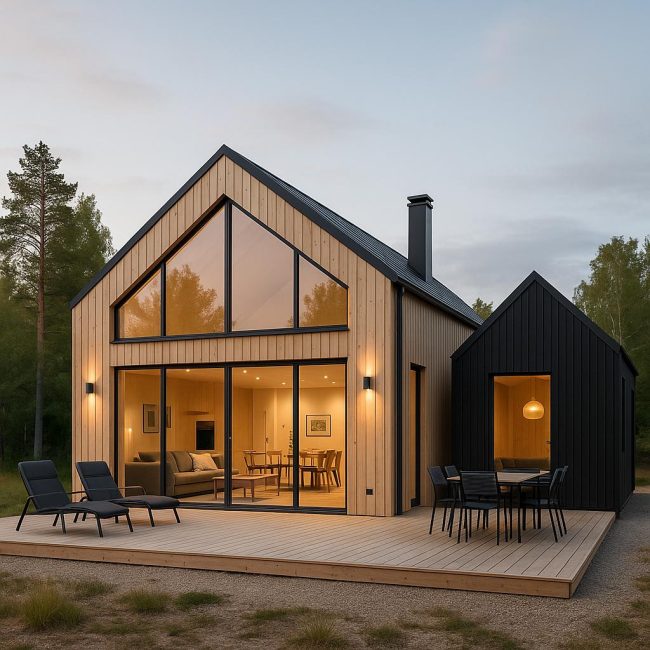
Scandinavian style remains one of the most popular trends in private construction. Its popularity is due to its simplicity, practicality, and ease of adaptation to any climate.
Main features:
- Simple geometry of forms;
- Large panoramic windows;
- Light color scheme;
- Natural materials: wood, stone, glass;
- Energy-efficient solutions (thick insulation, ventilation with heat recovery, smart glazing).
This style is ideal for turnkey home construction, as it's easily customized, adapts well to existing projects, and doesn't require excessive finishing. Scandi blends seamlessly with natural landscapes, making it a preferred choice for wooded or waterfront properties.
Barnhouse: the aesthetics of rural modernism
The barnhouse is another enduring trend in country house architecture. This stylistic direction originated in Western Europe and the United States, where farmhouses were historically reimagined as living spaces. In Russia, the barnhouse has become particularly popular due to its austere exterior and sophisticated interior.
Style features:
- Rectangular shape and high pitched or gable ceiling;
- Lack of a classic attic and loft;
- Facades made of wood, metal or standing seam roofing;
- Minimum number of partitions inside;
- Panoramic glazing across the entire wall.
Barnhouse is in demand in sUrban construction is popular because these homes are easily adapted to modern engineering solutions and fit well into any environment. It is especially popular among young people and families who value freedom, space, and unconventional architecture.
Eco-architecture and green technologies
Interest in eco-friendly construction is growing every year. It's not just a trend, but a necessity, driven by conscious consumption and the desire to minimize environmental impact. Architecture is becoming an ally of ecology.
Key features:
- Use of recycled and natural materials (eg clay, straw, wood);
- Alternative energy sources: solar panels, heat pumps;
- Rainwater collection and filtration systems;
- Green roofs and vertical greening of facades;
- Integration with the site's topography, rather than its reworking.
For companies offering turnkey country house construction, such projects are becoming an important segment. They demonstrate not only an environmentally friendly component but also high standards of engineering and comfort.
Modern minimalism and hi-tech
Technology has long since permeated architecture, and today's contemporary style is not just concrete and glass, but also thoughtful engineering, a smart home, and a reduction in unnecessary elements. Modern, minimalist homes emphasize the owner's status while remaining comfortable and energy-efficient.
What makes them different:
- Clean lines, asymmetry, monochrome;
- Abundance of glass and smooth surfaces;
- Technological materials: fiber cement, metal, concrete;
- Full glazing of facades, sliding panels;
- Lighting, heating, and security control system via smartphone.
While these homes are often individually designed, turnkey construction allows for the precise implementation of complex plans thanks to oversight of all stages—from foundation to commissioning.
Revival of traditional forms
Amid the desire for innovation, many developers are returning to traditional forms. Russian izba (traditional log cabins), Finnish log houses, and stylized versions of old estates—all of these are back in fashion. However, they are now being built using modern technologies.
What's popular:
- Log or glued timber houses;
- Modern exterior finishes while maintaining a classic shape;
- The use of traditional elements (carvings, platbands), but in a new interpretation;
- Warm roofs, modern foundations, insulation using Canadian or Finnish technology.
This destination is suitable for those who want to combine cultural traditions with 21st-century comfort.
Universal solutions for small areas
Another prominent trend is projects for compact plots. The market is increasingly offering solutions for 4–6 acres of land, which can accommodate a cozy one-story or one-and-a-half-story house.
Characteristic features:
- Compact houses up to 100 m²;
- Emphasis on functional layouts (for example, a kitchen-living room instead of two separate rooms);
- Combined zones (living room-study, bedroom-dressing room);
- Energy-efficient technologies: minimal heat loss, autonomous heating, ventilation with recuperation.
This is especially important for first-time landowners who turnkey construction of a country house becomes a way to immediately get ready-made housing without unnecessary costs for modifications.
Conclusion
Countryside construction in 2025 is more than just erecting walls. It's about creating a space that reflects the character and lifestyle of its owner. From Scandi to barnhouse, from green technologies to minimalism, each trend has its own philosophy and target audience.
By choosing turnkey country house construction, clients receive not only architectural and engineering solutions, but also confidence in the finished product. Contemporary styles allow for a balance between aesthetics, convenience, environmental friendliness, and cost effectiveness—and this is precisely the essence of today's trends.