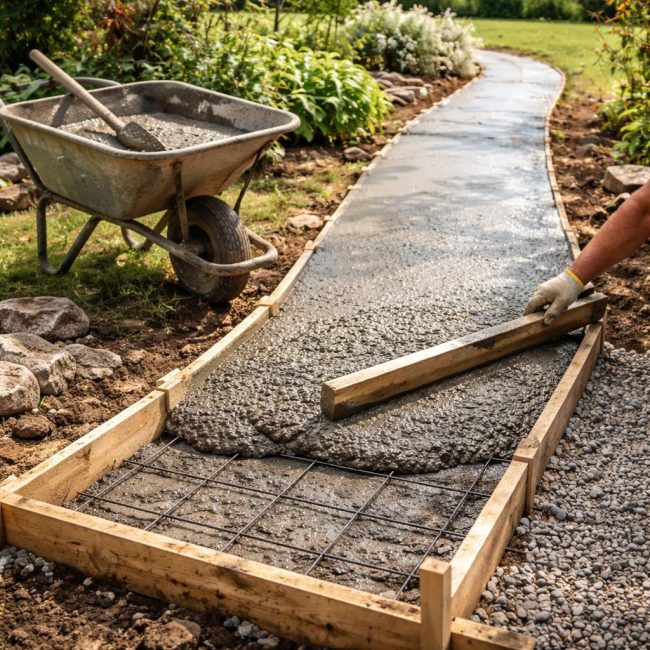
The design of garden and country paths is always a pressing issue, especially when choosing a durable and aesthetically pleasing material. Concrete is one of the most popular options for creating such structures. It combines durability, affordability, and the ability to create a walkway yourself. However, despite its apparent simplicity, laying a concrete path requires careful attention and adherence to several key points.
Why choose concrete for paths?
Concrete is an ideal material for building sidewalks for a number of reasons. Firstly, it is one of the most durable and strong materials, capable of withstanding the weight of human and vehicle traffic without losing its shape or appearance. Secondly, concrete is easily molded, allowing for the creation of various structures and decorative elements, such as curbs or patterns.
The third important factor is cost. Concrete is less expensive than many other materials, such as natural stone or tiles, while still offering comparable functionality. To ensure a long-lasting concrete path, it's important to choose the right mix, prepare the base, and consider weather conditions.
How does a concrete path work?
A concrete sidewalk operates on the principle of uniform load distribution. It is important that it be sufficiently strong and resistant to environmental influences. Therefore, to ensure the longevity of the sidewalk, it is necessary to properly prepare the base to prevent subsidence, and to use a high-quality concrete mix. The curing and shrinkage process of the concrete must be controlled to prevent deformation of the sidewalk over time.
The strength of concrete depends not only on the mixture proportions but also on the proper preparation and leveling of the base layer. The conditions in which the concrete will cure also play a significant role. During cold weather, temperature is especially important, as too low a temperature can slow the curing process.
Scenarios and consequences of choosing concrete
When laying a concrete path, you may encounter a number of nuances that depend on the soil conditions, the path's purpose, and its appearance. For example, in areas with frequent rainfall or high groundwater levels, concrete may crack if proper drainage isn't ensured. For such areas, it's recommended to use reinforcement or lay concrete with special polymers added to improve its moisture resistance.
The use of a concrete path in various conditions depends heavily on the concrete installation method. For example, in a country house where the path is not used intensively, a basic installation method may be sufficient. However, in urban areas or high-traffic areas, additional reinforcement and careful surface treatment are essential to prevent wear.
Limitations and nuances of installation
Despite its many advantages, concrete does have its limitations. For example, it's not a flexible material—any errors in preparing the mixture or foundation can lead to rapid deterioration. It's also important to consider that concrete takes time to gain strength, and in conditions subject to severe frost or moisture, the hardening process can be delayed, complicating the installation process.
Furthermore, concrete paths can be prone to cracking if soil settlement isn't taken into account in advance, or if the mix isn't prepared correctly. Therefore, it's important to follow the recommendations for preparing and pouring the concrete base to minimize risks.
Common Misconceptions When Laying Concrete Paths
One of the most common misconceptions is that a concrete walkway can be laid without preparing the base. This can lead to cracks and a deterioration in the walkway's appearance after several years. It's important to remember that a concrete walkway must have a strong and level base to ensure even distribution of the load.
Furthermore, there's a myth that concrete can be laid at any time of year. In fact, temperature plays a critical role in the curing process, and at low temperatures, concrete can harden too slowly, which can also lead to its failure.
Conclusion
Building a concrete walkway yourself is not only practical but also quite affordable. It's important to follow several key steps, from choosing high-quality materials to properly preparing the base. A concrete walkway will serve you for many years if you approach the process carefully and consider all the features and limitations.