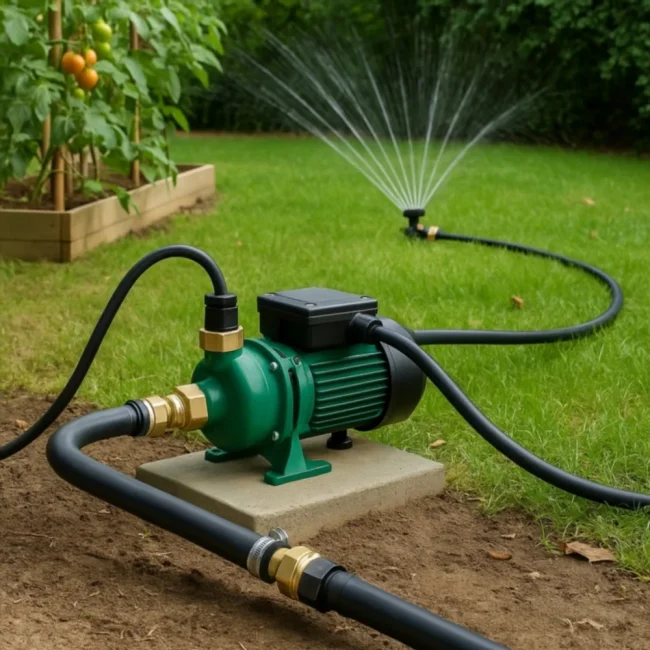
Modern suburban construction and landscaping increasingly involve the automation of various processes, including irrigation systems. One of the key components of such a system is the circulation pump. Its proper selection and proper installation ensure a stable water supply in the required volume, resource conservation, and a long service life for the entire system.
In this article, we'll take a detailed look at what a circulation pump is, why it's needed in an irrigation system, the different types available, how to choose the right model for your specific needs, and provide practical advice on installation and operation.
- What is a circulation pump?
- Difference from other types of pumps
- Why is a circulation pump needed in an irrigation system?
- Advantages of a circulation pump in irrigation
- Types of circulation pumps
- How to choose a circulation pump for irrigation
- Performance
- Pressure
- Connection diameter
- Body material
- Noise level
- Installation of a circulation pump
- Preparation
- Installation
- Examination
- Common mistakes during installation and operation
- Maintenance of the circulation pump
- Examples of use
- Alternative solutions
- Conclusion
What is a circulation pump?
A circulation pump is a device designed to ensure constant water movement in a closed or semi-open system. Unlike drainage or well pumps, it does not draw water from the source but rather distributes it throughout the system, creating a continuous flow.
In the context of irrigation, such pumps are most often used for:
- supplying water from the reservoir to irrigation devices,
- ensuring stable pressure in long pipelines,
- organization of recirculation when using storage tanks.
Difference from other types of pumps
A circulation pump is often confused with surface or deep well pumps. The main difference lies in their functions. Surface or deep well pumps pump water from a source (a well, a borehole, or a pond), while a circulation pump works with already available liquid, maintaining its movement through pipelines.
It is not designed for significant suction depth, but it copes well with pumping large volumes in a closed circuit or between several points with a small difference in height.
Why is a circulation pump needed in an irrigation system?
The use of a circulation pump is justified in the following cases:
- Automation of drip irrigation.Such systems require constant, uniform pressure, which is maintained by a pump.
- Pressure stabilization with a large number of consumers.If watering is carried out simultaneously in several areas, the pump guarantees the same pressure at all points.
- Use of storage tanks.When collecting rainwater or taking it from a tank, the pump supplies it to the system.
- Water recycling.For closed systems with biological filtration or fertilization.
Advantages of a circulation pump in irrigation
- Energy efficiency.Such pumps consume significantly less energy than well or drainage pumps.
- Compactness.They take up little space and are often mounted directly onto the pipeline.
- Low noise level.Especially important when used near a residential building.
- Durability.If used correctly, the service life can exceed 10 years.
Types of circulation pumps
- Dry rotor.The electric motor is separated from the water. These pumps require regular maintenance but are suitable for large volumes.
- Wet rotor.Water contacts the rotor, simultaneously cooling and lubricating it. This is the most popular type for domestic irrigation systems.
- With automatic control.Built-in pressure sensors and timers allow you to start the pump according to a schedule or when the pressure drops.
- With manual control.Simple devices that are switched on manually or via an external timer.
How to choose a circulation pump for irrigation
Performance
It is determined by the formula:
Q = A × N,
where Q is the required volume of water per hour (l/h),
A — average water consumption per irrigation point (l/h),
N is the number of irrigation points.
For drip irrigation of a single plant, the flow rate is 2–4 l/h. For lawn watering, the flow rate is up to 10 l/h per square meter.
Pressure
It depends on the length of the pipeline and the number of turns. On average, 50 meters of pipe requires a pump with a head of 2 to 3 meters of water column.
Connection diameter
Compatibility with pipes is an important parameter. Typically, threaded connections of 1/2", 3/4", and 1" are used.
Body material
- Brass is durable, but expensive.
- Stainless steel is durable and corrosion resistant.
- Plastic is inexpensive, but less durable.
Noise level
For installation near a house, it is important that the noise level is below 40 dB.
Installation of a circulation pump
Preparation
- Determine the installation location - at the outlet of the storage tank or on the supply pipeline.
- Make sure there is a check valve and filter in front of the pump to prevent debris from getting in.
Installation
- The pump is installed strictly horizontally with the shaft.
- Be sure to use sealant or fum tape when connecting to pipes.
- Connect the power supply, if necessary, through a RCD.
Examination
- Before the first start-up, fill the system with water, preventing dry operation.
- Check the tightness of all connections.
- Make sure the pump is producing the required pressure.
Common mistakes during installation and operation
- Work without water.Circulation pumps are not designed to run dry, as this leads to overheating and failure.
- No filter.Contaminants quickly clog the rotor.
- Incorrect flow direction.Installation must be strictly in accordance with the arrow on the body.
- Inappropriate pipe cross-section.Narrow pipes create resistance and reduce efficiency.
Maintenance of the circulation pump
- Once a seasonCheck the filter and clean it if necessary.
- Before winterthe system is drained or the pump is dismantled, especially in unheated rooms.
- Once every 2-3 yearsPreventive disassembly and inspection of internal parts is recommended, especially if noise occurs.
Examples of use
- Private house with a greenhouse.The pump supplies water from the storage tank to a drip system that waters 60 plants with a timer.
- Plot with lawn and automatic sprinklers.The circulation pump maintains stable pressure and uniform coverage of the area.
- Rainwater collection system.After the water has accumulated in the tank, the pump distributes it throughout the garden, saving water resources.
Alternative solutions
If the goal is not to maintain circulation, but to draw water from a source, it is better to consider:
- Surface pumps— for shallow wells and boreholes.
- Submersible pumps- when collecting from containers.
- Motor pumps— for large volumes and mobility.
The circulation pump can be combined with other types of equipment to create a complete autonomous irrigation system.
Conclusion
A circulation pump is an essential and useful tool for any homeowner. It allows for reliable, economical, and efficient watering, whether for a lawn, greenhouse, or garden beds. With proper selection, installation, and maintenance, such a pump will last for many years, ensuring comfort and abundant crops in your garden.