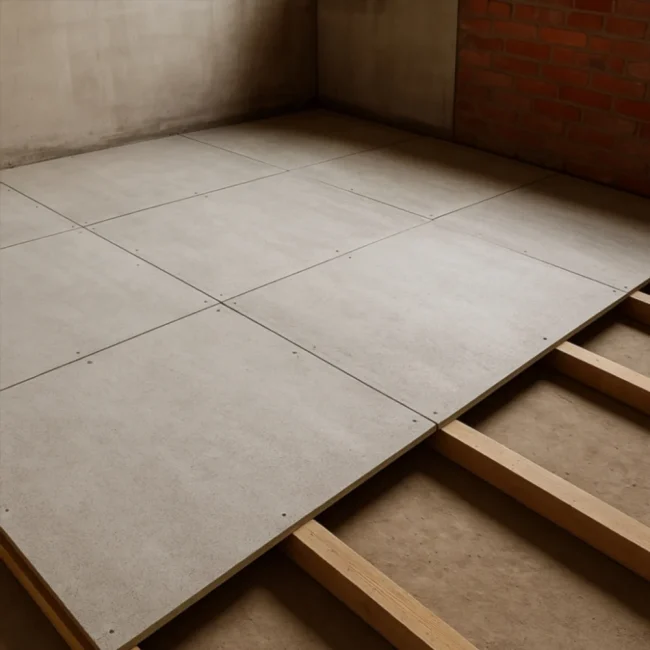
When installing subfloors in residential and commercial spaces, the choice of subfloor material is crucial. One of the best options is cement-bonded particle board (CBPB). This material combines strength, moisture resistance, and dimensional stability, making it particularly attractive for subflooring under a topcoat. In this article, we'll take a detailed look at why CBPB is a good subflooring solution, its advantages, and how to install it yourself.
- What is CSP?
- Advantages of CSP as a subfloor
- Where can you use cement-bonded particle board as a subfloor?
- Choosing CSP for Flooring: What to Consider
- Necessary tools and materials
- Preparing the base
- Technology of laying cement particle board on the floor
- What coverings can be laid over cement-bonded particle board?
- Common installation mistakes
- Care and operation
- Conclusion
What is CSP?
Cement bonded particle board (CBPB) is a multilayer board composed of wood chips, Portland cement, and a small amount of mineral additives. During production, the boards are formed under high pressure and then dried. This technology gives the material high density, resistance to deformation, and excellent performance characteristics.
Advantages of CSP as a subfloor
Using cement particle board as a subfloor has a number of objective advantages that make it popular among developers and private homeowners:
- Moisture resistance
Unlike plywood and OSB, cement particle board does not swell when exposed to moisture. This is especially important in areas with high humidity, such as bathrooms, kitchens, and basements.
- Strength and load resistance
The slab is capable of withstanding significant weight loads, making it suitable for use even in rooms containing heavy furniture or equipment.
- Fire resistance
Cement particle board is non-flammable and does not emit toxic substances at high temperatures, making it a safe option for subflooring.
- Environmental safety
The composition is free of phenols, formaldehyde, and other harmful substances. This is especially important for living spaces, including children's rooms.
- Good sound and heat insulation
Due to the structure of the material, cement particle board reduces noise levels and prevents heat loss.
- Resistance to biological influences
Cement particle board is not susceptible to rot, mold, or insect attack.
Where can you use cement-bonded particle board as a subfloor?
CSP is ideal for subflooring in various rooms:
- Living rooms (bedrooms, living rooms, children's rooms)
- Kitchens and bathrooms
- Balconies and loggias
- Corridors and hallways
- Rooms in wooden or frame houses
- Basements and attics
- Production or warehouse premises
Choosing CSP for Flooring: What to Consider
When purchasing cement particle board, the following parameters must be taken into account:
- Thickness
For subflooring, it is recommended to use slabs at least 10–12 mm thick. For joist spacing of 400 mm or more, slabs with a thickness of 16–20 mm are recommended.
- Slab size
The most common sizes are 3200×1200 mm and 2700×1200 mm. The choice depends on the room size and installation method.
- Surface
Slabs can be sanded or unsanded. Unsanded slabs are preferred for subfloors—they're less expensive and provide better adhesion to adhesives.
Necessary tools and materials
To install a subfloor from cement-bonded particle board, you will need:
- Cement-bonded particle boards of the required thickness
- Logs made of timber (if laid on a frame)
- A screwdriver or a drill
- Wood screws (or dowel nails if installing on concrete)
- Level, tape measure, pencil
- Jigsaw or circular saw
- Substrate (if necessary)
- Vapor barrier membrane (wet rooms)
- Waterproofing materials (in bathrooms)
Preparing the base
Before installing the slabs, it is necessary to carry out preparatory work:
- Cleaning the base
Remove construction debris, dust, and dirt. The surface must be dry and smooth.
- Floor level assessment
Use a spirit level to check for unevenness. Level the floor if necessary using self-leveling compounds or wooden joists.
- Waterproofing
In rooms with high humidity, it is necessary to lay a waterproofing film or mastic on the base, especially if the floor will be laid on a concrete slab.
- Laying logs (if necessary)
If installation is using joists, they are installed at intervals of 30–60 cm, leveled using a spirit level. Insulation can be placed between the joists.
Technology of laying cement particle board on the floor
The process of laying slabs consists of several stages:
- Sawing slabs
Measure the parameters of the room, cut the slabs taking into account the technological gap of 5 mm between the sheets.
- Installation of slabs
The sheets are laid in a staggered pattern, with adjacent rows offset to increase rigidity. The sheets are secured to the joists or base with screws spaced 200–300 mm around the perimeter and 300–400 mm in the middle.
- Joints and gaps
Leave a 4–6 mm gap between the slabs to accommodate thermal expansion. The space between the slabs can be filled with flexible sealant or foam.
- Additional reinforcement (optional)
In areas with high loads, you can lay fiberglass mesh and apply a thin layer of screed for additional strength.
- Primer and protection (if necessary)
If you plan to lay tiles, laminate or other coverings on the subfloor, the base can be treated with a primer to improve adhesion.
What coverings can be laid over cement-bonded particle board?
Subfloor made of cement-bonded particle boards is a universal base for most finishing coatings:
- Ceramic tiles
- Laminate and parquet boards
- Vinyl covering
- Linoleum
- Carpet
- Self-leveling floor
- Paint or varnish (for finishing rooms such as basements or utility rooms)
Common installation mistakes
- Lack of expansion gap between the slabs
- Uneven installation of joists
- Violation of the fastening step
- Laying slabs on a damp base
- Using unsuitable screws
- Lack of waterproofing in damp areas
All these errors reduce the reliability and service life of the floor.
Care and operation
Subflooring made of cement particle board requires little maintenance. Simply follow these basic guidelines:
- Do not expose to open water (unless protected)
- Avoid mechanical damage before laying the finishing coating.
- If necessary, periodically check the fasteners.
Conclusion
Cement particle board as a subfloor is a reliable, durable, and versatile solution, suitable for both major construction projects and home renovations. It's easy to install yourself, offers high performance characteristics, and serves as an excellent base for any type of finish. With proper subfloor preparation and installation techniques, this floor will last for many years, ensuring comfort and safety in your home.