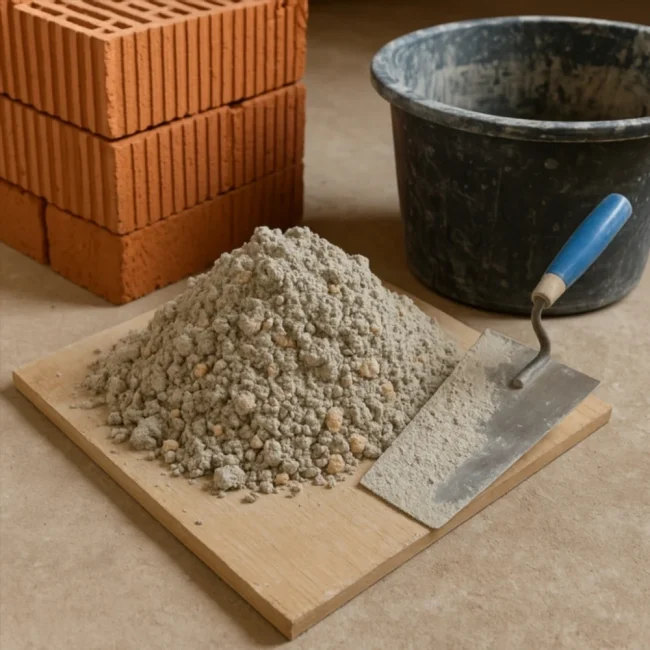
In modern construction, interest in technologies that ensure energy efficiency in buildings is growing. One such solution is warm cement mortar—a construction mixture that combines the strength properties of standard cement mortar with enhanced thermal insulation properties. It is particularly relevant in private home construction, for external wall construction, basement insulation, partition installation, and building renovations in cold climates. In this article, we'll take a detailed look at warm cement mortar, its uses, its composition, its preparation, and the nuances to consider when working with it.
What is warm cement mortar?
Warm cement mortar is a modified version of traditional cement-sand mortar, in which the sand is partially or completely replaced with lightweight thermal-insulating aggregates. The resulting mixture has lower thermal conductivity while maintaining sufficient strength and adhesion. This mortar can significantly reduce heat loss through masonry joints or other structural areas where traditional mortars act as "thermal bridges."
Where is warm solution used?
The main areas of application of warm cement mortar include:
- Laying warm ceramics or aerated concrete
For blocks with low thermal conductivity (e.g., aerated concrete, porous ceramics), using standard mortar negates their effect, as the mortar creates cold joints. Warm mortar helps maintain the insulating properties of the masonry.
- Installation of decorative facade elements
When installing moldings, architectural inserts, and insulation, warm mortar reduces the risk of heat loss and condensation.
- Insulation of the basement and foundation
This is especially important for external insulation followed by plastering – the solution serves as both a binding and insulating layer.
- Repair and reconstruction of old buildings
When restoring thermal insulation of walls, seams and ceilings.
- Filling cracks, joints and gaps in areas with heat leakage
For example, around heating pipes, window and door openings.
Benefits of a warm solution
- Low thermal conductivity
The main advantage is the ability to retain heat in the room, reducing the need for additional insulation.
- Reducing cold bridges
The solution matches the thermal properties of aerated concrete or ceramics, eliminating the problem of cold joints.
- Comparative strength
When formulated correctly, the warm solution retains sufficient strength characteristics for load-bearing structures.
- Eco-friendliness and vapor permeability
Especially when using natural fillers (perlite, expanded clay, vermiculite).
- Easy to apply
The mixture is plastic, easy to work with, and adheres well to most materials.
Composition of warm cement mortar
Main components:
- Cement
Typically, cement grade M400 or M500 is used. This is responsible for the strength of the mortar.
- Lightweight filler
It is this that ensures a reduction in thermal conductivity. The most common ones are:
- Perlite- expanded volcanic sand, has excellent thermal insulation and is lightweight.
- Expanded clay sand— a light, porous material made of baked clay.
- Vermiculite— a natural mineral with high thermal insulation.
- Foam glass- cellular glass granules, durable and moisture-resistant.
- Foaming or gas-forming additives- create micropores in the solution, reducing density and thermal conductivity.
- Water
We use pure water without any impurities of oils, acids or salts.
- Plasticizers and stabilizers
Modifying additives to improve plasticity, adhesion, resistance to freezing and cracking.
Warm cement mortar recipes
Example #1: Perlite mortar for masonry
- Cement - 1 part
- Perlite - 3-4 parts
- Water - as needed (approximately 0.5 parts)
- Plasticizer (for example, C-3) - 0.5% of the cement mass
This solution is lightweight and suitable for laying blocks and filling joints.
Example No. 2: Solution with expanded clay sand
- Cement M400 - 1 part
- Expanded clay sand - 2.5-3 parts
- Water - until the desired consistency is achieved
- Modifier (anti-shrinkage or water-retaining) - according to the instructions
Used for plastering and laying facade walls.
Example #3: Vermiculite Solution
- Cement - 1 part
- Vermiculite - 4-5 parts
- Water - until the consistency of thick sour cream
- If necessary, fiber for reinforcement
An excellent option for sealing cracks and insulating work in confined spaces.
Technology of preparation and work
- Preparing the components
All materials must be dry, clean, and free of contaminants. It's best to pre-wet lightweight aggregates to avoid "pulling" water from the mortar.
- Mixing
First, combine the cement and aggregate and mix until a homogeneous dry mass is formed. Then, add water and additives. Use a concrete mixer or a construction mixer.
- Consistency control
The mixture should be flexible but not runny. Runnyness increases shrinkage and reduces thermal insulation.
- Application
The solution is applied using standard tools—a trowel, float, or ladle. It's best to work at temperatures between +5°C and +30°C.
- Caring for the solution
After application, it is advisable to protect the surface from drying out (especially in hot weather) by covering it with film and spraying it with water.
Tips for use
- Do not use sand mixed with lightweight fillers.- this will worsen the thermal insulation characteristics.
- Take shrinkage into account— warm mortar tends to shrink, so a tighter joint is required when laying.
- Do not use for heavily loaded structures.— warm mortar is not suitable for load-bearing walls and foundations without additional reinforcement.
- Keep the proportions- too much filler reduces strength, and excess water increases thermal conductivity.
Comparison with traditional solution
| Indicator | Warm cement mortar | Conventional cement-sand mortar |
|---|---|---|
| Thermal conductivity | 0.09–0.3 W/(m K) | 0.8–1.5 W/(m K) |
| Density | 400–900 kg/m³ | 1600–2000 kg/m³ |
| Strength | 5–15 MPa | 10–25 MPa |
| Vapor permeability | High | Average |
| Weight of masonry | Less | More |
| Ease of use | Higher | Standard |
Conclusion
Warm cement mortar is an excellent solution for improving the energy efficiency of buildings, especially those constructed with aerated concrete, foam blocks, and porous ceramics. It reduces heat loss, improves indoor comfort, and helps lower heating costs. With the right composition and proper preparation and application techniques, this mortar will become a reliable and functional component of modern construction.