When it comes to landscaping, turnkey paving is considered a work organization format in which all stages are completed under a single contract. This approach includes design, base preparation, paving, and delivery of the completed project. Paving is used to create pedestrian areas, driveways, and areas, as well as to protect soil from erosion and create a well-ordered appearance.
What is included in the turnkey service?
The turnkey format means the contractor is responsible for the entire work cycle—from the initial site inspection to the completion of installation and cleanup. The client does not need to coordinate individual stages or contractors.
Work begins with a specialist's visit to assess the soil and terrain and determine the technical parameters of the future pavement. During the design stage, the installation plan is developed, the volume of materials is calculated, and an estimate is prepared. After approval, the foundation is prepared, materials are delivered, tiles are laid, and curbstones are installed. The final stage is the finishing of the joints and the handover of the completed work.
Paving technology: from base to finish
The quality and durability of the pavement are largely determined by proper base preparation. This stage is crucial when laying paving slabs and directly impacts the pavement's resistance to stress and external influences.
Work begins with marking out the future paths and areas, after which the topsoil is removed to the desired depth. For pedestrian areas, this is typically 20–30 centimeters, and for parking areas, 40–50 centimeters. Geotextile is laid at the bottom of the prepared pit to prevent soil from mixing with the crushed stone and vegetation from growing. Next, a base layer of medium-sized crushed stone is formed, compacted with a vibrating plate and serves as drainage. A leveling sub-base of sand or hartsovka (a mixture of sand with a small amount of cement) is laid on top of the crushed stone.
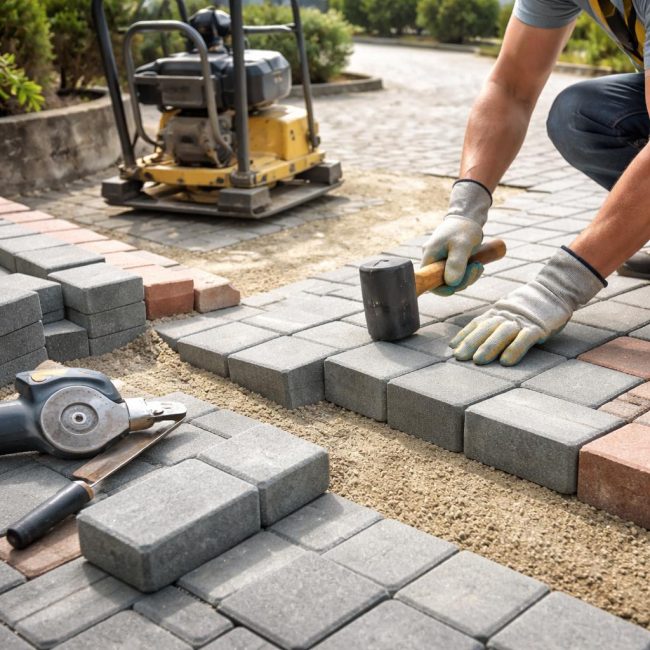
The actual laying of paving slabs is carried out away from the ground to avoid disturbing the prepared base. The slabs are laid according to the chosen pattern, maintaining 2-3 mm gaps, and are pressed in place with a rubber mallet. A tile cutter or an angle grinder with a diamond blade is used to trim the slabs. After laying, the surface is covered with fine quartz sand, which is distributed into the joints with a brush. The final step is compacting the surface with a vibrating plate with a rubber pad and rinsing the surface with water.
Features of professional performance of work
Organizing work with specialists requires adhering to technological standards and using specialized equipment. This allows for consideration of soil type, pavement loads, and drainage requirements. Furthermore, having design documentation and estimates simplifies monitoring the scope and sequence of work.
How to choose a contractor
When choosing a contractor, experience in similar projects, availability of a portfolio and equipment, and transparency of payments are important. It is recommended to draw up a contract that specifies deadlines, stages of work, and warranty obligations.
Result
Turnkey paving is a comprehensive approach to landscaping. This approach allows for a finished pavement that meets the design and technical requirements. Properly installed paving ensures a neat appearance, ease of use, and long-lasting durability.