A home is no longer just walls, a roof, and a lock and key. Today, security and convenience begin at the threshold—from the moment a person approaches their front door. Smart doors are becoming an important part of the smart home ecosystem, replacing traditional locks with high-tech solutions: biometrics, mobile device control, remote authorization, and automatic access control. This is not just a novelty, but a logical evolution of ideas about personal security, privacy, and comfort.
- What is a smart door: a basic definition
- Main functions of smart doors:
- Remote access control
- Biometric authentication
- Automatic closing
- Event registration
- Integration with other systems
- How Management Works: Protocols and Applications
- Benefits of smart doors
- Disadvantages and limitations
- What technologies are available today?
- When is it worth installing a smart door?
- Conclusion
What is a smart door: a basic definition
A smart door is an entryway equipped with electronic components and interfaces that allow for remote or automated access control. It includes both a physical element (door leaf, frame, lock) and integrated systems:
- electronic lock (digitally controlled mechanism),
- position and opening sensors,
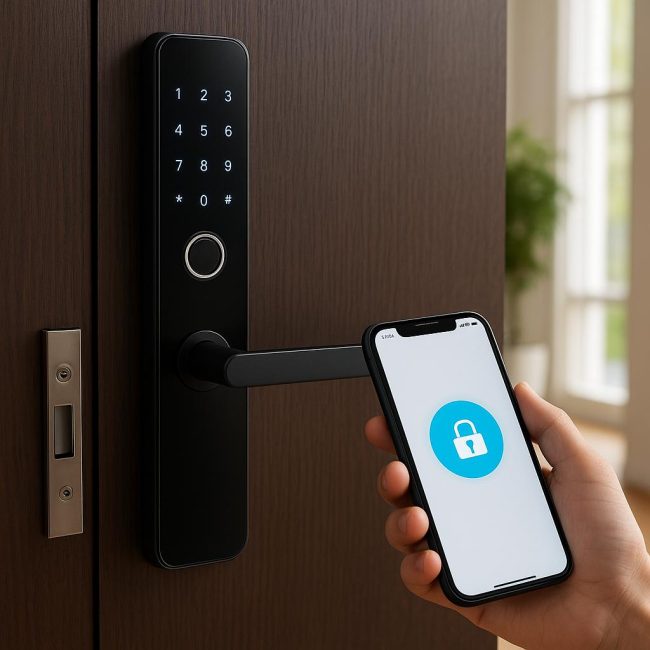
- authorization means (cards, smartphones, fingerprints, facial recognition),
- connection with a mobile application or smart home system.
Important: under smart door This can be understood as either fully integrated solutions (a door with built-in electronics) or traditional doors with installed intelligent locks.
Main functions of smart doors:
Remote access control
The owner can open the door even from another city – via a mobile app or cloud service.
Biometric authentication
Access is secured by fingerprint, palm vein pattern, or facial recognition. This prevents the possibility of key copying.
Automatic closing
The door locks automatically after a set time or after the occupant leaves (for example, when the smartphone is removed from the Bluetooth range).
Event registration
Records all opening attempts, accessible by time and method—who, when, and how they entered. Useful for monitoring children, tenants, or staff.
Integration with other systems
In conjunction with CCTV cameras, a security alarm, or lighting, you can create a scenario: when a door opens, the light turns on and the security is disarmed.
How Management Works: Protocols and Applications
Most modern solutions operate through one or more communication channels:
- Bluetooth Low Energy (BLE) - short-range access, stable connection, but limited range.
- Wi-Fi - constant connection to the Internet, control from anywhere in the world.
- Zigbee / Z-Wave — low-energy protocols used in complex smart home systems.
- NFC and RFID - for cards or tags, especially in commercial real estate.
All major manufacturers have mobile applications, through which you can:
- open/close the door,
- track the history of actions,
- set up time codes,
- receive notifications about events.
Benefits of smart doors
Convenience
- No need to carry keys, especially convenient for children and the elderly.
- Temporary access can be granted to a guest, nanny, or courier.
Safety
- Protection against hacking, key selection and duplication.
- Notifications about attempted hacking or opening.
Flexibility
- You can set up individual access scenarios (for example, for a cleaning lady on Tuesdays from 10 to 12).
- Complete control over what is happening, even from a distance.
Integration
- The smart door becomes part of the overall security and automation system: cameras, lighting, heating, voice assistants.
Disadvantages and limitations
- Energy dependence
Electronic locks require power. They typically use batteries, which need to be changed regularly. If the battery is completely discharged, an emergency release may be required. - Price
Smart doors are more expensive than regular ones, especially when integrated with other systems. - Risk of cyber hacking
With weak encryption and an unsecured network, remote access attempts by attackers are possible. - Difficulties with installation
Not all doors can be retrofitted, and not all systems are compatible with each other.
What technologies are available today?
The following types of solutions are available on the Russian and global markets:
- Digital door handles with touch panel (eg Samsung SHP-DH538)
- Locks with face and fingerprint recognition (Aqara Smart Door Lock D100, Kaadas Face Recognition series)
- Wi-Fi locks with app control (Yale Linus Smart Lock, Nuki Smart Lock 3.0)
- Integration with HomeKit, Google Assistant, Alexa, Yandex.Alice — for voice control and scenarios.
Many of these devices can be installed on both new and existing doors without replacing the door leaf.
When is it worth installing a smart door?
- In a new house or during a major renovation - it is easier to integrate the entire system.
- For rented apartments — control of tenants and remote issuance of codes.
- In offices and commercial properties — replacement of mechanical passes.
- In families with children, elderly people, staff - ease of control and security.
Conclusion
Smart doors aren't just a fad, but a response to the real needs of modern living: mobility, security, control, and comfort. They eliminate the need for keys, allow for flexible access, respond to emergency situations, and integrate the entrance into the overall digital home management system. Despite the higher price and the need for careful selection, they are a smart solution for those who want to be confident in the security of their home or business.