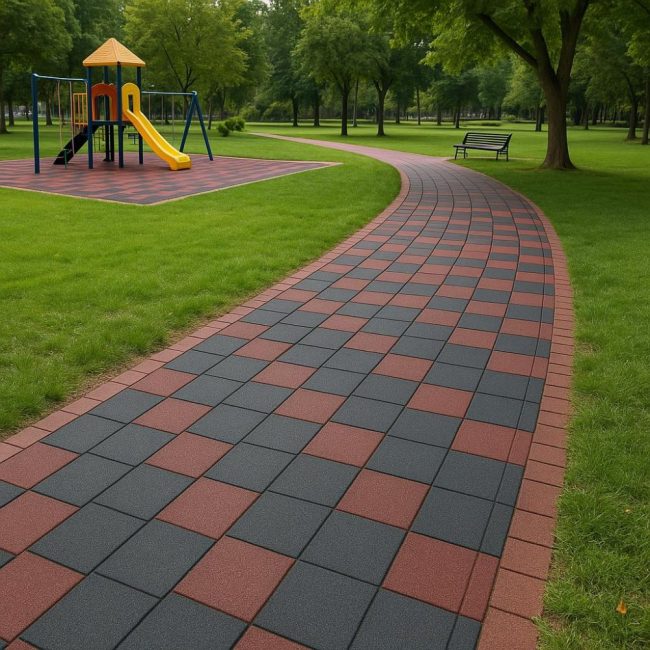
Modern construction has long ceased to be limited to the construction of houses and utility structures. More and more attention is being paid to the improvement of courtyards, parks, and public spaces. These areas shape the appearance of a city, create a comfortable environment for residents, and directly impact quality of life.
Among the materials that help solve these problems, a special place is occupied by rubber tilesIt's used not only in play areas but also on sports fields, park paths, residential courtyards, and private properties. It combines practicality, durability, and safety, making it suitable for a wide variety of projects.
- Why are versatile materials important?
- Rubber tiles as a universal solution
- Application:
- Advantages of rubber tiles for construction and operation
- Injury safety
- Durability
- Easy to install
- Economy
- Eco-friendliness
- Aesthetics and variability
- Alternative universal materials
- Practical experience of application
- Conclusion
Why are versatile materials important?
The versatility of construction solutions means they can be used in a variety of conditions and at various sites. For the developer and contractor, this means budget optimization, simplified logistics, and increased project completion speed. For the client, it means durability and functionality.
Key requirements for universal materials:
- Strength and load resistanceIn public areas, surfaces are exposed to high traffic and mechanical stress.
- SafetyThis is especially important where children play or engage in sports.
- AestheticsThe material must fit harmoniously into the architectural ensemble.
- Resistance to climatic conditionsIn Russia, frosts, sudden temperature changes, and high humidity are common.
- Easy to maintain and repairIt is important that the coating can be easily cleaned and partially replaced if necessary.
Rubber tiles as a universal solution
Although it is often perceived solely as an element of children's playgrounds, in reality this material has long established itself in a wider range of applications.
Application:
- Children's playgrounds — rubber tiles for children's playgrounds Minimizes injuries from falls and provides a comfortable playing surface.
- Sports areas — workout areas, mini-football fields, running tracks.
- Park paths and health trails - comfortable for walking, anti-slip effect.
- House territories - neat design of courtyards, especially in new residential complexes.
- Recreation areas near the water — thanks to its moisture resistance, it is used on piers, near swimming pools, and in spa areas.
Advantages of rubber tiles for construction and operation
Injury safety
The porous structure softens impacts and reduces the risk of injury. For builders, this helps ensure compliance with safety regulations, especially during construction.
Durability
A high-quality coating has a service life of 10–15 years. It does not crumble or lose its shape, even with heavy use.
Easy to install
It can be installed on a concrete base, crushed stone, or sand. Unlike asphalt, it doesn't require specialized equipment, reducing costs and speeding up the process.
Economy
Although the initial investment is higher than sand or grass, it is cheaper in the long run because it does not require frequent replacement or special maintenance.
Eco-friendliness
Many manufacturers produce tiles from recycled rubber (such as car tires). This reduces the impact on the environment and supports the concept of "green building."
Aesthetics and variability
The material is available in a variety of shapes and colors, allowing for the creation of design solutions: zoning areas, creating patterns, and highlighting paths.
Alternative universal materials
To better appreciate the versatility of rubber tiles, it's worth comparing them with other popular solutions:
- Paving slabs — durable, aesthetically pleasing, but dangerous for children and less slip-resistant in winter.
- Asphalt — a cheap and fast option, but not environmentally friendly and requires regular repairs.
- Artificial grass - Suitable for sports fields, but limited in use and wears out quickly under intense loads.
- Wood coverings (boards, decking) — beautiful and environmentally friendly, but require care and treatment against moisture and insects.
Against this backdrop, rubber tiles are truly versatile: they combine the durability of paving tiles, the safety of lawns, and the eco-friendliness of modern materials.
Practical experience of application
The construction industry is increasingly seeing examples of rubber tiles becoming the standard for landscaping.
- IN new residential complexes Developers use it for all areas adjacent to buildings: playgrounds, sports courts, and paths between buildings.
- IN city parksIt is used for running tracks and walking paths: it is wear-resistant and comfortable for walking.
- On private plotsoften replaces asphalt and concrete, creating a more comfortable and aesthetically pleasing atmosphere.
Conclusion
The improvement of public and private spaces has long ceased to be a secondary task in construction. Today, these areas shape the image of a modern neighborhood and ensure the comfort and safety of residents. Consequently, the demand for universal solutions is growing.
Rubber tiles are a shining example of a material that has transcended its narrow function and become a versatile tool for builders and architects. They combine safety, durability, ease of installation, eco-friendliness, and aesthetics. These solutions make courtyards and parks pleasant and safe places for all generations.