Insulating a home is one of the most important stages of construction and major renovations, directly impacting living comfort, heating system efficiency, and operating costs. One of the key parameters when choosing insulation is its thickness. In this article, we'll take a detailed look at insulating a home with a 50mm layer: how practical it is, which materials to use, where this thickness is acceptable and where it's absolutely insufficient, and how to maximize insulation effectiveness.
- Why is insulation thickness important?
- Where can 50mm thick insulation be used?
- Insulation of interior spaces
- Insulation of balconies, loggias and utility rooms
- The second layer for complex insulation
- Insulation of interfloor ceilings and floors
- Materials used for insulation with a thickness of 50 mm
- Mineral (basalt) wool
- Expanded polystyrene (EPS) and extruded polystyrene (XPS)
- Polyurethane and PIR panels
- Ecowool and other sprayed insulation materials
- Is 50mm thickness sufficient for basic insulation?
- Climate
- Wall material
- The purpose of insulation
- Consequences of insufficient thermal insulation
- How to improve the efficiency of a 50mm layer?
- Selecting a material with minimal thermal conductivity
- Installation without thermal bridges
- Multilayer insulation
- Vapor barrier and wind protection
- Example of calculating heat transfer resistance
- Practical tips for installing 50mm insulation
- Conclusion: When is 50mm a reasonable solution?
Why is insulation thickness important?
The thickness of the insulation determines its thermal resistance—the greater the thickness, the slower heat escapes from the home. However, excessive thickness can lead to unnecessary costs and a reduction in usable space (especially in the case of interior insulation). Therefore, choosing the right thickness is a balance between efficiency, cost, and technical feasibility.
50 mm of insulation is a relatively small layer, but in some cases it may be acceptable, especially when it comes to light insulation, upgrading existing insulation, or insulating utility rooms.
Where can 50mm thick insulation be used?
Insulation with a thickness of 50 mm can be used in the following cases:
Insulation of interior spaces
Internal wall insulation in living rooms is often limited by thickness. Using a thicker layer can reduce usable space. In such cases, insulation with low thermal conductivity but low thickness is used. 50 mm of extruded polystyrene foam (XPS) or PIR panels, with proper vapor barrier and finishing, can significantly improve thermal insulation, especially in multi-apartment buildings.
Insulation of balconies, loggias and utility rooms
For such spaces, 50mm insulation is often used to maximize usable space. Here, the insulation serves more as a cold barrier than as a complete thermal envelope.
The second layer for complex insulation
Sometimes, 50 mm of insulation is used as an additional layer to existing thermal insulation. This is especially important during renovations where a layer of insulation is added to the façade or attic.
Insulation of interfloor ceilings and floors
Internal partitions and ceilings between heated areas can be insulated with 50 mm of mineral wool to improve sound insulation or reduce heat loss between floors.
Materials used for insulation with a thickness of 50 mm
Let's look at the most popular thermal insulation materials available in 50mm thickness and suitable for various types of work:
Mineral (basalt) wool
- Advantages: vapor permeability, non-flammability, excellent sound insulation.
- Application: internal partitions, facades with a ventilated gap.
- Flaws: afraid of getting wet, requires protection from moisture.
Expanded polystyrene (EPS) and extruded polystyrene (XPS)
- Advantages: low thermal conductivity, moisture resistance, rigidity.
- Application: foundations, facades, floors, flat roofs.
- Flaws: flammability, low vapor permeability.
Polyurethane and PIR panels
- Advantages: very low thermal conductivity (1.5-2 times better than basalt wool), high strength.
- Application: facades, roofs, internal partitions.
- Flaws: high price, difficult to process.
Ecowool and other sprayed insulation materials
- Advantages: fills all the gaps, environmentally friendly.
- Application: attics, wall cavities, ceilings.
- Flaws: special equipment is needed, thickness is not always controlled.
Is 50mm thickness sufficient for basic insulation?
The answer depends on the following factors:
Climate
- In warm regions (Krasnodar Krai, southern Russia), 50 mm may be sufficient in combination with other energy-saving measures (sealed windows, insulated attic).
- In the middle zone, this is not enough for walls, but is quite suitable for loggias or interior work.
- In northern regions and Siberia, 50 mm is absolutely inconsistent with the heat transfer resistance requirements for enclosing structures.
Wall material
- Aerated concreteAndfoam blocksThey have thermal insulation properties on their own. 50 mm of insulation can be an adequate supplement.
- BrickAndconcrete— cold materials. Here, 50 mm is very little. At least 100–150 mm of insulation is needed.
The purpose of insulation
If insulation is carried out for:
- Condensation protection- 50 mm may be enough.
- Improving energy efficiency- Most likely, more will be needed.
- Preparations for decorative finishing- 50 mm provides a stable surface.
Consequences of insufficient thermal insulation
Using insulation that is not thick enough can lead to:
- Educationdew pointsinside the structure - this is fraught with dampness, mold and destruction of the walls.
- Insufficient thermal insulation, which will cause the house to lose heat and heating costs to increase.
- Failure to achieve SNiP standardsand, as a consequence, problems with paperwork or receiving compensation for energy savings.
How to improve the efficiency of a 50mm layer?
If circumstances do not allow increasing the thickness of the insulation, the following measures can be used:
Selecting a material with minimal thermal conductivity
For example, 50 mm of PIR panels are equivalent in thermal resistance to 80–100 mm of mineral wool.
Installation without thermal bridges
It's important to prevent cold from penetrating through the frame, joints, and fasteners. Use thermal spacers, sealants, and continuous fasteners.
Multilayer insulation
Combine two different layers: for example, 30 mm of XPS + 20 mm of mineral wool. This will create a thermal barrier and improve overall performance.
Vapor barrier and wind protection
Correct placement of the vapor barrier (on the warm side of the room) and wind protection (on the outside) will minimize heat loss and protect the insulation from getting wet.
Example of calculating heat transfer resistance
Let's say you are using 50mm thick extruded polystyrene foam (XPS) with a thermal conductivity of 0.032 W/(m K).
- Thermal resistance:
R = 0.05 / 0.032 ≈ 1.56 (m² K)/W
For central Russia, the standard for walls is about 3.0 (m² K)/W. That is, 50 mm of insulation provides onlyhalf of the required level, without taking into account the resistance of the wall itself. This means that to comply with the standards, either an additional layer or a different material will be required.
Practical tips for installing 50mm insulation
- The base must be level.— otherwise the insulation will not fit tightly and gaps will form.
- Fixation— with mushroom dowels or glue, depending on the material and surface.
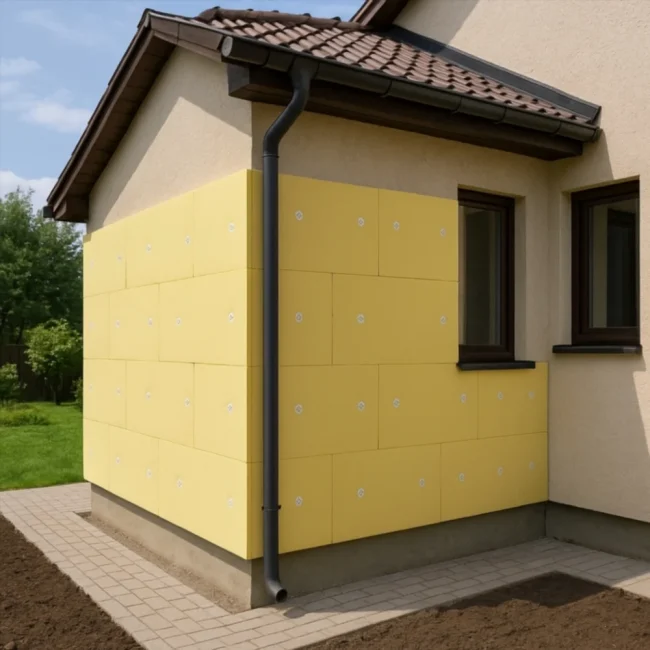
- Covering with reinforcing meshand application of plaster - for facades.
- Using a vapor barrier membrane- indoors.
- Mandatory protection from UV rays and moisture, especially when insulating with foam or XPS.
Conclusion: When is 50mm a reasonable solution?
Insulating a house with a 50 mm layer is a compromise solution that may be justified in certain cases:
- Internal insulation in limited space;
- Modernization of old insulation;
- Insulation of auxiliary and non-residential premises;
- Use of high-performance materials with low thermal conductivity.
But for full insulation of walls, especially in cold climate zones,this thickness is not enoughTherefore, it's important not only to choose the material and insulation thickness, but also to evaluate the entire thermal envelope of the house—walls, windows, roof, and foundation—as a whole. Only then can you ensure a warm, energy-efficient, and durable home.