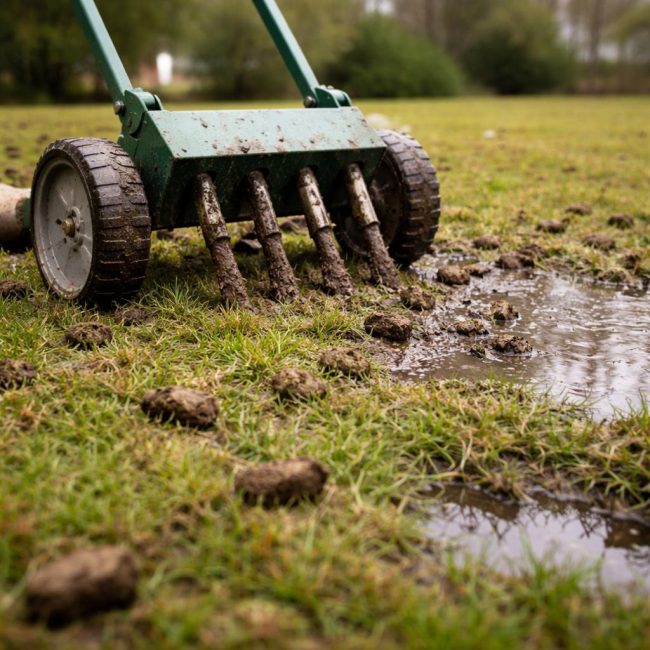
After winter, a lawn often looks tired: water pools in places, the grass is sparse, the roots seem to be struggling to grow, and the surface feels compact, like a compacted path. At this point, the property owner faces a practical question directly related to the improvement of the house and grounds:Will spring aeration help restore your lawn or will it just create new problems?This is the question that the entire subsequent conversation will focus on.
- Soil Compaction: The Hidden Cause of Spring Lawn Problems
- Why spring seems like a logical time to intervene
- What exactly changes in a lawn after aeration – without simplifications
- Situations in which spring aeration is really justified
- When spring aeration becomes a source of new problems
- Why the effect of aeration is often overestimated
- Relationship of aeration with other site development decisions
- Common Mistakes in Understanding Spring Aeration
- How to think about aeration in the context of long-term care
Soil Compaction: The Hidden Cause of Spring Lawn Problems
Most spring lawn problems aren't directly related to the grass. They start lower down—in the soil. Over the winter, the soil compacts under the influence of snow, ice, and meltwater, especially in areas with clay soils and heavy use. Air is forced out of the pores, water stops penetrating, and the roots find themselves in an environment where they simultaneously lack oxygen and struggle to absorb moisture.
This condition isn't always immediately noticeable. The lawn may be green, but also "flat," with slow recovery from stress and uneven growth. In the spring, this compaction becomes the backdrop against which any subsequent measures—from fertilizing to overseeding—have little effect.
Why spring seems like a logical time to intervene
Spring is perceived as a time of renewal, and for good reason. The soil is still moist, the grass is entering its growth phase, and damage is visually noticeable. It seems that intervention now is the fastest way to "rejuvenate" the lawn. But this feeling also has a downside:spring soil is most vulnerable to mechanical impact.
Unlike in summer, when the turf is already formed and stable, in spring the root system is weakened by winter. Any intervention that disrupts the soil structure too abruptly or inappropriately may not improve aeration but instead further damage the roots and turf.
What exactly changes in a lawn after aeration – without simplifications
Aeration is often thought of as "breathing for the lawn," but in practice, its effect is far more complex. Punctures or soil sampling temporarily increase pore volume, improve air and water movement, and reduce surface soil tension. However, this effectis not long-lasting in itself.
If the soil is prone to compaction and the lawn is heavily used, the structure begins to return to its original state within a few weeks. Therefore, aeration is not a stand-alone solution, but an intervention that only works within a specific context: the presence of stable turf, proper drainage, and continued restoration of the soil structure.
Situations in which spring aeration is really justified
There are scenarios in which spring intervention is logical and justifiable from a site-use perspective. For example, if water lingers on the surface for a long time after the snow melts, and the lawn becomes waterlogged and yellowed in patches. Or if the grass in frequently used areas is sparse, and the soil underfoot feels like a dense slab.
In such cases, aeration does not cure the lawn on its own, butcreates a window of opportunity: the soil begins to absorb moisture and air, the roots get a chance to recover, and subsequent measures begin to work more noticeably.
When spring aeration becomes a source of new problems
It's equally important to understand when spring aeration isn't just useless, but harmful. If the soil is still waterlogged and hasn't regained its load-bearing capacity, any mechanical action will collapse the structure rather than loosen it. This may look like a "treated lawn," but in reality, the pores collapse and the turf is damaged.
Another risk is aerating a young or weakened lawn. Where the root system is shallow and unstable, aeration disrupts the turf's bond with the soil. As a result, the lawn takes longer to recover, bald spots appear, and weeds gain a competitive advantage.
Why the effect of aeration is often overestimated
A common misconception is expecting immediate visual improvement. In practice, aeration rarely improves a lawn's appearance on its own. In fact, it can actually worsen its appearance in the short term: the surface becomes uneven, the grass appears disheveled, and traces of the intervention are visible.
The real effect manifests itself later and indirectly—in the lawn's ability to recover, grow evenly, and respond to care. If the site's management regime remains unchanged after aeration and the soil structure continues to degrade, the difference quickly disappears.
Relationship of aeration with other site development decisions
A lawn isn't an isolated element, but rather part of the overall site system. Slopes, drainage, soil type, and intensity of use all influence the outcome. Spring aeration can temporarily compensate for layout deficiencies, but it doesn't replace them.
If water regularly accumulates in the same spots or the soil is constantly compacted by foot traffic, aeration becomes a cyclical "patch." In this scenario, it acts as a symptomatic measure rather than a solution to the underlying cause.
Common Mistakes in Understanding Spring Aeration
One of the most common mistakes is aerating "just because it's spring." Without assessing the condition of the soil and lawn, this becomes a ritual rather than a conscious action. Another mistake is viewing aeration as a universal way to revive a lawn, ignoring other factors: light, soil composition, and soil load.
Confusion is also common: aeration is confused with loosening or lawn restoration in general. As a result, expectations don't match reality, and disappointment is attributed to a "failing technology."
How to think about aeration in the context of long-term care
When viewed as a landscaping project rather than a one-time project, aeration becomes a tool for tuning, not for saving. In the spring, it may be appropriate if it addresses a specific problem, such as compaction and waterlogging. But it doesn't replace a systematic approach to soil and site management.
In this sense, spring aeration is not a mandatory step, butconscious choice, which is only justified when the cause and expected effect are clear. A lawn, like a house, responds better to a logical sequence of solutions tailored to the site's actual conditions rather than to drastic interventions.