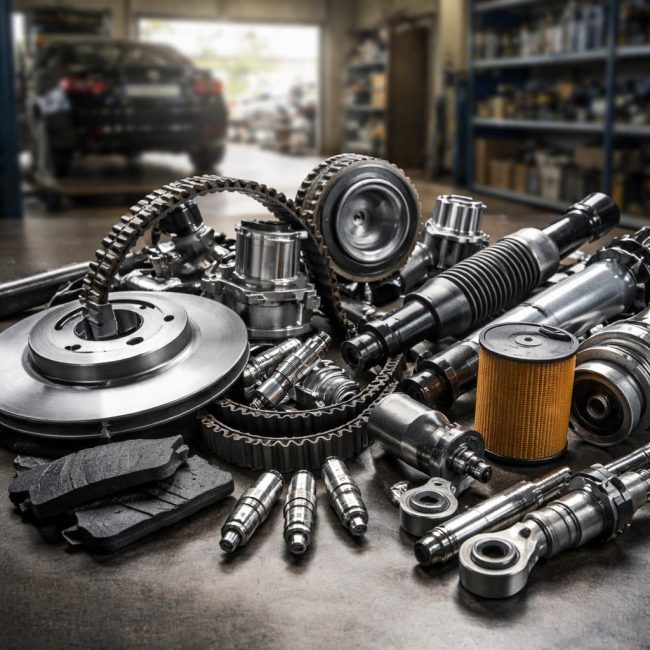
A car's reliability directly depends on the condition of its components. Even the most robust structure eventually requires replacement of individual parts, at which point the owner faces the question of what types of auto parts are available and how to make the right choice. The market offers a variety of solutions, from original parts to alternatives that vary in price, quality, and service life.
Modern car enthusiasts may need to select components for both foreign cars and mass-produced domestic models. For example, VAZ parts are no longer in short supply and are available in various categories, clearly demonstrating the importance of understanding the classification of auto parts and their features.
- Main types of auto parts
- Original auto parts (OEM)
- Aftermarket Parts
- Contract and remanufactured parts
- Universal and analog spare parts
- Classification of auto parts by purpose
- Engine and transmission
- Suspension and steering
- Brake system
- Electrical and electronics
- Body parts and interior
- How to choose the right auto parts
- Balance of price and resource
- Result
Main types of auto parts
All automotive parts are divided into several groups. Each has its own advantages and limitations, which should be considered when purchasing and installing them.
Original auto parts (OEM)
Genuine parts are those manufactured directly by the automaker or commissioned by it. They fully comply with factory standards and are installed on the vehicle during assembly.
Advantages:
- full compatibility with a specific model;
- expected service life;
- stable quality of materials and assembly.
Flaws:
- high cost;
- limited choice for older generation cars.
Genuine spare parts are most often chosen for new vehicles or when repairing critical components where errors are unacceptable.
Aftermarket Parts
This category includes parts produced by third-party manufacturers. Their selection is significantly wider and the price range is significantly lower.
Pros:
- affordable price;
- wide selection of brands and modifications;
- availability of improved or reinforced versions of parts.
Cons:
- quality depends on the manufacturer;
- Deviations in resource and manufacturing accuracy are possible.
Non-original solutions include both budget options and products comparable to the original in terms of characteristics.
Contract and remanufactured parts
Contract parts are those removed from low-mileage vehicles. These are most often cars written off after accidents or for insurance reasons.
Reconditioned parts are disassembled, wear parts are replaced, and then reassembled.
Peculiarities:
- the cost is lower than that of a new original part;
- the resource may be partially used up;
- It is important to assess the condition before installation.
Such spare parts are often used when repairing units with high cost of new components, such as engines or gearboxes.
Universal and analog spare parts
Universal parts are suitable for several car models or even different brands. These can include filters, suspension components, and consumables.
Analogue spare parts replicate the shape and function of the original ones, but are manufactured using the manufacturer's own technologies.
When properly selected, such parts can ensure stable operation of the vehicle without significant compromises.
Classification of auto parts by purpose
Besides their origin, parts also differ in their functionality. This helps us more accurately determine which components require special attention.
Engine and transmission
This group includes pistons, rings, timing belts and chains, clutches, and transmission components. Errors in selection here can lead to serious failures, so priority is given to proven brands and precise tolerances.
Suspension and steering
Shock absorbers, control arms, ball joints, and tie rods directly affect handling and safety. It's important to consider your driving style, road conditions, and the vehicle manufacturer's recommendations.
Brake system
Brake pads, rotors, calipers, and hoses are critical components. Cutting corners here is undesirable, and the choice should be based on technical specifications and real reviews.
Electrical and electronics
Sensors, control units, starters, generators, and lighting components require precise alignment with vehicle parameters. Even minor discrepancies can lead to system malfunctions.
Body parts and interior
Fenders, bumpers, headlights, and interior components are often selected based on appearance and mounting compatibility. Similar and remanufactured options are common in this segment.
How to choose the right auto parts
Selecting a part begins with accurately identifying the vehicle model, year, engine type, and trim level. Part numbers play a key role and help avoid errors.
It's equally important to consider operating conditions. Standard components are suitable for city driving, while heavier-duty versions are better. The manufacturer's reputation is an additional guide. Many auto parts companies specialize in specific vehicle systems, achieving high quality in their niche.
Balance of price and resource
A low price doesn't always mean a good deal. A part with a limited lifespan may require replacement soon, which ultimately increases overall costs. On the other hand, buying the most expensive original isn't always justified.
The optimal approach is to assess:
- the importance of the node for security;
- difficulties of replacement;
- expected resource;
- vehicle operating conditions.
This analysis allows you to select auto parts that will operate reliably and without unnecessary costs.
Result
The wide variety of auto parts gives car owners freedom of choice, but it also requires a careful approach. Understanding the differences between genuine, aftermarket, aftermarket, and universal parts helps make informed decisions. Proper selection of components, taking into account their intended use, quality, and service life, ensures stable vehicle operation, extends its service life, and reduces the risk of unexpected breakdowns.