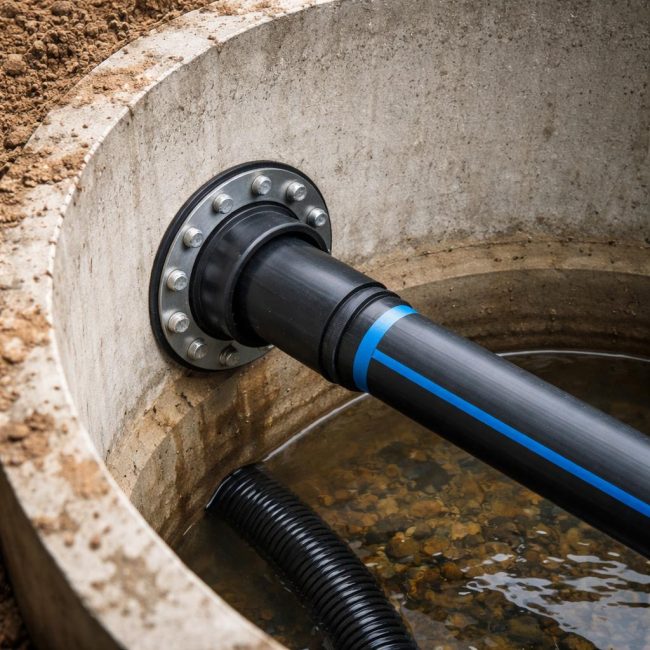
Water supply from a well or central water supply rarely ends with laying the pipe across the site. One of the most critical sections of the system is the HDPE pipe entry into the well. This is where various media intersect: soil, concrete or well rings, a moving pipe, and a fixed structure. Errors at this stage may go unnoticed for a long time, but over time they can lead to leaks, foundation erosion, freezing, or accelerated wear of the pipeline.
The topic of inserting HDPE pipes into wells is a sound engineering practice and is well described within the editorial material: this is not an isolated incident, but a typical water supply unit used in individual housing construction.
- The role of the pipe entry in the water supply system
- Why does PND require a special approach?
- Location of the inlet relative to the water level and freezing
- The main methods for inserting HDPE pipes into a well
- Passage through the sleeve
- Sealed entry with rubber cuffs
- Combined solutions
- Sealing as a key element of the unit
- The influence of soils and foundation movements
- Common misconceptions about input devices
- Connection of input with further operation of the system
The role of the pipe entry in the water supply system
A well in a water supply system serves more than just access to water. It is often used as a location for shutoff valves, filters, adapters, or connections to internal piping. The HDPE pipe entry connects the underground pipeline to the well's interior and must simultaneously ensure watertightness, mechanical stability, and compensation for ground movement.
Unlike metal pipes, HDPE is flexible and sensitive to point loads. Therefore, the entry unit must take into account the material's properties and not simply replicate the solutions used in older concrete or steel systems.
Why does PND require a special approach?
Low-density polyethylene tolerates water pressure and seasonal temperature fluctuations well, but it is susceptible to deformation. If the pipe is rigidly fixed to the well wall without compensation, ground movement can cause stress at the penetration site.
An additional feature is the smooth surface of HDPE. While this reduces the risk of corrosion and fouling, it also complicates the creation of a reliable, sealed assembly without specialized solutions. Simple cement grouting, a common practice in the past, is not durable for HDPE pipes.
Location of the inlet relative to the water level and freezing
The location of the HDPE pipe entry into the well is not chosen randomly. It must be below the frost line to prevent the risk of ice plugs. At the same time, the entry point should not be located too low, so as to avoid constant contact between the pipe and groundwater or surface water within the well.
In practice, the optimal location is considered to be the entry at a level that allows for easy maintenance of the connection from inside the well, without having to reach the water table. This location simplifies pipe inspection and reduces the likelihood of hidden leaks.
The main methods for inserting HDPE pipes into a well
In the practice of individual construction, several sustainable solutions are used, differing in the degree of tightness and complexity of execution.
Passage through the sleeve
One of the most reliable options is to use a sleeve pre-inserted into the well wall. The sleeve is a section of larger diameter pipe through which a HDPE pipe is passed. The space between them is filled with an elastic seal.
This approach allows the pipe to shift slightly with ground movement without damaging the well wall or compromising the seal. The sleeve is especially suitable for wells made of concrete rings, where rigid fixation is undesirable.
Sealed entry with rubber cuffs
Modern systems offer ready-made sealed entries with rubber or polymer cuffs designed for a specific HDPE pipe diameter. The cuff tightly compresses the pipe and secures it in the manhole opening.
The advantage of this solution is predictable sealing and neat installation. The disadvantage is its dependence on precise dimensions and the quality of the well wall. Uneven concrete or misaligned rings can reduce the effectiveness of the seal.
Combined solutions
In some cases, a combination of a sleeve and a cuff is used: the pipe passes through the sleeve, and the seal is achieved by an elastic element on the inside of the well. This option is often used during the renovation of old wells, where it is impossible to design a perfect opening in advance.
Sealing as a key element of the unit
A well's watertight seal is important not only to prevent water leaks from the system. Equally important is protecting the well from groundwater and surface water. A poor-quality well seal becomes a conduit for contaminants, especially during spring floods.
Flexible seals are preferable to rigid mortars because they retain their properties despite seasonal deformations. However, excessive rigidity of the assembly increases the risk of cracks in the well wall.
The influence of soils and foundation movements
Soil type directly impacts the requirements for HDPE pipe installation. In heaving soils, seasonal movements are more pronounced, and rigid solutions fail more quickly. Here, it's especially important to allow for micro-movements of the pipe without losing its seal.
In stable sandy soils, the load on the inlet is less; however, even in this case, failure to compensate for movements over time leads to localized damage to the pipe or concrete.
Common misconceptions about input devices
One common misconception is that HDPE pipe is inherently flexible enough to require no special fittings. In practice, the material's flexibility doesn't compensate for its rigid anchorage in concrete.
Another common simplification is to use regular cement mortar to seal the hole. This solution may appear secure immediately after installation, but over time it loses its seal due to differences in the expansion coefficients of the materials.
Connection of input with further operation of the system
The quality of the HDPE pipe's entry into the well directly impacts the ease of maintenance of the entire system. A sealed and well-designed unit reduces the risk of emergency repairs, facilitates pipe or fitting replacement, and allows for monitoring of the water supply without opening the ground.
As a result, the inlet becomes more than just a technical detail, but an element that determines the longevity and sustainability of the entire site's water supply system. Understanding its role helps avoid hidden problems that become apparent years after construction is completed.