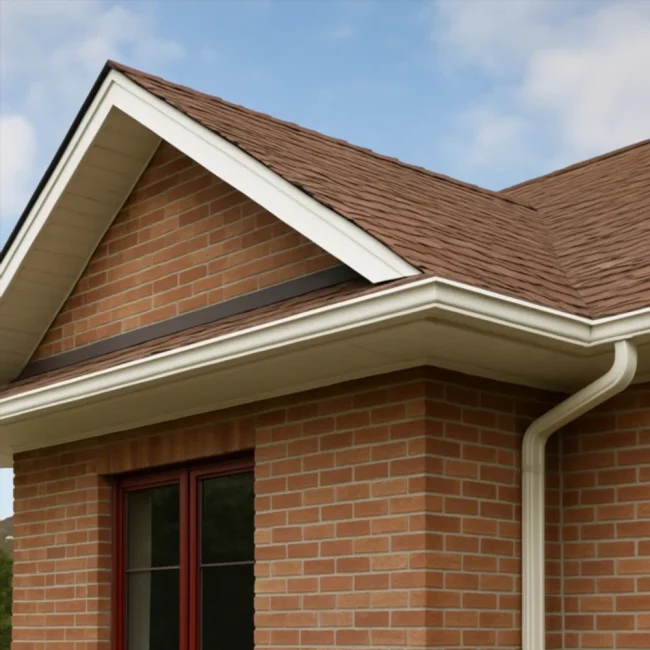
One of the most important parameters when constructing or renovating a roof is the roof overhang. Although it seems like a simple structural element, it plays a crucial role in protecting the building's façade from precipitation, contributes to the durability of the walls and foundation, and influences the aesthetic appearance of the entire structure. In this article, we'll explore in detail what roof overhang is, the regulations that apply, how it's calculated, what determines its size, and what practical considerations should be made when configuring the overhang.
- What is the roof overhang from the wall?
- Main types of roof overhang
- Regulatory requirements for roof overhang
- What does the overhang size depend on?
- Roof overhang calculation
- Design features of the departure device
- Wooden roof
- Brick and block houses
- Hemming and finishing of the extension
- Errors in design and installation of the overhang
- Recommendations for arrangement
- Conclusion
What is the roof overhang from the wall?
Roof overhang— is the horizontal section of the roof overhang that projects beyond the outer plane of the building wall. It can be either a rafter overhang (in wooden structures) or a specially designed element attached to the wall plate or sheathing.
Functionally, the overhang performs several tasks at once:
- Protection of walls from rain and snow;
- Preventing moisture from entering the foundation area;
- Formation of shade and protection of windows from overheating in summer;
- Aesthetic design of the building architecture;
- Possibility of installing lining, ventilation holes and lighting.
Main types of roof overhang
Roof overhangs may vary depending on the roof structure and architectural features of the house:
- Cornice projection
Located horizontally along the lower edge of the slope. This is the most common type, especially for houses with gable or hip roofs.
- Pediment overhang
It is placed on the sides of the house where the slopes do not extend beyond the walls. It is most often found on gable roofs.
- Visor overhang
A separate element, often used above the entrance, windows or balconies.
- Complex (volume) departure
Combines several functions: from a canopy to fastening decorative elements of the facade.
Regulatory requirements for roof overhang
In Russian construction, roof overhang is regulated by a number of regulatory documents:
- SP 17.13330.2017 "Roofs"— specifies the minimum parameters and recommendations for roof construction.
- SP 31-105-2002 "Design and construction of houses"— contains data on residential buildings, including private ones.
- SNiP 2.01.07-85 "Loads and Impacts"— is important for calculating snow and wind loads, on which the overhang length depends.
The minimum roof overhang in most cases is0.3 meters, but in practice they most often do it from50 to 70 cm, depending on the region, building height and climatic conditions.
What does the overhang size depend on?
The roof overhang size is not arbitrary - it is determined by a number of factors:
- Climate zone
In regions with heavy rainfall or strong winds, the overhang is increased to better protect the facades.
- Type of roofing material
The installation of metal tiles, flexible tiles or slate involves various fastening methods and permissible overhang lengths.
- Width of the plinth and blind area
The overhang must completely cover not only the wall, but also the blind area, especially in houses with a shallow foundation.
- The architectural style of the house
Modern minimalist house designs often feature small overhangs, while in classic and Russian styles they can reach 1 meter or more.
- Availability of a storm drainage system
If there are gutters, the overhang should ensure their correct positioning and drainage of water to the desired point.
Roof overhang calculation
To roughly calculate the departure, use the following formula:
W = (H × K) + M
Where:
W— extension length (in mm);
H— wall height;
K— climate region coefficient (from 0.1 to 0.3);
M— minimum permissible value (300 mm).
However, in reality, the calculation must take into account:
- snow load (according to the SNiP map);
- wind load (especially in tall buildings);
- weight and length of the rafter leg;
- permissible bending of wooden elements (for wooden roofs).
It's also important to consider ergonomics—the overhang shouldn't interfere with free movement around the house or the installation of façade elements.
Design features of the departure device
Wooden roof
For wooden houses, the natural rafter overhang is most often used. The ends of the rafters are simply extended beyond the wall to the desired length, then trimmed and hemmed.
Advantages:
- Ease of implementation;
- Strength;
- Aesthetics of natural wood.
Brick and block houses
Here, the sheathing is extended or cantilever brackets are installed to which the roofing sheet is mounted. Metal corners, wooden braces, or anchors are often used.
Peculiarities:
- Careful insulation of the adjoining area is required;
- A waterproofing coating (for example, a drip cap and valley) is required.
Hemming and finishing of the extension
The lining is made from various materials:
- Lining (wood, PVC);
- Soffits (perforated panels);
- Plastic panels;
- Metal (corrugated sheet).
It is important to ensureventilation— the presence of perforations or ventilation grilles will prevent the accumulation of condensation and extend the service life of the rafter system.
Errors in design and installation of the overhang
- Too short overhang
Water will flow down the facade, washing away the blind area and destroying the base.
- Lack of a drip
Even with a large overhang, if there is no drip cap, water can leak under the roofing material.
- Weak fastening
Particularly in houses with strong wind loads, the extensions must be securely fixed.
- Incorrect hemming
Sealed sheathing without ventilation can lead to rotting of rafters and formation of mold.
- Incorrect drainage system
The projection must be consistent with gutters, funnels and pipes.
Recommendations for arrangement
- Minimum recommended reach -60 cm;
- UseIV dripalong the entire length of the overhang;
- Sew the overhangperforated materials;
- When arranging an attic, don't forget aboutthermal insulation of the departure area;
- Calculate carefullysloperoofing, it affects the water runoff zone;
- Do itfireproof finishing, especially if a wooden house is used.
Conclusion
The roof overhang is more than just an aesthetic element; it's a vital functional component of any building. Its proper design determines the durability of the façade, the efficiency of the drainage system, and the overall appearance of your home. Ignoring this aspect when designing a roof means creating potential problems for years to come. Therefore, during construction or renovation, it's important to pay special attention to the calculations, selection of materials, and installation technology for the overhang.
A properly installed overhang guarantees dry walls, a durable foundation, and a neat appearance for your home for years to come.