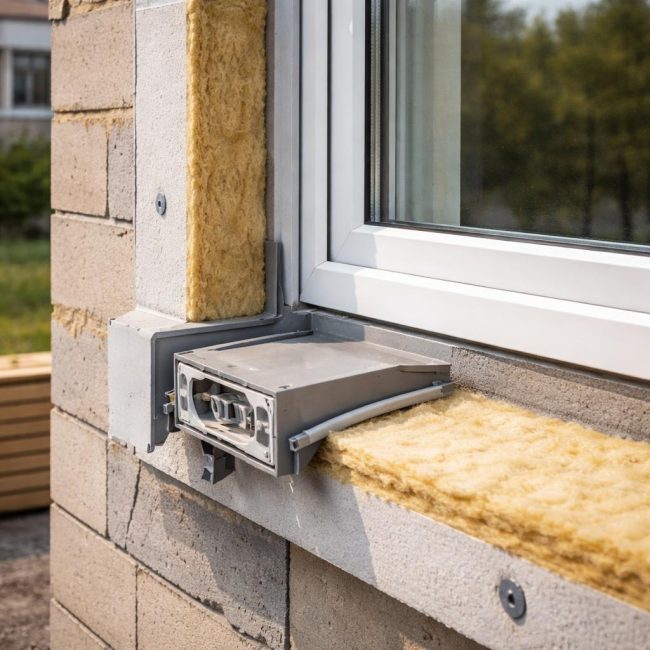
In modern low-rise and multi-apartment construction, the position of the window frame is considered not as a secondary detail, but as an element of the building's thermal design. One commonly used technique is to move the window into the insulation zone. This isn't a decorative shift of the frame, but a fundamental change in its position relative to the load-bearing wall and the thermal insulation layer. This approach is used in the design of energy-efficient homes and in façade renovations, where it's important to reduce heat loss without complicating the design.
- Where is the "insulation zone" and why does window position matter?
- Thermal engineering logic for window block removal
- Effect on dew point and humidity conditions
- Constructive methods for implementing the extension
- Connection of window extension with the facade insulation system
- Limitations and design risks
- Common misconceptions about window removal
- When is window removal justified and when is it excessive?
- Expanding the context: the window as part of the thermal circuit
Where is the "insulation zone" and why does window position matter?
In a classic wall with external insulation, the thermal insulation is located outside the load-bearing layer, creating a continuous thermal envelope. The window can be installed in various planes: flush with the inner wall surface, within the load-bearing material, or closer to the outer edge. The insulated zone is the area where the temperature changes most smoothly across the wall cross-section, avoiding sharp fluctuations.
If a window unit is installed deep in a cold part of the wall, its slopes and mounting joint are exposed to unfavorable conditions. In these areas, the risk of condensation increases, linear heat loss increases, and the effectiveness of the insulation itself is reduced. Offsetting the window toward the thermal insulation layer allows the window opening to be integrated into the building's overall thermal envelope.
Thermal engineering logic for window block removal
The main purpose of a window extension is to reduce the so-called thermal bridge around the perimeter of the opening. In a standard design, the window frame is exposed to cold outside air through the wall, and the insulation only partially covers this area. As a result, heat escapes not only through the glass unit but also through the slopes.
When the window is moved into the insulation zone, the frame is surrounded by thermal insulation on the outside and partially on the slopes. The temperature on the inner surfaces of the opening rises, the heat distribution is evened out, and the installation joint operates under more stable conditions. This does not increase the thermal resistance of the insulated glass unit, but it significantly reduces losses along the perimeter.
Effect on dew point and humidity conditions
Window placement is directly related to the dew point within the structure. When a frame is installed in a cold zone, the temperature in the joint area can drop below the critical value, leading to periodic moisture buildup in the joint and interior reveals. Even with a high-quality vapor barrier, this creates the conditions for material degradation.
Extending the window shifts the colder temperature zone outward, closer to the insulation layer. The interior surfaces of the opening remain in a warmer area, reducing the likelihood of condensation and maintaining a stable humidity level. This effect is especially noticeable in buildings with high internal humidity—for example, in buildings with dense building envelopes and inadequate ventilation.
Constructive methods for implementing the extension
Moving a window into the insulation zone requires a support capable of supporting the weight of the window frame and wind loads. Several solutions are used in practice, depending on the wall material and the thickness of the insulation.
A common option is to use special mounting frames or brackets secured to the load-bearing wall. These extend the installation plane beyond the load-bearing wall and create a rigid support for the window frame. In brick and concrete walls, such elements are calculated taking into account the loads and the spacing of the fasteners.
In low-rise construction, wooden or composite subframes integrated into the insulation system are sometimes used. It is important that the subframe material has sufficient load-bearing capacity and does not create a significant thermal bridge. An error at this stage negates the thermal benefits of the extension.
Connection of window extension with the facade insulation system
Window extensions cannot be considered separately from the façade system. They are closely linked to the type of insulation—plaster or ventilated. In plaster façades, the window is typically extended so that the insulation overlaps part of the frame, creating a warm slope. This requires precise sizing and careful work with the joints.
In ventilated facades, the window is often positioned in the same plane as the insulation, and the cladding forms an additional protective layer. Particular attention is paid to the junctions with the facade substructure and protecting the assembly joint from drafts. Incorrect detailing leads to localized heat loss, despite the window's formally "correct" position.
Limitations and design risks
Window overhangs increase the requirements for fastening calculations and installation quality. The further the frame extends from the load-bearing wall, the higher the bending moments at the fastening points. This is especially critical for large window openings and panoramic structures.
Another risk is related to geometric stability. An improperly installed support can become deformed over time, leading to frame distortion and hardware failure. Therefore, window offsetting cannot be considered a universal solution, applicable without considering the specific conditions of the building.
Common misconceptions about window removal
It's a common belief that simply moving a window automatically makes a house warmer. In practice, this effect only manifests itself when combined with continuous insulation and properly installed joints. If the insulation is interrupted or the joint is not protected from moisture and air, moving the window will not produce the desired effect.
Another misconception is related to aesthetics. Sometimes, offsetting is perceived as an architectural technique that merely affects the depth of the slopes. In reality, it is primarily an engineering solution, and its visual impact is secondary to thermal and structural requirements.
When is window removal justified and when is it excessive?
Window extensions are most effective in buildings with substantial external insulation and high energy efficiency requirements. In these conditions, they allow window openings to be aligned with the thermal envelope without the need for complex compensating measures.
In buildings with thin insulation or during renovations without changing the façade system, overhang may prove excessive. Sometimes, a more rational solution is to improve the quality of the assembly joints and slopes without changing the frame's position.
Expanding the context: the window as part of the thermal circuit
Examining the window's relocation into the insulation zone reveals that the window unit is no longer an isolated element. It has become part of the overall thermal design, where not only the glass unit's performance is important, but also its placement within the wall structure. Window relocation is a way to align various building envelope elements into a unified system, where each component operates under predictable conditions.
This approach requires project thinking and an understanding of physical processes, but it avoids many hidden problems that become apparent during operation. It is in this context that window extensions should be viewed not as a fashion trend, but as a logical development in building insulation practices.