Attending international construction events in Japan requires careful preparation. First and foremost, Russian specialists must obtain a Japanese visa, which is essential for attending the major industry exhibitions in Tokyo and Osaka. However, those who overcome the bureaucratic hurdles find themselves in a unique environment where they can discover the most advanced solutions in water supply, plumbing, and utility systems.
Events such as Japan Home & Building Show, EcoHouse & EcoBuilding Expo Trade shows, or specialized plumbing equipment exhibitions, annually attract tens of thousands of professionals. These are where developments are showcased that, within a few years, become standards in many countries.
Water as a Resource: A Japanese Perspective
Japan has historically viewed water as a strategic resource. Despite being surrounded by the sea, fresh water is scarce, and its dense population and high land costs dictate the need to conserve every drop. This directly impacts engineering decisions.
At exhibitions, Japanese companies showcase technologies aimed not only at comfort but also at maximizing resource efficiency:
- water reuse systems (e.g. filtration and return of wastewater for technical purposes);
- touch faucets that automatically regulate pressure and temperature;
- pipes and fittings with an extended service life, designed for operation in aggressive environments.
Innovative materials for pipes
One area that consistently attracts the interest of specialists is new pipeline materials. In Japan, the following are actively developing:
- Multilayer composites. Lightweight, corrosion-resistant and designed to last for decades without replacement.
- Antibacterial coatings. They prevent the formation of plaque and the proliferation of microorganisms inside the system.
- Flexible pipelines. A solution for multi-story buildings where minimizing vibration and noise during water supply is important.
Japanese engineers emphasize the combination of compactness and reliability, which is especially important in the limited space of large cities.
Smart water supply systems
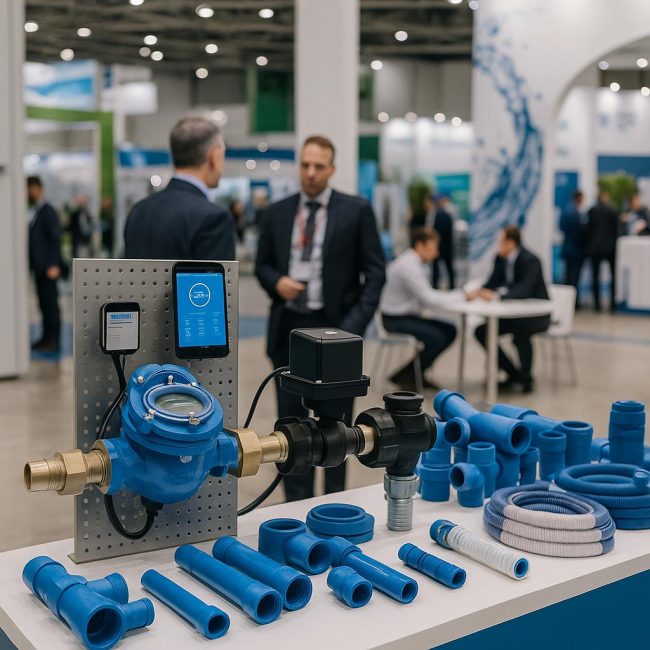
At exhibitions in Tokyo, you can see how the integration of digital technologies is changing the approach to water supply. Modern Japanese homes are equipped with entire networks of sensors that:
- monitor water pressure and temperature in real time;
- detect leaks at early stages;
- automatically shut off the supply in emergency situations.
In addition, solutions for integrating water supply into smart homes are increasingly being demonstrated—where the user controls all parameters via a mobile app.
Eco-friendliness and recycling
Particular attention is paid to environmental aspects. Japanese exhibitions feature greywater treatment systems, compact filtration and disinfection units, and innovative rainwater harvesting solutions.
Japanese companies offer:
- mini-treatment stations that can be installed in private homes;
- technologies for recycling water for use in technical purposes (e.g. irrigation or flushing);
- pipelines made from recycled materials without loss of quality.
What Russian specialists can learn
For engineers and repair technicians, participation in Japanese exhibitions is an opportunity to adopt practices that help conserve resources and improve system reliability.
Here are some ideas you can implement today:
- Use of flexible and composite pipes to reduce the risk of accidents.
- Installation of automatic leak detection sensors even in small apartments.
- Save water with touch-sensitive faucets and recirculation systems.
- Using pipes with antibacterial coating to improve water quality.
Why is this important for the future?
The global trend is for water supply technologies to become increasingly environmentally friendly and intelligent. Japan is playing a leading role in this process. What's being demonstrated in Tokyo today will appear in Europe within a few years, and then gradually in Russia.
Therefore, by obtaining a Japanese visa and attending such exhibitions, specialists gain direct access to a source of knowledge and practical experience. For companies, this is a chance to strengthen their competitiveness, and for rank-and-file professionals, an opportunity to broaden their professional horizons.
Conclusion
Japanese exhibitions are more than just a showcase for products; they're a platform for shaping future standards in water supply and engineering systems. Here, you can see how cutting-edge materials, digital technologies, and an environmentally friendly approach harmoniously combine.
While visas and travel expenses may seem expensive, the experience and knowledge a specialist gains pays off many times over. After all, it's in Japan today that solutions are being born that will shape the world of renovation, construction, and utilities tomorrow.