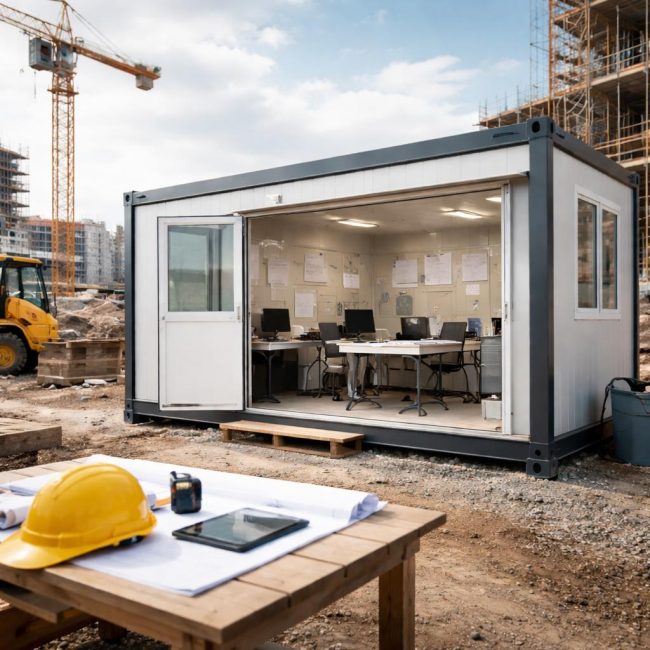
A modern construction site involves more than just equipment, materials, and work crews. It also involves constant work with documentation, schedules, contractors, and regulatory authorities. That's why, even in the first days of a project's launch, a mobile office is increasingly being set up, becoming a fully-fledged construction management center right on-site.
Unlike older-style temporary buildings, mobile offices are well-designed metal structures designed for long-term use, comfortable work environments, and quick adaptation to specific project needs. Below, we'll explore in detail why this format has become the standard for construction sites and the tangible benefits it offers.
- Why do you need an office directly at the construction site?
- How is a mobile office different from a regular construction trailer?
- The main tasks of a mobile office on a construction site
- Construction process management
- Working with documentation
- Conducting meetings
- Control and acceptance
- The economic benefits of a mobile office
- Reducing rental costs
- Quick commissioning
- Multiple use
- Comfortable working conditions for staff
- Flexibility and adaptation to a specific project
- Logistics and on-site accommodation
- Security and safety of information
- When a mobile office is especially worthwhile
- Result
Why do you need an office directly at the construction site?
Construction is a dynamic process, where decisions are often made "here and now." If the management office is located far from the site, obvious difficulties arise:
- loss of time on travel;
- delays in approval;
- difficulties with control of contractors;
- lack of a single communications center.
A mobile office solves this problem by allowing you to set up a workspace directly on the construction site. It can be used for meetings, document storage, drawings, and customer or inspection visits, all without interrupting the ongoing work.
How is a mobile office different from a regular construction trailer?
At first glance it may seem that these are the same thing, but in practice the differences are fundamental.
Construction site trailer — this is, as a rule, a temporary room for staff: to change clothes, have lunch, and take shelter from bad weather.
Mobile office — is a workspace focused specifically on management and administrative tasks. It is distinguished by:
- improved heat and sound insulation;
- full lighting for working with documents;
- possibility of installing office equipment;
- layout designed for work places;
- more presentable external and internal appearance.
In fact, it is a full-fledged office, just implemented in a mobile format.
The main tasks of a mobile office on a construction site
Construction process management
Foremen, engineers, and project managers work in the mobile office. Schedules are created, plans are adjusted, and work and materials are recorded here.
Working with documentation
Design documentation, contracts, work logs, and as-built plans all require a dry, warm, and protected space.
Conducting meetings
It's more convenient to hold operational planning meetings and meetings with contractors and subcontractors directly on-site, without wasting time on travel.
Control and acceptance
The mobile office is often used as a point of interaction with the customer and representatives of regulatory authorities.
The economic benefits of a mobile office
One of the key arguments in favor of a mobile office is financial.
Reducing rental costs
Renting a permanent office near a construction site can be expensive, especially in large cities. A mobile solution eliminates these costs.
Quick commissioning
Unlike permanent buildings, a mobile office doesn't require lengthy construction or complex approvals. It can be installed and operational in no time.
Multiple use
Once the project is completed, the mobile office can be easily transported to a new site, making it a long-term asset for the company rather than a one-time expense.
Comfortable working conditions for staff
It's a mistake to think that comfort doesn't matter on a construction site. On the contrary, working conditions directly impact the quality of decisions made.
A modern mobile office may include:
- efficient heating for the winter period;
- air conditioning or ventilation;
- high-quality artificial lighting;
- sockets and electrical wiring for equipment;
- Possibility of internet connection and communication.
As a result, employees work in normal office conditions, rather than on their knees.
Flexibility and adaptation to a specific project
Another important advantage is flexibility. A mobile office can:
- select the required size;
- equip with the required number of workstations;
- divide into zones (office, meeting room, archive);
- to be completed as the project grows.
For small projects, a compact solution is sufficient, while for large construction projects, modular offices consisting of several units are used.
Logistics and on-site accommodation
Mobile offices are designed taking into account real construction site conditions:
- installation is possible on a prepared base without a permanent foundation;
- the design is designed for transportation;
- multiple movements within one object are allowed;
- minimum requirements for connecting communications.
This is especially important at stages when the construction site layout is constantly changing.
Security and safety of information
Construction documents and equipment require protection. Mobile offices include:
- metal structures with increased strength;
- reliable doors and locks;
- possibility of installing an alarm system;
- protection from moisture and temperature changes.
This makes the office a safe place to store important data and equipment.
When a mobile office is especially worthwhile
Using a mobile office is most effective in the following cases:
- construction of remote facilities;
- temporary or staged projects;
- large construction projects with a large number of contractors;
- objects with long implementation periods;
- work in difficult climatic conditions.
In all these situations, having an office directly on site significantly simplifies management.
Result
A mobile office on a construction site isn't a temporary whim, but a practical project management tool. It helps reduce costs, speed up processes, enhance control, and create optimal working conditions for key specialists.
This is why mobile offices are becoming a standard feature of modern construction sites, not the exception. They combine mobility, functionality, and cost effectiveness—three key factors for successful construction.