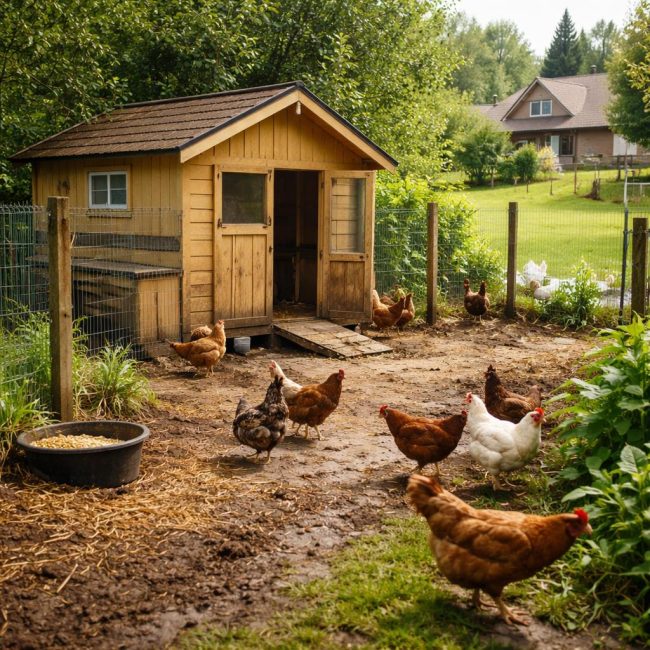
The idea of owning your own eggs usually comes suddenly, along with a sense of simplicity: set up a chicken coop, buy some birds, and off you go. But in practice, the main question is different:What changes will need to be made to the house and property if chickens appear not "somewhere" but near the living space?The answer to this question determines whether the household will become a stable part of everyday life or a source of constant compromise.
- Why chickens are primarily a question of arrangement, not poultry farming
- How a chicken coop affects the site and house already in the first season
- Why temporary solutions almost always become permanent
- Connection of the chicken coop with the site's engineering solutions
- How the rhythm of use of the yard and utility areas is changing
- Limitations that are rarely thought about in the beginning
- Typical distortions of understanding that prevent you from making the right decision
- What ultimately determines a successful start?
Why chickens are primarily a question of arrangement, not poultry farming
Chickens don't require sophisticated equipment, but they immediately interfere with the layout of the property. A constant odor, a new rhythm of noise, humidity, litter, and the movement of organic matter appear. All of this begins to interact with the house, paths, outbuildings, and engineering solutions. The error here isn't in the feeding or breed, but in viewing chickens as "animals" rather than asa new functional element of the courtyard.
When a chicken coop is too close to the house, the microclimate around the foundation and windows changes. If it's too far away, maintenance becomes more difficult, and the house becomes annoying. The question of "where to start" in this context isn't about buying birds, but aboutthe boundary between residential and commercial.
How a chicken coop affects the site and house already in the first season
Even a small herd quickly reveals weaknesses in the layout. Wet litter increases soil moisture, which affects the pavement and paths. Dust and feathers are blown about by the wind and settle where they're least expected: on the terrace, in the utility room, at the entrance to the house. Morning noise can coincide with bedroom windows, and habit alone won't correct this.
It's important to understand: chickens don't confine themselves strictly to a building. They expand their range. Therefore, even before the birds arrive, the area must be mentally "redrawn," taking into account new traffic flows, dirt, and odors. Failure to do so will result in the coop becoming a point of constant conflict with the rest of the infrastructure.
Why temporary solutions almost always become permanent
One typical situation is "let's put it here for now and move it later." In practice, moving it almost never happens. The chicken coop quickly becomes overgrown with connections, shelters, temporary decks, a walkway, and storage space. All of this becomes a single unit, which is difficult and expensive to move.
Therefore, the question of “where to start” logically comes down to another:where the chicken coop can stand for years without interfering with the house and without requiring any alterationsThis is a design decision, not a pet management one, and this is where most mistakes are made.
Connection of the chicken coop with the site's engineering solutions
Chickens add stress to systems designed without them. Organic waste requires temporary storage or disposal space, which means it interacts with compost, drainage, and site slopes. Water for cleaning and maintenance impacts drainage and soil conditions. Electricity for lighting or heating requires wiring, which is rarely installed correctly from the start.
If engineering solutions don't take this into account in advance, "temporary" extension cords, puddles, and washed-out paths appear. Over time, these become commonplace, but they are precisely what turns a simple property into a source of constant minor repairs.
How the rhythm of use of the yard and utility areas is changing
The arrival of chickens almost imperceptibly shifts habits. The yard ceases to be just a place for relaxation—it becomes a workspace with daily activities. This influences the choice of flooring, the width of passageways, the location of the utility room, and even the most convenient exit point.
If these changes aren't consciously embraced, the feeling arises that the property has "become inconvenient," when in fact, it's simply begun to serve a different function. Chickens, in this sense, are a catalyst that quickly reveals how ready the house and yard are for the blending of residential and commercial uses.
Limitations that are rarely thought about in the beginning
There are nuances that aren't immediately apparent until the first season. For example, seasonal dirt in the spring and fall is especially intense in the area where the chicken coop is located. In winter, there's the added challenge of storing bedding and organic matter. In summer, odors arise when the heat and wind blow in certain directions.
These effects aren't critical individually, but together they create a persistent background. If a location is chosen without considering these factors, the chicken coop begins to weigh on the house—emotionally and functionally. This can be corrected later, but at great expense and inconvenience.
Typical distortions of understanding that prevent you from making the right decision
People often assume that chickens are like a garden bed: set it and forget it. Or that a small number of hens doesn't affect the overall appearance of the property. In practice, even a few hens can change the way space is used more than many decorative elements.
Another misconception is to focus only on area and not on connections. It's not so much "how many meters" that matters, butHow the chicken coop connects to the house, paths, utilities, and daily routesWhen these connections are well-thought-out, housekeeping becomes a natural part of life. When they aren't, it constantly requires attention and compromise.
What ultimately determines a successful start?
The beginning of keeping chickens is not buying the birds or choosing a design. It is decidingIs the house and the plot ready to accept the new function without losing comfort?If the space is adapted for this role in advance, chickens will fit seamlessly into the home and cease to be perceived as a source of trouble.
That's why the question of "why get laying hens?" logically comes from the perspective of home and yard arrangement. Chickens, in this context, aren't the goal, but a test of how thoughtfully everything around you has been designed.