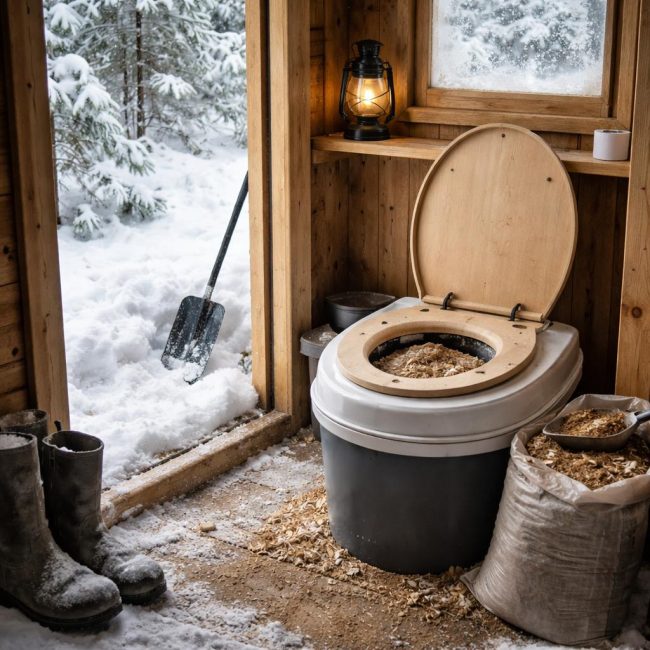
The question that most often arises among owners of country houses and summer cottages is simple:Is it possible to use a peat toilet in winter the same way as in summer, without any unpleasant consequences?This question stems not from curiosity, but from a very practical concern: freezing, odors, overflow, loss of functionality, and the risk of turning a convenient solution into a constant source of trouble. It is this practical question that defines the entire subsequent conversation.
Peat toilets are often perceived as "low-maintenance" and independent of utility lines. In the summer, this perception is usually justified. In winter, however, the system faces different conditions, and these determine whether operation is feasible or merely a formality.
- What exactly changes in winter and why is it critical?
- Temperature threshold after which restrictions begin
- Winter Smells: Where They Really Come From
- Ventilation: Why it's more important in winter than in summer
- Use in a heated house and in a cold building are different scenarios
- What happens to the contents before spring?
- Limitations that are rarely discussed in advance
- Common misconceptions that hinder adequate assessment
- When is winter use justified and when is it not?
- A winter peat toilet is a compromise, not a universal solution.
What exactly changes in winter and why is it critical?
The winter period fundamentally changes not the design of the toilet, butthe environment in which he worksA peat toilet relies on biological processes: moisture absorption, odor binding, and slow decomposition of organic matter. All these processes are temperature-sensitive.
At stable negative temperatures:
- biological activity slows down or stops completely;
- moisture stops evaporating and begins to accumulate;
- organic matter loses its ability to “self-service” and goes into storage mode.
In fact, the toilet is transformed from a recycling system intotemporary storage containerThis doesn't automatically mean you shouldn't use it, but it does radically change your expectations of the outcome.
Temperature threshold after which restrictions begin
The key point of winter operation isindoor temperature, not outside. If the toilet is located in an unheated building, the temperature inside quickly equalizes with the outside temperature.
At temperatures around zero, the system still retains some of its properties. Below that, a fundamentally different regime begins:
- peat loses its ability to absorb moisture as effectively;
- waste is not recycled but accumulates in layers;
- Local freezing of contents is possible.
It is important to understand:A peat toilet doesn't break down in the cold., it simply stops performing some of its functions until warming.
Winter Smells: Where They Really Come From
A common fear is that a peat toilet will inevitably start to smell in winter. In practice, the situation is more subtle.
Odors are not caused by the cold itself, but by a combination of factors:
- absence of active evaporation of moisture;
- overflow of the storage part;
- deterioration of natural ventilation due to cold air and draft.
In winter, odors are often perceived more acutely also because the room is closed, ventilated less often, and the person himself is more sensitive to “unnatural” impurities in the air during the cold period.
Ventilation: Why it's more important in winter than in summer
During the warmer months, the ventilation system operates almost "on its own." The temperature difference creates a stable draft. In winter, however, this mechanism becomes unstable.
Cold air:
- it's harder and harder to lift;
- can create reverse thrust;
- reduces the effectiveness of natural odor removal.
As a result, even a properly functioning system may behave differently than expected. This is one of the main reasons why a toilet that worked flawlessly in the summer suddenly starts to cause discomfort in the winter.
Use in a heated house and in a cold building are different scenarios
Winter operation varies fundamentally depending onwhere exactly is the toilet installed.
In a heated room:
- the temperature remains positive;
- biological processes do not stop completely;
- Operation is close to off-season.
In a separate unheated building:
- the system switches to accumulation mode;
- processing is postponed until spring;
- the importance of the volume and frequency of maintenance increases.
Both scenarios are acceptable, but they require different approaches and different expectations of the outcome.
What happens to the contents before spring?
In winter, waste does not disappear and is not processed “slowly” - itare cannedThis is not an emergency mode, but a natural state at low temperatures.
In spring, when temperatures rise:
- decomposition processes are resumed;
- activation of odors for a short period is possible;
- The accumulated volume requires attention.
This transitional moment is often perceived as a “malfunction”, although in fact it is a consequence of the winter break.
Limitations that are rarely discussed in advance
Winter use of a peat toilet is possible, but has objective limitations:
- It is not designed for intensive year-round use without supervision;
- the accumulation volume becomes a critical parameter;
- Comfort depends directly on temperature and ventilation, not on the model itself.
It is precisely the discrepancy between expectations and these limitations that most often becomes the source of disappointment.
Common misconceptions that hinder adequate assessment
One of the most persistent misconceptions is the expectation that a peat toilet “works the same way every time.” In fact, itadaptable to conditions, and winter is not his strong point, but a test of his tolerance for compromise.
Also often confused:
- slowdown of processes with breakdown;
- odors with design defects;
- the need for maintenance with the inconvenience as such.
Understanding these differences allows us to soberly assess the situation and not write off the system prematurely.
When is winter use justified and when is it not?
A peat toilet is justified in winter:
- with moderate and irregular use;
- in the presence of at least minimal heat or a protected room;
- if you are willing to accept it as a temporary solution.
It becomes a problem:
- in case of permanent residence without heating;
- under high loads;
- while expecting summer comfort levels in winter conditions.
A winter peat toilet is a compromise, not a universal solution.
Ultimately, the question of “can you use a peat toilet in winter” comes down not to the design, but towillingness to accept his winter work logicThis is not a refusal or a ban, but a change of regime.
Understanding that the toilet doesn't recycle but stores waste in winter, that odors are related to the physics of the air and not to "bad peat," and that spring is the moment to reset the system, you can use it without illusions and unnecessary irritation.
A peat toilet in winter isn't about the comfort of a city bathroom, nor is it a technical error. It's a conscious compromise that's either accepted or replaced by another solution, based on the actual conditions of the home and lifestyle.