In recent years, outdoor sports grounds and workout areas have become increasingly popular. People prefer to exercise outdoors, in parks and courtyards, where pull-up and parallel bars, treadmills, and exercise machines are available. However, the quality of such areas depends largely not only on the sports equipment but also on the surface used. This is why rubber surfaces for sports grounds have become a popular solution: they ensure safety, comfort, and durability of the entire structure.
Choosing the right surface is crucial, as it directly impacts workout comfort, injury prevention, and the longevity of the entire facility. Let's explore the different types, what to consider when choosing, and what mistakes are common when setting up workout areas.
- Why is it important to pay attention to the coating?
- Basic types for outdoor gyms
- Asphalt and concrete
- Artificial grass
- Natural materials (sand, soil, wood chips)
- Rubber coatings
- Types of rubber coatings
- What to look for when choosing
- Mistakes when choosing a coating
- Why is rubber flooring considered optimal?
- Result
Why is it important to pay attention to the coating?
At first glance, it might seem like the surface of an outdoor gym is a secondary element. In fact, it forms the foundation of the entire area. Consider this: training on asphalt or concrete significantly increases the stress on joints and can lead to injuries from falls. Uneven ground or sand, on the other hand, quickly deteriorates, creating mud and making exercise unsafe.
A good coating should perform several functions at once:
- Injury safety. When falling, it should soften the impact.
- Wear resistance. Considering the constant load and weather conditions, the material must maintain its strength.
- Ease of care. It is important that the coating does not retain moisture and can be easily cleaned of dirt.
- Aesthetics. The color and structure should be in harmony with the overall style of the yard or park.
Basic types for outdoor gyms
Today, there are several solutions used to create workout zones. Each option has its pros and cons.
Asphalt and concrete
- Pros: low cost, easy installation, load resistance.
- Cons: high risk of injury, heating in summer, rapid wear and tear of joints in athletes.
Artificial grass
- Pros: softness, visual appeal, suitable for team sports.
- Cons: limited lifespan, high maintenance costs, fading.
Natural materials (sand, soil, wood chips)
- Pros: eco-friendliness, low price.
- Cons: rapid contamination, uneven surface, difficulty in cleaning, increased risk of injury.
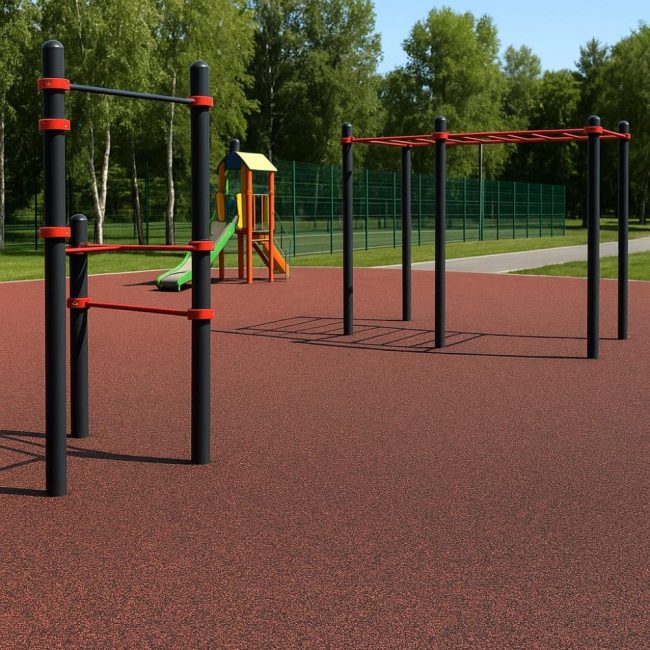
Rubber coatings
They are considered the most balanced option for modern workout areas. Rubber surfaces provide cushioning, are moisture-resistant, frost-resistant, and UV-resistant. Furthermore, they are available in a variety of colors and formats, from modular slabs to rolls.
Types of rubber coatings
Let's take a closer look at the rubber solutions used for sports grounds.
- Roll coverings.
They are easy to install, create a continuous canvas without seams, and are convenient to use in large areas. - Modular tiles.
They are easy to install and can be replaced individually if damaged. Tile thickness can be varied, allowing for the desired level of cushioning. - Seamless (bulk).
Installation is performed using a special mixture that is poured and hardened in place. It creates a perfectly smooth surface that is resistant to moisture and mechanical stress.
What to look for when choosing
To ensure your workout area lasts a long time and pleases athletes, it's important to consider several criteria when choosing a surface:
- Thickness of the material.
For high-load areas (horizontal bars, parallel bars, jumping areas), the thickness should be at least 20–30 mm. - Climate resistance.
In regions with cold winters, it must withstand temperature changes and not crack. - Shock-absorbing properties.
The better the material absorbs impact, the safer the workout. This is especially important for children's and teen playgrounds. - Easy to care for.
The rubber surface is easy to clean from debris, can be washed with water, and does not retain moisture. - Aesthetics and color.
The colored coating creates an attractive appearance and also helps to zone the area (for example, to highlight areas for running or strength training).
Mistakes when choosing a coating
Very often, typical mistakes are made when arranging outdoor sports areas:
- Saving on the thickness of the coating makes it unsuitable for intensive training.
- Choosing a material without taking the climate into account—for example, a coating that cracks in winter.
- Ignoring safety and certification requirements.
- Incorrect installation - laying on an unprepared base leads to deformation.
Why is rubber flooring considered optimal?
Rubber surfacing is versatile: it's suitable for both playgrounds and outdoor sports areas. This material is durable, moisture-resistant, and resistant to mechanical stress, while providing a high level of safety. It can be tailored to suit any budget and design.
Therefore, if you're considering setting up a workout area, rubber flooring is the most practical solution: it creates a comfortable and safe workout environment, lasts for years, and requires little maintenance.
Result
Choosing a surface for an outdoor gym is a key decision, determining the comfort and safety of athletes. Among all the options, rubber sports ground surfaces have proven to be the most versatile and practical. This means, with the right approach, they can transform an ordinary area into a fully-fledged, modern active recreation zone.