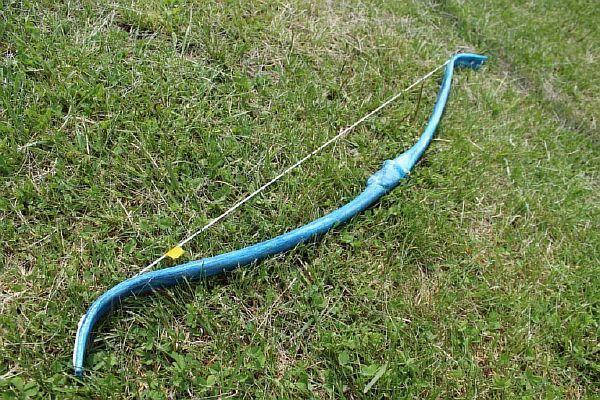
 The bow is a noble weapon. Since ancient times, it has been used for hunting wild animals. Over the millennia, this weapon has been refined and improved.
Its modern versions are made from new materials and technologies, and differ from previous products in their firing range and accuracy.
Many people think that a homemade product will be crude and far from ideal. But by following the tips and carefully watching the video, you can learn how to make a bow from PVC pipe yourself.
Advantages of PVC products
This device is easy to transport. And its large size doesn't hinder its size at all, as it's collapsible and very easy to disassemble.
It fits easily into a quiver with arrows. This bow is lightweight and highly accurate. A good homemade bow is in no way inferior in combat capabilities to its factory-made counterparts.
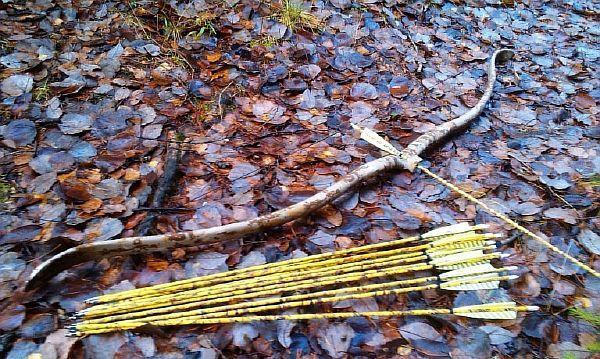 This ancient weapon, handcrafted from PVC pipe, is lighter than the factory-made version and more durable than its wooden counterpart.
This video will help you make a bow from a PVC pipe, where the manufacturing process is shown in great detail.
The low cost of synthetic materials allows this device to be manufactured at a cost significantly lower than purchasing a finished product.
PVC pipe is considered the simplest and most affordable material option. You can use leftovers from renovations or purchase small pieces (3 meters).
An additional advantage of a bow made of PVC is its longevity. Unlike wood, this product is not susceptible to rot.
What parts does an onion consist of?
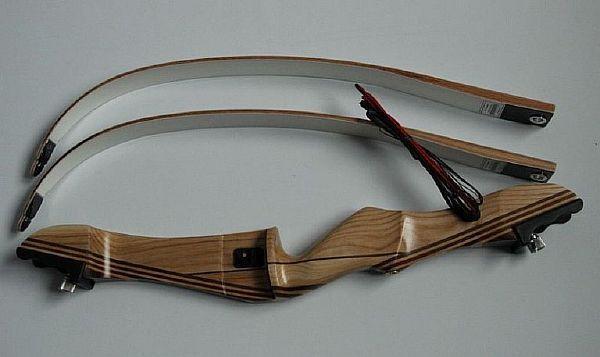 This product consists of:
- Shoulder;
- Handles;
- Bowstrings;
- Arrow;
- Final design.
A sturdy shoulder is crafted from a one-and-a-half-meter-long pipe blank. The handle is also made from this material, or supplemented with a wooden blank.
The handle length depends on the user's hand. Strong fishing line is used for the bowstring.
Detailed work process
The video provides a clearer understanding of how to make a PVC bow. For a full understanding of the process and its specifics, watch the videos.
Video - Making ancient weapons with your own hands.
The entire process consists of a few simple steps: preparing the parts and then assembling them. We need to gather the necessary materials:
- A piece of PVC pipe. 4 meters is enough (bear in mind that the first piece may not work);
- A hair dryer to heat it up without an open flame;
- Protective gloves;
- Sealing cable. You can use thick installation cable or twist several thinner ones together. If the prepared cable has high deflection resistance, the cable can be omitted;
- A flattening structure. This can be made using a wood board with special clamps for bow parts. The surface of the board can be lined with foil;
- Handle mold;
- Fishing line up to 2 meters;
- Hacksaw for metal;
- Arrow blanks;
- Materials for decoration.
Sequence of work
Video: Compound Bow. Cold Weather Testing.
 Making the shoulderThis part is the most important in the design. And it's where the work begins. A piece of blank is cut from 70 to 1.50 meters long. A shorter length is suitable for a small bow. If you need a larger piece, you'll need a piece from 1 to 1.5 meters long.
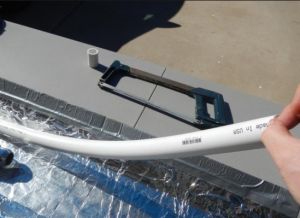
The shoulder curve is marked with a pen or pencil. Leave 15 cm for the handle, and divide the rest into three equal sections. The middle section will be the curve.
Using a heat gun, heat the pipe until it becomes soft. (Don't forget to wear protective gloves.)
Then, a cable is inserted into it, and the workpiece is reheated, this time only at the bending points. Once one side has softened, it should be firmly pressed using specially prepared clamps. To ensure the handle maintains its shape, blocks of the same height are placed underneath it.
Once the pipe has hardened, the second side of the shoulder is worked on (the procedure is exactly the same as for the first side). The result is a straight stick with two flattened ends.
Forming the arc. To do this, the entire surface of the workpiece must be slightly softened. The performance of the device depends on the arc shape.
It's important to remember that the bow bends slightly when the string is drawn. During this process, the handle itself is left untouched to prevent deformation.
To make the ends look nice, excess parts are filed down with suitable tools.
 Handle shapeWhen preparing the handle mold, ensure it is hollow (it should accommodate the pipe). When joining these parts, it's important that the pipe and handle be softened.
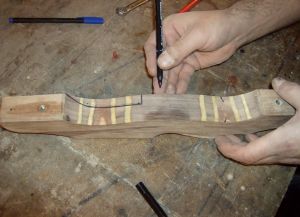
If a blank isn't used, the handle is created by heating the marked area with a heat gun. The desired shape is then carefully created by hand. (Just remember to wear protective gloves.)
IMPORTANT! The bow handle requires special attention. Its shape determines the ease of use of the bow.
 Drawing the bowstring10 centimeters are indented on each side of the edge and marks are made. Now the edges are heated one by one, and a bend (approximately 60 degrees) is made on them in the opposite direction from the arch bend.
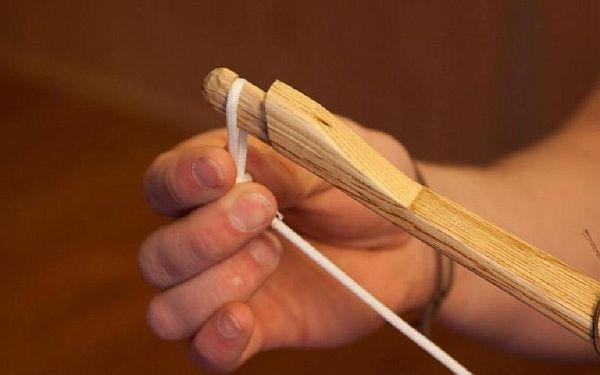
After the wood has cooled completely, trim off almost a third of the wood at the edge mark. The corners are trimmed off, leaving the center section for attaching the bowstring. After trimming, the edges must be finished with a file.
A fishing line is tied to the resulting fastenings. It should be secured carefully. The tension is checked with a special device and should be 20 kg. If so, everything has been done correctly.
- ArrowsTo test the device's functionality, you'll need arrows. You can buy them at a store, or you can make your own.
Video - Making arrows.
 DesignThis detail may seem unimportant, but every self-respecting ancient who used a bow decorated it in every way. These actions were imbued with special meaning. Every string and every additional element had immense significance.
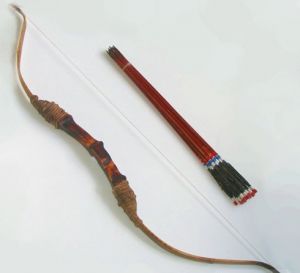
If you want to somehow highlight your creation, you can use any suitable things for this.
When designing, remember that the structure should not be overloaded, and all the nuances must be taken into account.
Making a compound bow
A compound bow is distinguished by its additional pulleys, which facilitate drawing and releasing the bowstring. This type of device is more difficult to manufacture.
The information below will help you understand how to make a compound bow from PVC pipe. You'll need:
- Pipe (PVC);
- Roller (2 pcs.);
- Wooden plank;
- Electric jigsaw;
- A rope of great thickness;
- Toothbrush.
First, the arms are made. Two 44cm long pieces of pipe are cut. They need to be thicker to make the device more powerful.
Video - Making a Compound Bow
Indentations are made at the ends of the pipe and rollers are attached to them. Through holes are drilled at the opposite ends of the pipe for bolts.
To make the handle, a pattern is drawn on a wooden board and cut out with a jigsaw. The arm tubes are attached to the edges of the piece at specific angles. They are secured with screws.
Next comes the bowstring attachment. One end of the rope is secured to the top edge of the limb. It is threaded through both pulleys, and the other end is secured to the other limb.
An arrow rest can be made from an ordinary toothbrush. Drill a hole in the handle, and then attach the top of the toothbrush to the hole.
This is detailed information on how to make a compound bow from PVC pipe. This is the simplest compound bow model. For more complex designs, drawings are prepared beforehand, and only then can work begin.
Making arrows
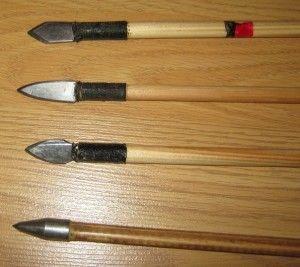 Once you've figured out how to make a compound bow, making arrows for it is quite simple.
First, you need to decide on the shaft. Buy ready-made round slats or use glazing beads.
The glazing beads are cut into 80 cm pieces. To give them a round shape, you need to clamp the piece in a drill chuck and run it through a thread cutting die (10 mm).
Video - Making arrows.
After this, the workpiece must be sanded. The groove for the bowstring is cut with a hacksaw and then reamed with a file.
The simplest fletching can be done using reinforced tape. Two strips of tape are applied to the end of the arrow on either side, and then the fletching is shaped into the desired form. Arrow embellishments are a personal choice.
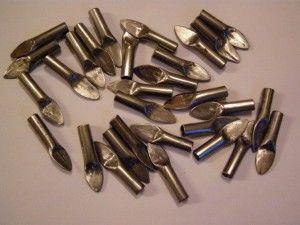
An arrowhead can be made from a piece of flattened electrode. After shaping, the arrowhead is inserted into the shaft and lightly sharpened.
Now you know how to make a compound bow. Just remember that this hunting weapon and recreational item can cause serious harm to its owner if used without proper safety precautions.
The injuries caused by this weapon can be very serious. And remember, using it for hunting purposes is illegal.