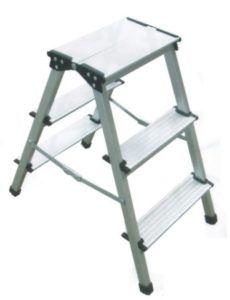
 Stairs made from profile pipes are widely used in many farms and homes. Previously, metal structures were used. It was believed that the heavier the metal, the greater its strength. However, during assembly, the extra weight could have a significant negative impact.
Now, heavy and angular buildings have been replaced by elegant structures made of profile pipes, which, in addition, were cheaper and demonstrated a high level of strength.
Buying this product at a hardware store can be quite expensive. However, making your own staircase from profile pipe can save you a significant amount.
- Why choose a profile and which one is better?
- Preparatory work
- Preparing a drawing and what to consider when making calculations
- What types of structures can you make yourself?
- Preparation before welding
- Ladder
- Interfloor flight of stairs
- Metal frame for marching buildings
- Spiral staircases
- Making a stepladder
- Decorative stairs
Why choose a profile and which one is better?
Manufacturing stairs from profiled tubing has proven to be a very successful idea. But before the craftsmen arrived at this solution, they had to experiment with other materials.
The structure was made of channel steel and angle iron. Only after a certain period of use did it begin to deform under the load. Eventually, an alternative was found: a profile pipe.
Advice! Experts recommend using 40x60 mm square pipes for this project. These dimensions are considered the most acceptable. If smaller dimensions are used, the square pipe, like an angle, will simply deform. And if a larger section is used, the staircase made from the square pipe will be too bulky and, on top of that, will have an unpresentable appearance.
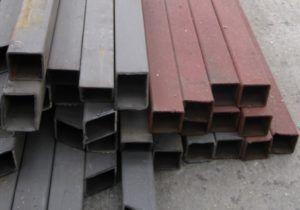
The answer to the question of what kind of profile pipe to use to make a staircase should be as follows. Thick-walled take a profile for work not recommendedThis is especially important if you need to create a lightweight structure. This type of staircase is sturdy, but will be quite heavy.
Also, if you make a staircase from thick-walled profile tubing, it will place additional stress on the foundation and supports. Therefore, when deciding which material to use, keep in mind that a cross-section of 5 to 7 mm is optimal.
Only in this situation can additional vibration under load be eliminated. For example, for a lifted internal structure in the attic, it's not recommended to use pipes with a large cross-section. For an external attic passage, a spigot is perfectly suitable. Wooden inserts can also be used to reduce the weight of the attic structure.
A structure made from a profile pipe, made by hand, has a number of advantages, including:
- the ability to make any type of stair lift with different turning angles;
- the profile accepts various combinations with other materials;
- long period of use of the structure;
- assembly speed, the duration of which is not affected by the level of complexity of the frame;
- such a staircase can be installed in a house at any stage of construction work;
- affordable price;
- the ability to do everything on your own.
Preparatory work
Before constructing a structure from a profile pipe, it's necessary to conduct careful calculations and create a drawing on paper. Calculating the cost of a staircase constructed from a profile pipe will help determine the required amount of materials.
Watch the video
A completed calculation and diagram are essential. They put everything in its place and help eliminate any inaccuracies even at the design stage. Using calculations, you can accurately calculate the materials needed not only for the load-bearing elements but also for the stair bases.
Besides this, you'll need to prepare your tools. You won't need much for this job, but you'll need:
- welder;
- Bulgarian;
- hammer drill and drill set;
- hammer;
- roulette;
- markers.
Preparing a drawing and what to consider when making calculations
The quality of a future structure built from profile tubing depends on the proper preparation and drawing. Once the drawing is completed, the dimensions of the future structure can be fully determined.
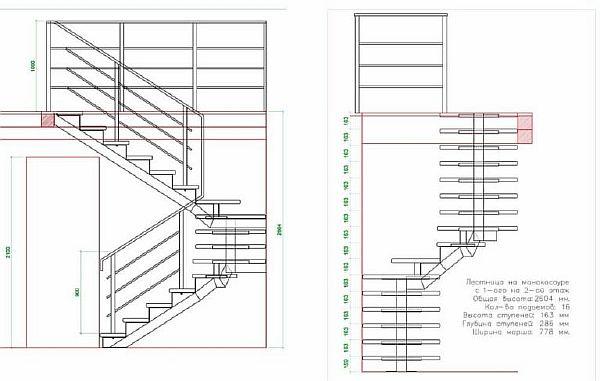
Moreover, this way you can see how the future project will look. A well-designed drawing of a staircase made from profile pipe significantly simplifies the assembly work. Therefore, everything needs to be depicted in great detail.
Also during the preparatory stage, you need to mark and cut the profile blanks to the required dimensions. If you plan to build a simple structural model, then careful calculation of the markings won't be necessary. However, for a complex structure, all parts will need to be numbered to avoid confusion during assembly.
When steps are made from plywood or wood during the construction of a staircase, they must be prepared in the required dimensions.
Watch the video
For additional fastening to the floor, stair assembly modules made from profile tubing are used. This is optional. Assembly modules are installed only in situations where it is important to reduce vibration during use. If the decision is made to install assembly modules, they must be taken into account when developing the layout.
What types of structures can you make yourself?
A homemade staircase constructed from profiled pipes can be of the following types.
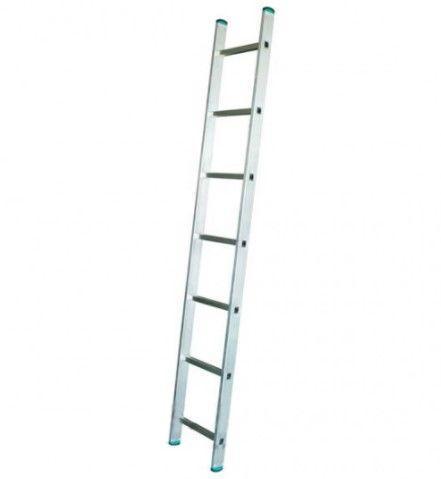
- An extension ladder. This is the simplest option. A DIY extension ladder made from profile pipe consists of two parallel supports with rungs installed between them. It is portable and lightweight.

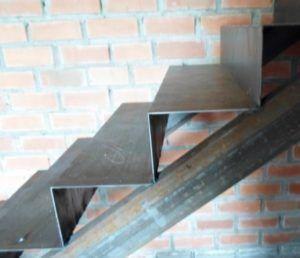
- A flight staircase. This type of staircase, made of rolled steel tubing, has a more complex structure. It consists of beams fixed at a single level, onto which the steps are subsequently installed. If the metal flight staircase forms a straight row, it is called a single-level staircase. However, when it forms two rows and a flight, it is called a two-level staircase.
 This type of homemade structure is built more often than other types. The supports for these types of staircases are formed by stringers. These are simply beams that support the steps from below. Alternatively, they can be stringers that support the end of the steps.
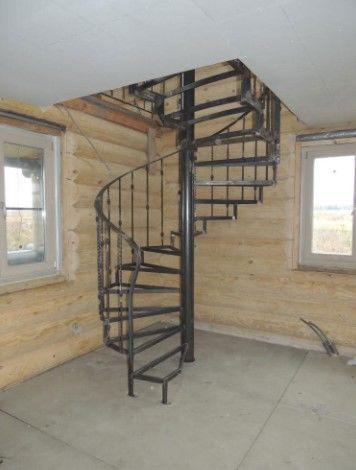
 - Spiral stairs. These are stairs welded from a profile pipe on a single stringer. A step is attached to one side of the stringer. This row wraps around the stringer from bottom to top. A railing is attached to the other side.
 Buildings on a single stringer are not often constructed independently. A homemade structure on a single central base is very steep and inconvenient.
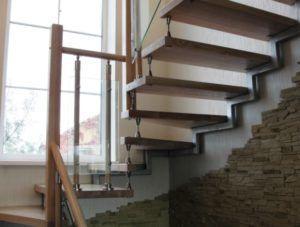
 - Bolted. In this version, the steps are secured to the walls with special, strong bolts. A distinctive feature of these homemade structures is the need for a strong wall.

Preparation before welding
Profiled tubing is an excellent material for constructing any type of structure. However, in this situation, the contractor will need specific knowledge of welding processes. Otherwise, welding a staircase from profiled tubing will result in the creation of a hazardous, unsafe, and unreliable structure.
Before welding the staircase, the metal must be carefully treated. Particular attention is recommended for the handrails, as they should not have any sharp edges or burrs.
When welding, it's also important to ensure the integrity of the entire structure. To achieve this, all work must be carried out in strict compliance with existing regulations.
Ladder
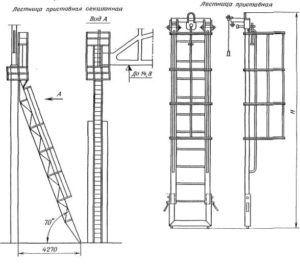 The main purpose in this case is to reach a high place. However, for lifting with a load, a prefabricated stepladder should be constructed from a profile pipe. When folded, it can serve as an extension.
Welding an extension ladder from profiled tubing isn't particularly difficult. This structure isn't difficult to construct.
The instructions for working with this structure are as follows:
- two profile pipes are prepared and markings are made on them (the distance between the steps is made 35 cm;
- the required number of steps is prepared;
- the steps are attached using a welding machine;
- Plastic or rubber tips are placed on the legs of the finished extension piece.
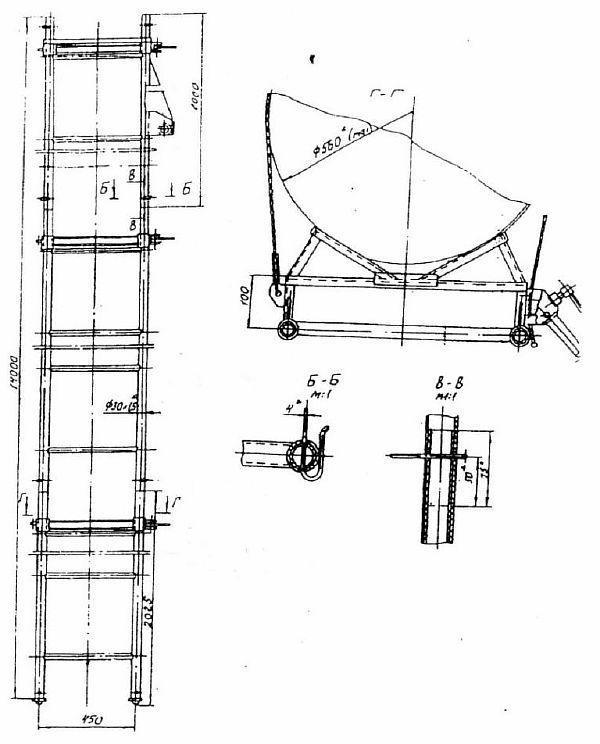 As you can see, welding this device is not difficult. This homemade extension ladder will last a long time. If welded correctly, it can support over 100 kilograms.
Interfloor flight of stairs
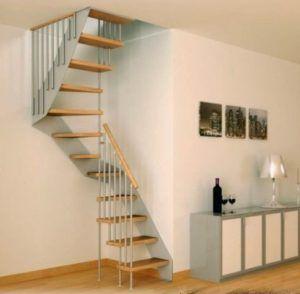 A staircase between floors in a private home, made of profiled tubing, is a key element that becomes the focal point of the interior. At the same time, it is a significant engineering structure that provides comfortable access to the second floor of the house.
The structure leading to the second floor in a private home can be a single-flight, spiral-shaped, or a combination of both. The configuration of the structure leading to the second floor is chosen based on the available space. The optimal option for a small home is a single-flight structure consisting of sixteen convenient steps.
In a spacious, high-rise building, the staircase to the second floor includes intermediate landings and turns. These complex structural elements can be L-shaped or U-shaped.
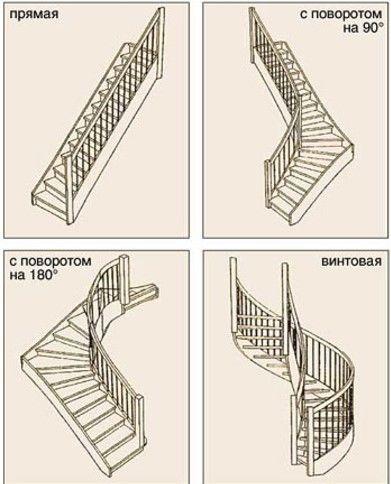
If a private house is small, then screw-type options are used. The classic type of such a structure is rarely more than 1 m.2, and it is easy to install anywhere, even in the center of the room.
Large houses often feature combined structures. This decision is usually dictated not by structural relevance, but by the owners' tastes. Incidentally, it's precisely these structures that tend to be the most beautiful.
Metal frame for marching buildings
The metal frame of stairs made of profile pipes is produced as follows.
- The markings for the metal frame are made and the profile is cut.
- Each step is connected by a frame.
- The necessary elements of the metal frame base are being concreted.
- The stringers are installed. The backs of the steps are reinforced, and they are welded together.
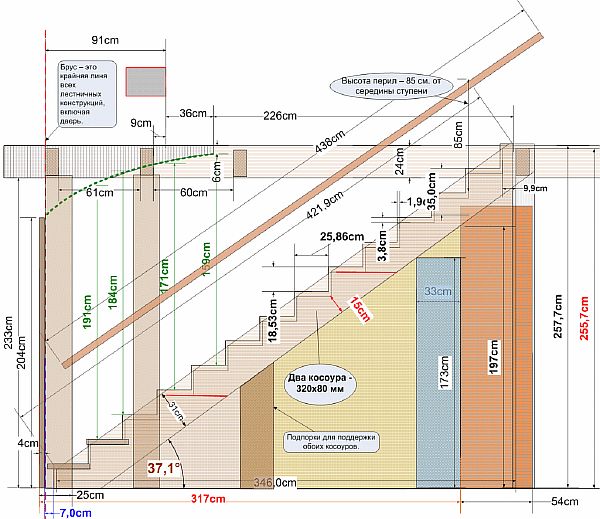 Installation is carried out in the following sequence.
- The exact number of steps and their dimensions are determined.
- The frame of a metal staircase made from profile tubing is made from 10x10 cm section steel and 4x4 cm angle iron. In this case, the metal profile material is used instead of a channel. It performs its function perfectly, as a metal profile frame is more rigid.
- A pedestal is created for a flat structure. A starting point for the steps is placed at the extreme end of the platform.
- A profile pipe is welded to the lower platform. The surface section is also secured to the upper portion of the future structure. Then, an angle is welded in place.
- Railings are welded to the side of the profile. Typically, when installing railings, a 1-inch offset is made from the end, which slightly narrows the opening.
Spiral staircases
If we're welding a helical profile structure, we first cut the tubular pieces prepared for the steps. The riser dimensions are 22 cm. Therefore, the room's height is divided by this value. This will determine the number of elements we'll need to weld the structure from.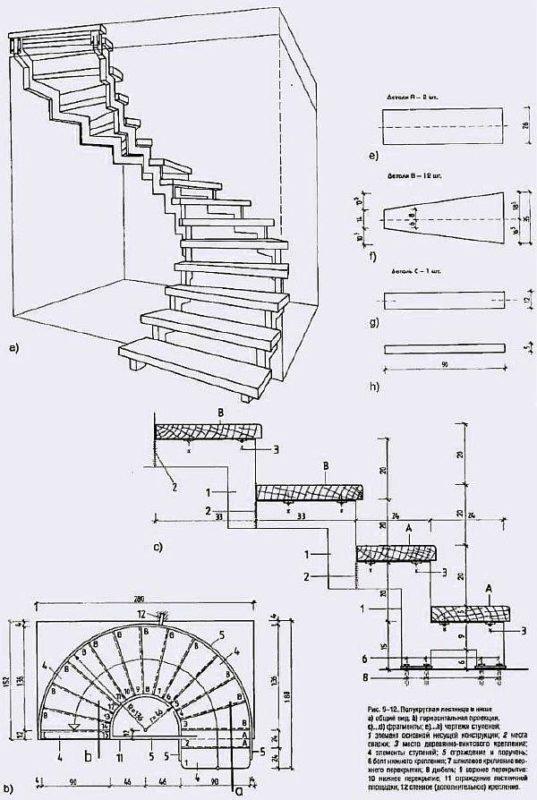
A metal pipe is used to cut the gasket and bracket. They are welded together, and then the resulting parts are joined using tubular materials.
The steps are placed on the spacers and secured with screws. When performing this work, avoid any distortion or play.
Railings for the building can be made from a 4x4 cm profile, and a 2x2 cm tubular product is used for handrails.
Making a stepladder
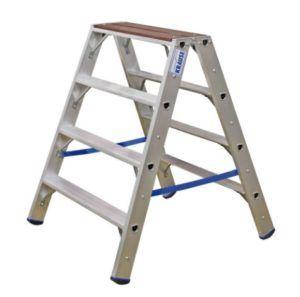 A homemade stepladder made from profile is structurally similar to store-bought aluminum versions. However, building one yourself is much cheaper than buying one from a store.
Such a homemade device is simply indispensable in the home and will serve more reliably than soft aluminum. Therefore, a homemade stepladder will not be subject to deformation.
You don't need many tools for the job. Just a welder, an angle grinder, a drill, a marker, a square, and a tape measure.
Work begins with preparing a drawing. Then, sections of profile pipes are cut according to the plan. After this, the steps are tack-welded to the two main frame pipes. After checking the homemade structure for any irregularities, the steps can be securely fastened. The other side of the stepladder is made in a similar manner. After this, the two halves are connected with suitable hinges.
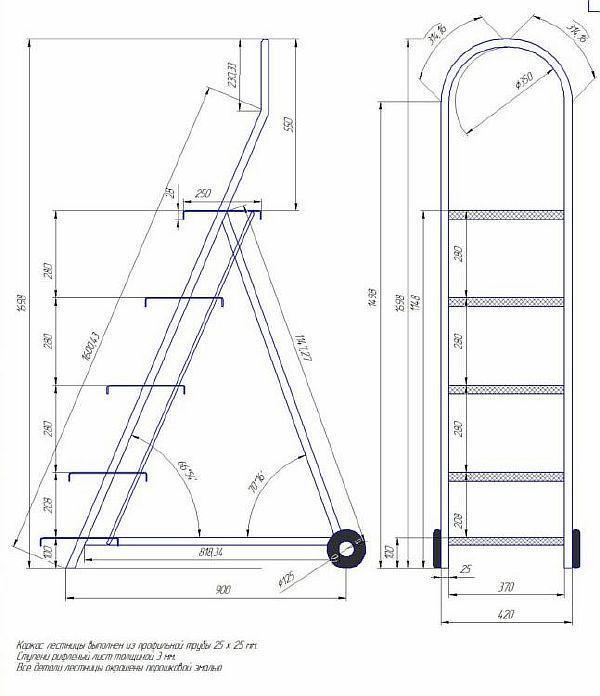
Next, we drill holes in the middle of the stepladder. These holes are needed to install a strap that will secure the two halves of the stepladder so they don't slide apart when we're using it.
Doing this job yourself isn't difficult; any DIYer with a reasonable amount of experience can handle it. If done carefully and according to the instructions, installation won't be a problem.
Decorative stairs
Decorative staircases made from profile tubing are very common. This is because the profile pairs perfectly with a variety of materials.
Watch the video
The decorative design of a staircase in a home often becomes the focal point for the rest of the room's decor. The choice of decorative material is a personal decision, based on budget and taste.
Decorative embellishments are used for both outdoor and indoor buildings. In both cases, the building's appearance is distinguished by its presentable appearance.
If you're struggling to decide how to decorate your staircase, you can always seek advice from a professional. They'll help you find the perfect solution and provide the necessary calculations.
Profiled stair structures are a relatively new practice. However, this solution has proven to be quite successful. A properly selected structure made from such a pipe will not only blend seamlessly into the overall design of the room but will also provide reliable service for many years to come.
Watch the video