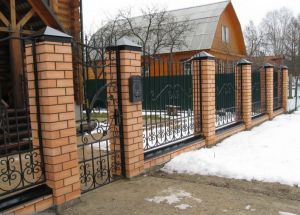
 Fencing a country property is one of the first tasks an owner addresses when developing it. First and foremost, it's essential to prevent the theft of building materials and tools used for construction of the house and outbuildings.
To achieve this, the owner installs a fence made of profile pipe—a material that is almost always readily available, affordable, and easy to install. A thrifty owner prefers to install the final fence immediately, rather than invest in a temporary one, which would directly increase costs.
The supporting structures for a property's fencing are the supports. They support wind loads, ensuring the durability and reliability of the frame.
- The main stages of fencing installation
- How to install pillars step by step
- Materials and tools we will need
- What kind of profile pipes are needed for a fence?
- Tools for installing fencing from profile pipes
- Manufacturing stages step by step
- Final editing
- Pros and cons of fencing made of corrugated pipes
- Drawings of fences made of profile pipes
The main stages of fencing installation
Before installing fence posts made of pipes, it's necessary to calculate the distance between them. To do this:
- Carefully measure the distance between the corners of the plot.
- Determine the location of the gate and wicket, and drive in pegs at these locations to indicate their positions.
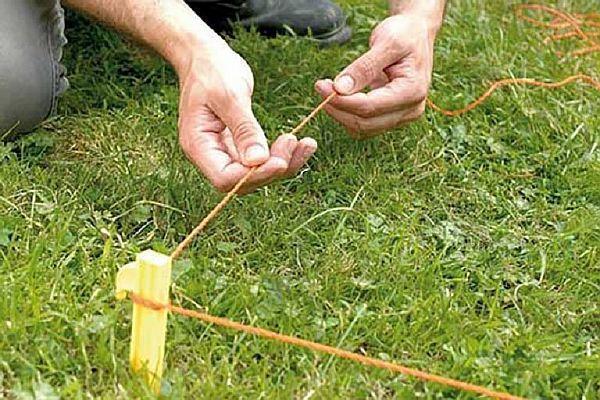
- Divide the distance on either side of the stakes into equal sections, determining the distance between them, and drive the stakes in. Depending on the fence design, the distance should be 1.8-2.3 meters.
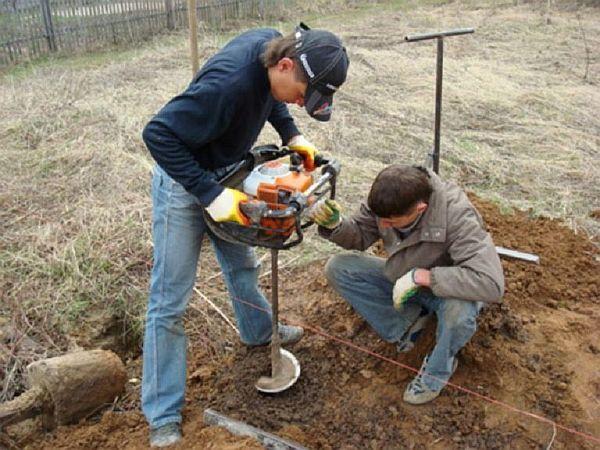
- Using a garden auger, dig pits at the locations marked with stakes. The depth of the holes depends on the soil freezing level in the construction area. It should be 20-25 centimeters deeper.
- Place a 15-20 cm thick drainage layer of sand and gravel at the bottom of the holes. Its purpose is to allow groundwater to drain during snowmelt.
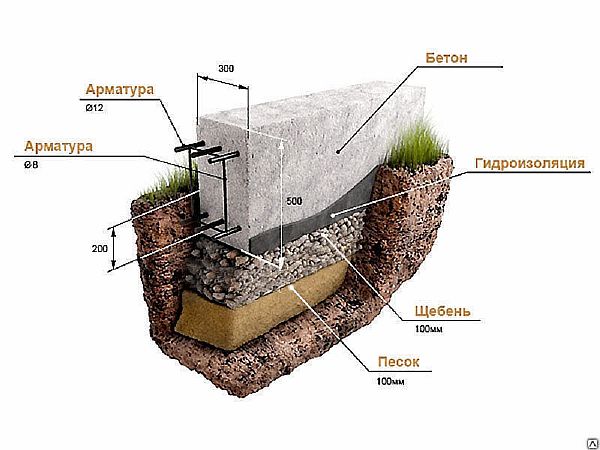
- Dig a trench for the strip foundation at least 50 centimeters deep and 30 centimeters wide. Where the supports will be installed, the foundation width should be at least 60 centimeters.
- Install the formwork approximately 10 centimeters above ground level. Align its top edge horizontally, not with the ground, using a spirit level.
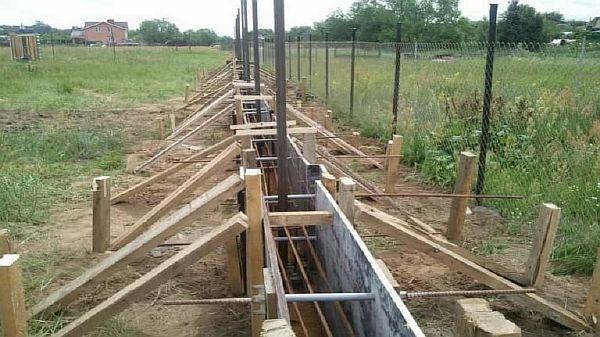
- Pour a drainage layer of sand and gravel about 20 centimeters thick, level it, and water it to compact it.
- Lay a reinforcing layer of 50x50mm or 100x100mm mesh along the bottom of the trench. A 5-centimeter gap should be maintained between the mesh and the bottom, which can be achieved by placing broken brick chairs under the mesh. Separate sections of the mesh are secured with binding wire. A second reinforcing layer should be laid 15 centimeters above the first.
- Concreting is carried out continuously using grade 300 mortar. The mass must be compacted, for which a deep vibrator is used.
- After the concrete has been poured, allow it to harden for at least 7 days. During hot weather, the foundation should be watered several times a day and covered with plastic film.
How to install pillars step by step
When installing supports, the most important thing is to maintain precise spacing between them, which is especially important for sectional fencing. Any deviation can require redesigning the section to accommodate the installation. Therefore, it's advisable to create a template and use it to install the supports.
Watch the video
The ability to move the support becomes possible when using a 200-250 mm diameter garden auger to dig the holes. The support pipe is inserted until it touches the bottom, after which its actual location is determined using a template.
After this, it must be secured with wedges directly in the pit and further braced with braces. During the concrete pouring process, the installation site must be filled with extreme caution.
As the concrete pours, install supports made of the pre-selected material at the marked locations. They should be secured with temporary braces in a strictly vertical position and left in place until the concrete has completely crystallized.
The supporting bases can be made from various materials:
- round pipes with a diameter of 80 millimeters;
- square or rectangular pipes;
- concrete supports, reinforced with pre-installed embedded parts for fastening spans;
- brick supports with purlins installed during the masonry process;
- wooden round or profiled posts (timber).
During the forced wait, you can leisurely construct the fencing spans. Once completed, the spans are suspended between the supporting structures. Fastening methods depend on the material used.
This is how the outer (front) part of the fence is constructed. The side and rear fences are simpler, usually using metal or plastic mesh stretched between the posts. A foundation between them is usually not constructed.
Materials and tools we will need
Metal profiles were created as a structural material. Pipes, on the other hand, are the most technologically advanced of these, allowing for the creation of reliable structures with minimal labor and time. A DIY fence made from profile pipes is one such example.
Watch the video: DIY Fencing, Part 1
What kind of profile pipes are needed for a fence?
For support posts, you'll need pipes with a minimum cross-section of 80x80 mm. The exception is gate posts, for which 120x120 mm is best.
Another application for profile pipes is horizontal lintels between posts. This is a load-bearing structural element designed to withstand wind loads on the fence, especially if a solid structure is used. For this application, 40x80 mm pipes are preferred.
The distance between them should be be no more than 75 centimetersTherefore, two or three purlins will be needed for each span. It's important to avoid welding these components together. This creates a monolithic structure, which can cause significant deformation when heated during hot weather. Building a welded fence from profile pipe yourself carries the risk of losing the structure.
Watch the video: DIY Fence Part 2
To calculate the required materials, you need to calculate how many are needed for one section, and then multiply by the quantity for the entire perimeter of the site.
What other profile pipe can be used for fencing? Certainly, smaller sizes of profile pipe can be used to create sections between posts, such as 10x10, 15x15, 10x20, or 20x20 millimeters. This is convenient when filling a fence frame made of profile pipe with lattice. Moreover, this work can be done either separately on a frame or on-site.
Fencing made of corrugated sheets is currently very popular. This is due to the variety of colors available and its high load-bearing capacity. It successfully withstands heavy wind loads and all types of climatic conditions.
What's the best pipe for a corrugated fence? In this case, it's used for the purlins, and a 40x80 mm profile is quite sufficient. The fence sheets can be secured with self-tapping screws or aluminum pop-rivets.
Tools for installing fencing from profile pipes
Considering the entire range of work, before starting it, you need to purchase the following tools:
- Construction cord.
- Pegs made from scrap materials, approximately 40 centimeters long.
- Hammer.
- Bayonet shovel.
- Scoop shovel.
- Road mesh.
- Concrete mixer and deep vibrator for compaction of mortar.
- Edged boards or sheet materials for formwork.
- Bars for supports.
- Welding machine for fencing installation.
- Angle grinder for cutting metal profiles.
- Personal protective equipment.
- Building level, plumb line.
- Clamps for fixing parts before welding.
Of course, it's a good idea for a thrifty homeowner to own such items. However, it's also possible to rent sophisticated products on a daily basis. This can significantly reduce the cost of building a fence.
Manufacturing stages step by step
Above we have already considered the procedure for performing preparatory work, including the installation of support pillars.
Watch the video: DIY Fencing Part 3
If the chosen fence design for profile pipes requires the filler to be made of corrugated sheet metal, euro picket fencing, or other similar materials, the installation process is simple. The individual filler elements are attached to the installed purlins one by one using self-tapping screws.
Building a sectional fence is a bit more complicated. It should be done in the following order:
- Develop a drawing of a fence section with details.
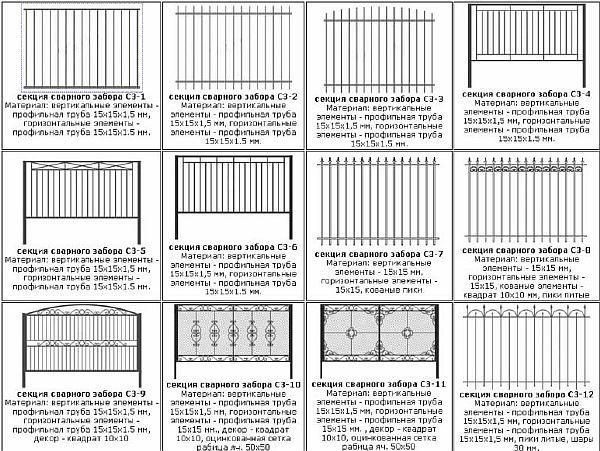
Using the ideas provided here, you need to draw a fence to your exact dimensions, including decorative elements. Incidentally, ready-made inserts are available at a hardware store. Simply attach them to the actual section drawing. This will significantly save time in implementing your design.
- Make the necessary grille parts using the developed drawings.
- Prepare a frame for installing sections.
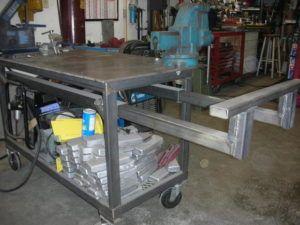
You can use a welder's workbench or construct a frame from 100x100 mm wooden beams. The main requirement is that the supporting surface be horizontal.
- Preparatory operation. Using the drawings, fabricate a set of parts for the section and lay them out on the workbench (stack). Make adjustments if necessary.
- Assemble the section using tack welds, check that the obtained dimensions correspond to the drawing requirements, and then weld it completely.
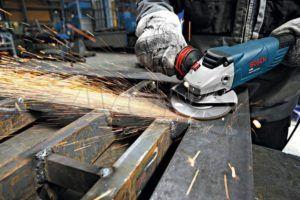
- Clean the weld seams with a hand grinder.
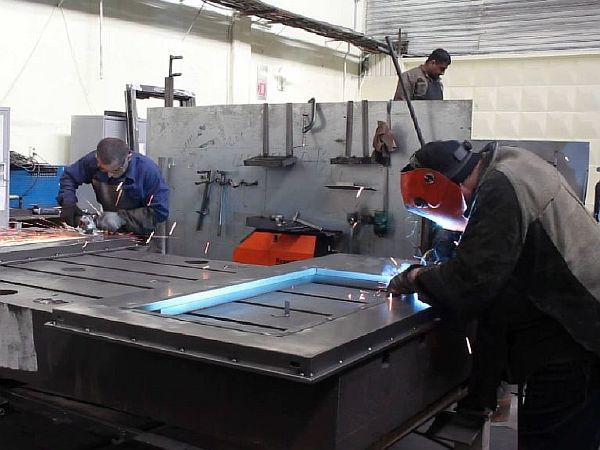
- Once assembly is complete, drastic measures must be taken to protect the metal from corrosion. To do this, thoroughly degrease all surfaces with acetone. Drying time is 10 minutes.
- Paint the product with a primer. For instructions on how to use it, refer to the instructions on the packaging.
- For the final painting, you need to use enamel paint for exterior work, or better yet, Hammereit metal paint.
Final editing
No matter how carefully the support posts are installed, it's usually impossible to ensure that the holes for fastening the section to the post are perfectly aligned. Therefore, instead of round holes, the sections should have grooves cut into them, approximately three times the diameter of the fastening screw.
Watch the video
Additionally, it's best not to drill a hole in the embedded part or bracket installed on the support post before installing the post. This will make it easier to mark and drill the hole on-site. The fastener diameter should be 10-12 millimeters; it's best to use a drill bit half a millimeter larger to drill the hole.
Galvanized profile pipes with a reliable protective coating up to 0.1 mm thick are often used for poles. These pipes must be welded. This process burns away the cladding layer, leaving the weld seam vulnerable to corrosion.
To avoid this, after removing the scale, the weld should be painted with a special paint consisting of 95% zinc powder, with the remainder being binders. This paint provides reliable protection for welds on galvanized steel.
A prerequisite for long-term operation of a fence made of profile pipes is protection of the inner surface of the pillarsFor this purpose, the construction market offers special plastic plugs of various sizes to match the pipe sizes.
But you can also use the old-fashioned method of making caps from galvanized steel to cover the holes. First, make a cardboard template for the cap, and after testing, you can transfer the dimensions to the metal and make these safety devices yourself.
Video: DIY installation and fitting of corrugated sheeting
Pros and cons of fencing made of corrugated pipes
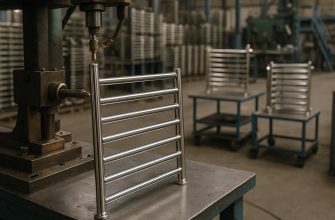
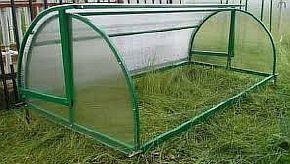
The use of profile pipes for fencing isn't limited to their applications. This valuable material is used to make a wide range of products, from furniture to complex arched structures for winter gardens or gazebos. This is facilitated by a number of positive qualities, including the following:
- high load-bearing characteristics with proper layout of structures;
- low dead weight;
- comparatively cheap compared to other construction materials;
- high weldability, determined by the use of low-carbon steel grades.
At the same time, structures made from profile pipes are not without certain disadvantages:
- Only transparent structures can be made from them, and if the owner does not want prying eyes, a low-transparency material can be additionally used, such as cellular polycarbonate;
- Errors during processing are almost impossible to correct; the part has to be made from a new blank;
- the need for regular maintenance of structures to protect against corrosion.
Bending is widely used to create design elements of structures, often using homemade equipment.
Drawings of fences made of profile pipes
The artists' imagination knows no bounds. The result is often stunningly beautiful design solutions.
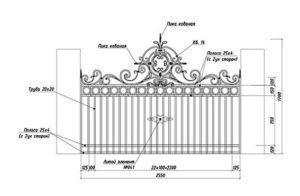
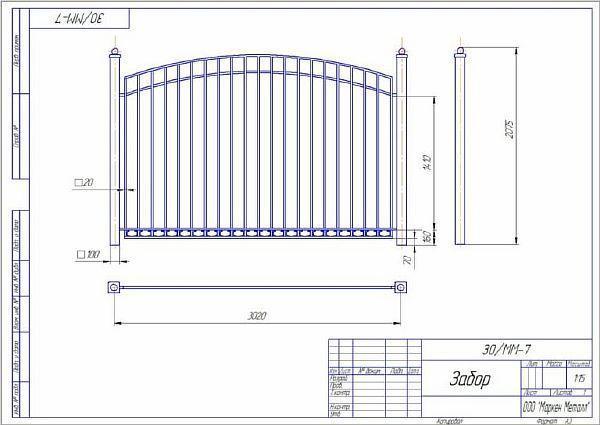
The dimensions of the fence profile pipe are determined by the design of the sections based on considerations of sufficient strength to withstand wind pressure.