Any garden plot will benefit from building a homemade greenhouse out of plastic pipes. This design allows for seedlings to be grown as early as early spring. It can also be used to grow cucumbers or tomatoes without additional heating in northern climates, where temperatures drop significantly at night and the ground cools.
The main problem with construction is the cost of materials and the complexity of the work.
Using PVC pipes allows for a durable greenhouse. It doesn't require significant investment. You can assemble the structure yourself in 1-2 days.
Below you can read about how to build a greenhouse from PVC pipes yourself. A greenhouse made from this material follows a similar pattern.
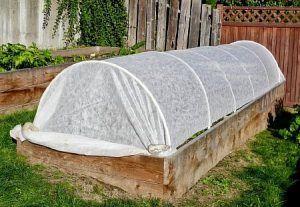
- Why do we use PVC pipes as a basis?
- Types of greenhouses
- Dimensions, diagrams and drawings of the greenhouse
- How to calculate the amount of material
- Necessary tools
- Making a greenhouse – step-by-step instructions:
- Making a wooden foundation
- Installation of PVC pipes and methods of their connection
- Creating a framework
- Covering and fixing the film
Why do we use PVC pipes as a basis?
Until recently, wood or metal were the primary materials used to construct greenhouse frames. Both of these materials have significant drawbacks.
Tree:
- short service life;
- low strength.
Metal:
- heavy weight;
- high cost;
- complexity of the work (welding is required, you can’t do it without an assistant).
Wooden structures don't handle the high humidity that occurs in a greenhouse well. Metal frames are expensive and rust over time. Both wooden and metal structures require periodic painting.
Plastic water pipes have proven to be a virtually ideal construction material. Anyone can build a PVC greenhouse themselves. They are durable, resistant to sun and precipitation, require no painting, are resilient, and retain their shape well. Furthermore, they are much cheaper than metal. Most private greenhouses are made from them.
Working with metal and wood requires skill. Metal structures are joined by welding and must be cut with an angle grinder. Bending to a radius requires special tools. Due to the weight of the materials, at least one assistant is essential. Not everyone can handle welding on their own.
Wood also requires at least some experience. It needs to be treated to protect it from rot, fungus, and insects. It's difficult to construct a greenhouse with an arched roof from planks. Just like with metal, installation without an assistant is difficult.
But building a greenhouse yourself from plastic pipes is easy, and can be done by one person in a very short period of time. These pipes bend easily without breaking.
Simply anchor one end to the ground to maintain a perfect dome shape. Fittings such as a double or tee are suitable for connecting. A pipe soldering iron or PVC adhesive will be required for this. Clamps and screws are also an option.
Types of greenhouses
Greenhouses come in two main types: arched and flat-roofed. The former is a cylinder cut lengthwise, while the latter is a simple rectangular structure.
Greenhouses are typically used only for growing seedlings. Therefore, they are built low, no more than 1-1.3 meters high. Opening windows allow access to the interior and provide ventilation. Without it, plants can overheat and die on sunny days.
PVC pipes don't allow for the construction of a classic flat box. The material's flexibility prevents this. Therefore, an arched greenhouse is the most cost-effective and convenient option for a plastic pipe greenhouse. It requires little material, and its shape is suitable for covering with plastic film. A PVC greenhouse for cucumbers can be assembled in just a few hours.
Thanks to the design features in the form of a semicircular vault, it is well lit at any position of the sun.
However, it's difficult to install opening windows in such a structure. Therefore, a different approach is taken.
There are several options for solving the problem.
- The end section is adapted for ventilation, where an opening is left.
- A mini greenhouse can be built with a hinged lid. To do this, simply build a wooden foundation of four planks, on which sits a frame of the same size, made of the same material. The foundation and frame are connected at one end with door hinges. Alternatively, one side of the greenhouse can be tied to stakes driven into the ground—this will also allow the lid to be hinged back.
- A PVC greenhouse can be made portable; its lightweight size allows you to lift it yourself and move it to another location. However, this requires available space in the garden, which is usually not a problem in the spring.
- The polyethylene film is secured with removable fasteners or its edges are sprinkled with earth - this allows it to be raised at the top.
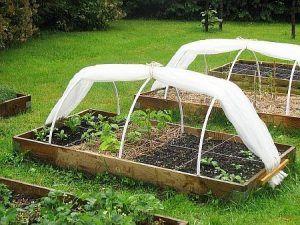
The height is adjusted depending on the height of the plants that are supposed to be grown in it.
If you want to build a greenhouse yourself from PVC pipes with shelving, similar to a simplified greenhouse, then the height should be chosen so that a person can move along the central axis of the structure.
A path is installed in this area, allowing easy access to any part of the greenhouse. The greenhouse doesn't necessarily have to be as tall as a person; it can be smaller, although this will require stooping.
A small amount of space at the top allows warm air to remain in the lower layer, which is beneficial for plant growth.
Dimensions, diagrams and drawings of the greenhouse
A simple greenhouse built from PVC pipes is a very straightforward design, requiring no complex construction. All that's needed is a lower frame made of planks to which the ends of the pipes are attached, as well as the rolled pipes themselves.
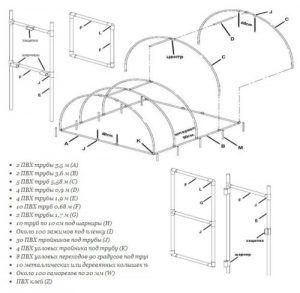
To avoid mistakes during the work, first draw a drawing of the structure. A simple diagram will suffice. The main thing is that each element is calculated and its dimensions indicated.
Before starting the drawing, you should determine the greenhouse size: length, width, and height. The amount of material needed will vary depending on the size.


Greenhouse assembly diagrams
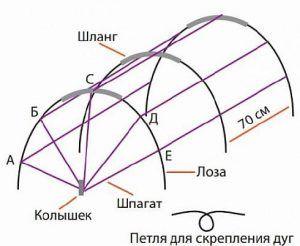
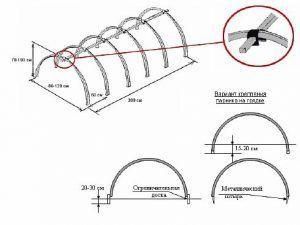
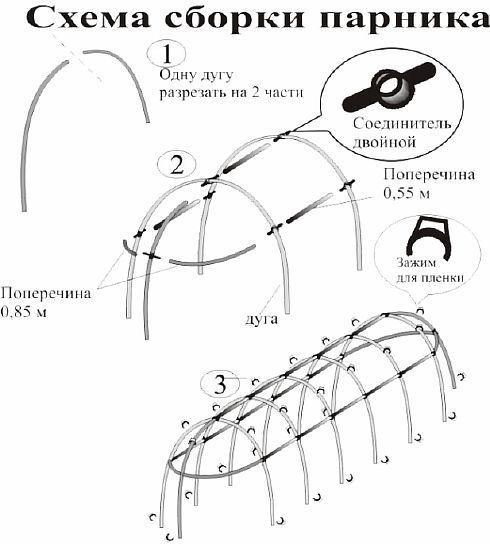
How to calculate the amount of material
The calculation is made independently based on the dimensions of the structure.
The length of PVC pipes running to the greenhouse arches is easily calculated based on the diameter of the circle they form. However, usually only the width and height of the greenhouse are known. Therefore, it's more convenient to use the following formula:
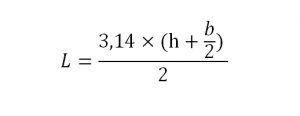
Where:
L – the length of the pipe used for the arch arc;
h – greenhouse height;
b is the width of the greenhouse.
That is, if the width of the greenhouse is 2.5 meters, and the height is 1.2 meters, then according to the formula, for the arch we need to prepare PVC pipe sections according to:
(3.14x(1.2+2.5/2))/2=3.8465 m
Rounding up, we get that the sections for the arches are needed to be 3 meters 85 centimeters long.
The distance between the arches is 0.5 meters. So, if the greenhouse is 3 meters long, you'll need 3 x 2 + 1 = 7 pieces. For structural rigidity, the tops of the arches can be connected with PVC pipe pieces. For a 3-meter greenhouse, you'll need 6 pieces of 0.5 meters each. In reality, the pieces will be smaller because you need to take into account the thickness of the arch pipes and the size of the fittings, if they're used for fastening.
Alternatively, you can take a 3-meter piece of PVC pipe and attach it to the arches using screws or a wire threaded through the drilled plastic. In this case, the pipe should run along the entire length underneath the arches to avoid interfering with the installation of the film. This type of fastening is easier to do yourself.
In addition to PVC pipes, to build a greenhouse yourself, you'll need boards or timber. Two pieces equal to the width of the structure and two more equal to the length.
Depending on your choice, you will need fittings, glue, screws, nails, and wire for fastening.
The transparent covering is a film or polycarbonate sheet. The film can be made of PVC, polyethylene, or a thick polypropylene sheet is ideal.
If you're using film, it's best to use reinforced film. It's more expensive than regular polyethylene film, but it's more durable and will last for many seasons.
Polycarbonate is even better—it's a durable, transparent material that transmits sunlight well and is lightweight. It will last for years and is easily attached to the pipes using screws and washers. Using polycarbonate makes the dome structure rigid, eliminating the need for horizontal pipe to connect the arches, simplifying assembly.
It's best to make the structure long enough so that the polycarbonate sheet or film doesn't overlap. The length of the covering material is calculated using the same formula as the length of the PVC pipes for the arches, adding an overlap of 30 cm on each side.
Necessary tools
To work you will need:
- hammer,
- a screwdriver or a drill for working with screws;
- tool for cutting PVC pipes: special scissors, hand hacksaw for metal, electric jigsaw;
- If fittings are used to connect PVC pipes, you will need either a pipe soldering iron or plastic glue.
For screwing in screws, it's best to use an electric screwdriver. Or a corded one, if you have one, and can run an extension cord. Using a screwdriver is very inconvenient and time-consuming. A cordless screwdriver allows you to tighten the fasteners with one hand while holding the structural members with the other. This allows you to work independently.
Making a greenhouse – step-by-step instructions:
The construction of such a building is not a complicated matter; it consists of several stages.
Making a wooden foundation
The first step is to build the foundation. It's assembled from four boards. Level the area where you plan to install the unit. Mark the area with pegs and string, marking the corner locations.
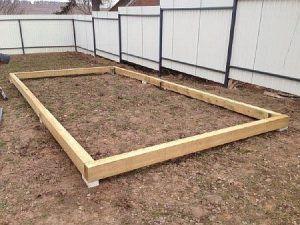
Dig shallow trenches 10-15 cm deep where the boards will be installed. Fasten them together at the corners with screws. It's best to use lumber 2-4 cm thick, with 4 cm being the optimal thickness. To prolong the life of the wood, treat it with a rot-preventive agent. Then, you can thoroughly stain the boards with drying oil, paint, or varnish.
The foundation is needed primarily to securely hold the pipes in place, acting as their base. Furthermore, the structure has significant windage. Strong winds can tip the structure over. To prevent this, wooden or metal stakes are driven into the ground to secure the foundation.
Installation of PVC pipes and methods of their connection
The ends are secured to the foundation boards using metal clamps and screws.
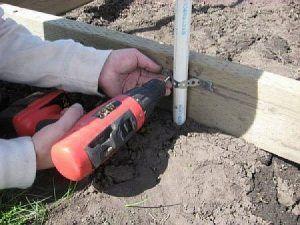
For a mini greenhouse, this type of pipe support is sufficient. However, if it's even medium-sized, the arches will need to be connected with horizontal braces.
There are several options for connecting PVC arches:
1) Fittings secured with a pipe soldering iron.
2) Fittings secured with glue.
3) Wire. In this case, a hole is drilled through both rods, a piece of annealed steel wire is passed through, and the ends are tightly twisted. This connection is reliable, requires no construction skills, and is easy to repair. A plastic cable tie can be used instead of wire.
4) Bolted connection. A hole is drilled through the rods laid crosswise, a bolt is inserted into the hole, and secured with a nut. Washers are essential.
The first two options create permanent connections. In contrast, bolted or wired connections allow the structure to be disassembled. This type of structure can be disassembled at any time and moved to another site.
Creating a framework
When using PVC pipes with a diameter of 20-30 mm, special tools are not required for bending them. They are already flexible enough. Simply secure one end to the foundation, then grasp the other end and gently, without jerking, push it into place. The pipe will bend automatically; a builder's hand can easily do this.
Larger diameter PVC pipe materials will need to be bent using a heat gun.
You don't have to bend the rod at all. In this case, the arc is made from straight sections and takes the form of a triangle, with the upper corner formed by the fitting.
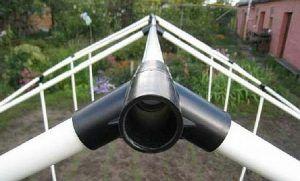
The simplest designs require nothing more than arch pipes and plastic film. The ends of the arches are driven directly into the ground, and the ends of the plastic film are covered with soil. You can build such a cucumber greenhouse from PVC pipes in a couple of hours, but it will only last for one season.
Covering and fixing the film
When covering the greenhouse, you'll need several people to help you carefully straighten the sheeting. The length of the sheeting should be equal to the length of the structure plus twice its height, with a slight overlap. This ensures that the entire structure is covered, not just the sides but also the ends.
The film is attached to the wooden base with nails or screws. In this case, a wooden strip is laid first, and then nailed to the foundation.
Alternatively, the ends of the film can be secured with soil or weight rather than nailed down. In this case, the film should have an extra 30-40 cm of slack.
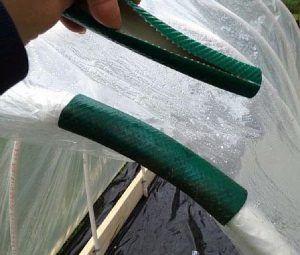
It is convenient to attach the film to the arches using homemade fasteners made from pieces of rubber or PVC hose.

I thought I wrote it down or copied and pasted it from someone else, saying it was a 20-40 cm diameter when making a wooden foundation. And just fill it with concrete to make a bunker.
There was a typo, and you're holding on to it, nerve cells aren't recovering.