The construction of plumbing systems using plastic materials is already becoming a tradition. The most popular type of heating pipe is aluminum-reinforced polypropylene pipe.
Polypropylene is a product obtained by polymerizing petroleum cracking products. Its molecule consists of two carbon atoms bonded to hydrogen.
The carbon-carbon bond consists of two bonds, one of which is weaker. Under high temperature and pressure, it breaks, and the molecule becomes chemically active.

Since there are numerous such formations in space under these conditions, they link together, forming molecular chains that form the basis of polypropylene. The process occurs in the presence of catalysts.
The resulting material is a solid, plastic substance that melts at elevated temperatures. This property of the substance is used to produce various products, including pipes, using extrusion.
However, the physical properties of polypropylene pipes leave much to be desired. Their main drawback is their high coefficient of linear thermal expansion.
As a result, pipelines operating temperature of the coolant underwent significant elongation, which resulted in their deformationIn addition, the fact that the substance is a thermoplastic caused the pipes to bulge under the combined effects of temperature and pressure.
- Why is aluminum reinforcement used?
- Properties and characteristics of aluminum-reinforced polypropylene
- Disadvantages of aluminum-reinforced PPR pipelines
- Scope of application
- Comparison of fiberglass and aluminum reinforcement
- Markings and designations
- Let's look at the manufacturers
- Features of polypropylene installation
Why is aluminum reinforcement used?
A solution to these problems was found in the design field. The polypropylene mass in the pipe is reinforced with reinforcing inserts. Materials with opposing mechanical properties were selected: fiberglass and metal.
Reinforcing polypropylene proved to be a successful idea – the mechanical properties of the pipelines improved significantly: the coefficient of linear thermal expansion decreased by 75%, and its residual value is comparable to that of metal analogues.
And the strength indicators have increased more than twice – Reinforced pipes can withstand hot water pressures of up to 20 atmospheres. This method has enabled the widespread use of aluminum-reinforced polypropylene pipes in hot water and heating systems.
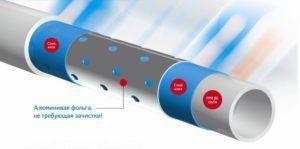 The reinforcement of polypropylene with aluminum foil deserves special attention. First of all, why was aluminum chosen? A characteristic feature of this metal is the reliable protection of the surface of products made from it by an oxide film. Aluminum patina (Al)2O3) is very resistant to the effects of any oxidizing agents and chemically active substances.
Only mercury salts can destroy it. Therefore, it provides reliable chemical protection for strengthening pipes. At the same time, the mechanical strength of the products is sufficient to withstand excess pressure from the transported liquid inside, even with a thickness of 0.1-0.5 millimeters.
Some other metals, such as gold, silver, and platinum, possess similar properties. However, we won't seriously consider their use in pipe production for obvious reasons.
Properties and characteristics of aluminum-reinforced polypropylene
Fiberglass-reinforced pipelines offer a number of remarkable properties. One of the few drawbacks of these products is the permeability of the walls to atmospheric molecular oxygen, which is one of the strongest natural oxidizers. This leads to accelerated corrosion of the metal parts of the pipelines:
- In heating systems, this is the inner surface of boilers, heated towel rails and metal heating radiators, as well as metal shut-off valves.
- In hot water supply systems, filters, meters, metal-to-plastic adapters, and anything else that is susceptible to oxidation are damaged.
It utilizes the high protective properties of aluminum and its high metallic density. Aluminum-reinforced polypropylene offers superior oxygen protection and can serve plumbing systems for up to 50 years.
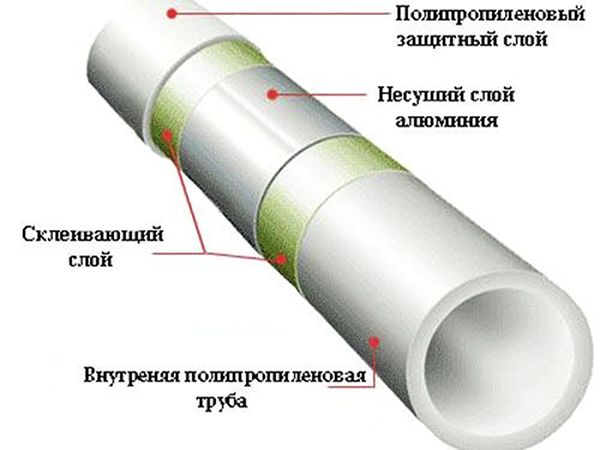
Polypropylene, marked PPR, is a more durable material for hot water pipes, as it better withstands elevated temperatures and pressure in the system compared to other, traditional products.
The inner surface of the pipes is represented by a stable surface, which:
- does not corrode;
- not subject to bacteriological contamination;
- does not deposit limescale deposits typical of water pipes;
- practically not subject to physical wear and tear.
This allows the use of PPR pipes for a long time without changing the physical parameters of the system.
Disadvantages of aluminum-reinforced PPR pipelines
In this case, we're dealing with a fairly advanced material that can provide long-lasting and reliable service. However, it does have significant drawbacks.
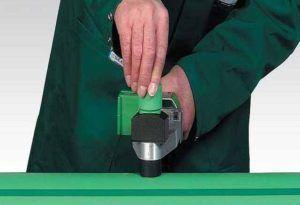
These include the need to clean the mating ends, removing the reinforcing layer. This is an inconvenient operation, and an error in performing it can compromise the integrity of the system.
Watch the video
[sociallocker]
Another disadvantage is the material's vulnerability to harsh ultraviolet radiation. With prolonged exposure to sunlight, it becomes brittle and can easily break.
To enhance UV resistance, carbon black is added to the composition at a rate of up to 2% of the total weight. However, it's safer to simply avoid using PP pipes for pipelines in exposed areas.
Scope of application
When considering the applicability of such products, one must take into account their origin and basic properties.
The fact that the material is a thermoplastic directly implies that it cannot be used at elevated temperatures. Therefore, non-reinforced rolled pipe materials are used for gravity-flow pipelines, such as sewer systems.
However, here too, the possibility of maximum heating must be taken into account. up to a temperature of 95 degreesConsumers avoid overheating by mixing it with water from the cold tap when pouring out boiling water.
The second possible use is in ventilation ducts. There are no problems with this application, as these objects are always located indoors and protected from sunlight and high temperatures.
Watch the video
All the disadvantages of the original material are eliminated by reinforcement. The creation of a protective layer of fiberglass compensates for its flow properties and high thermal expansion capacity.
As a result, the products can withstand pressures of up to 25 atmospheres without deformation. This ability is maintained even at temperatures of 95 degrees Celsius. However, this is a cautious recommendation from the manufacturer; in reality, these products can withstand temperatures as high as 135 degrees Celsius.
Manufacturers of aluminum-reinforced pipes claim that the durable oxygen barrier of the aluminum layer prevents corrosion of metal components in heating or hot water supply systems. While this is theoretically true, there are no reliable statistics on increased wear and tear of such systems.
Comparison of fiberglass and aluminum reinforcement
We propose to consider this issue in detail, starting with the production process.
In both cases, identical presses are used, and in some cases, they can be used in dual configurations. The significant difference lies in the method of applying the reinforcing layer.
For aluminum, this requires the application of adhesive layers, which are highly toxic. If solid aluminum rebar is used, a high-precision laser welding head is required. This somewhat complicates the equipment, resulting in higher production costs for aluminum-reinforced pipes.
The performance characteristics of both types are almost identical. when used for both hot and cold water.
Watch the video
Essentially, the products being considered are made from the same material, so the installation technology for the plumbing systems is virtually identical. The only minor difference is the need to clean the aluminum jacket before soldering during installation.
It's logical to conclude that we're dealing with the same material with virtually identical properties and applications. The claimed advantage of oxygen-barrier pipes is justified only theoretically.
It is obvious that the differences between pipes reinforced with fiberglass and aluminum are, in principle, small.
Markings and designations
The designation on these product samples is the abbreviation PPR-AL-PPR, which fully explains the material's structure. These pipes come in several subtypes:
- The first option is presented for products with perforated aluminum inside;
- the second option is made with a solid metal layer, which provides reliable protection against oxygen penetration;
- The third type is a five-layer pipe, where there is polypropylene on the outside and inside, an aluminum layer in the middle, and two layers of hot-melt adhesive on top and bottom.
Some manufacturers replace the PPR designation with the abbreviation PEX, which is, in principle, the same thing.
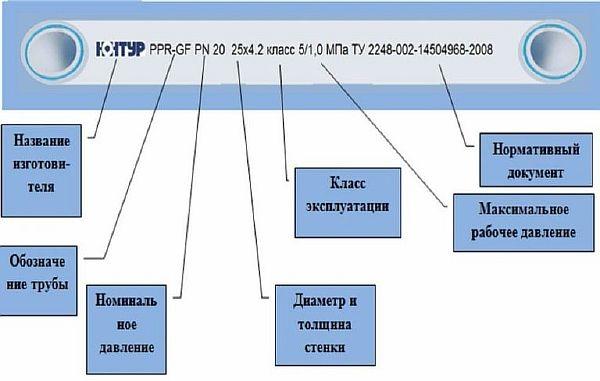
All plastic pipes are marked on the outer surface. For aluminum-reinforced polypropylene, this includes the following information:
- Logo or trademark of the manufacturer.
- Designation of the pipe type.
- The value of the nominal working pressure.
- Pipe dimensions indicating outside diameter and wall thickness.
- Operating conditions class.
- Maximum allowable working pressure.
- Indication of compliance with technical documentation – GOST or technical specifications.
Let's look at the manufacturers
It's safe to say that plastic pipes are produced worldwide. The following are prominent on the global and Russian markets:
- Czech company FV Plast is present on the European market It's not that long ago—15 years. But during this time, it has earned a well-deserved reputation for the high quality of its products and reliable delivery. The company's order portfolio includes 30 regular customers in Europe.
The manufactured pipe range covers a full range of sizes from 20 to 115 millimeters across all product types, including both pure plastic and reinforced products. We also supply the Russian market.
 Russian plastics manufacturer Metak LLC specializes in the production of polypropylene pipes in sizes from 16 to 100 millimeters and a full range of fittings. A total of 250 product types are manufactured. A significant role in the company's success lies in its engineering team, which is constantly improving its technology and developing new products. The high quality of its products has earned the company a well-deserved reputation and recognition in the market.
- One of the most famous suppliers of plastic products for pipelines Banninger, a German company based in Hesse, Germany, is a leading manufacturer of high-quality products. They place particular emphasis on the quality of raw materials, ensuring their products are always reliable and durable. However, their most important activity is their laboratory for developing advanced products. Thus, they not only produce standardized products but also pioneer new ones.
 Russian plastics manufacturer Metak LLC specializes in the production of polypropylene pipes in sizes from 16 to 100 millimeters and a full range of fittings. A total of 250 product types are manufactured. A significant role in the company's success lies in its engineering team, which is constantly improving its technology and developing new products. The high quality of its products has earned the company a well-deserved reputation and recognition in the market.
 Banninger, a German company based in Hesse, Germany, is a leading manufacturer of high-quality products. They place particular emphasis on the quality of raw materials, ensuring their products are always reliable and durable. However, their most important activity is their laboratory for developing advanced products. Thus, they not only produce standardized products but also pioneer new ones.
The company's product range fully covers all housing construction material needs. Pipeline installation equipment and tooling are also manufactured here.
Features of polypropylene installation
Compared to other plastics, polypropylene has one important distinguishing quality: hardness. For this reason, bending pipes during installation is not possible. Therefore, all pipeline components are connected using diffusion welding fittings.
Watch the video
It involves melting the mating surfaces to a depth of approximately 1 millimeter, followed by compression. This process mixes the materials of the parts, forming a monolithic mass at the joint. Hardening occurs within one to two minutes, resulting in a secure connection. The assembly of the water pipe sections is performed on a workbench.
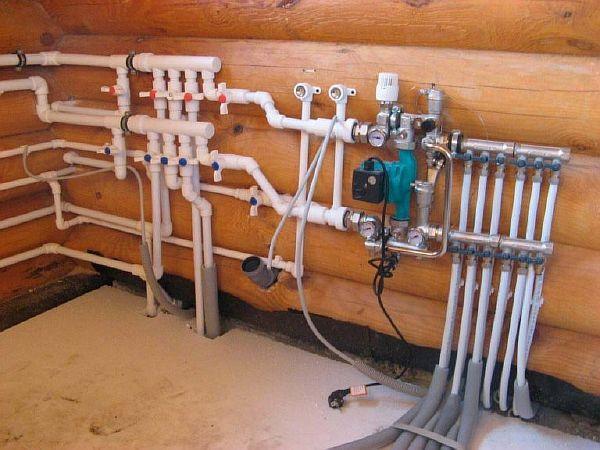
The sections are connected to each other while suspended, which is not very convenient and requires the help of an assistant.
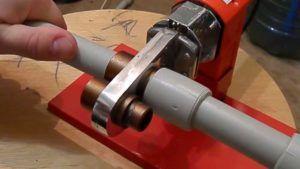
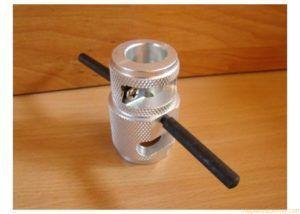
When working with aluminum-reinforced polypropylene, the end of the part must be cleaned, freeing it from the metal jacket, as the metal cannot bond to the plastic by diffusion. Special tools are used for this.
 Properly installed polypropylene-aluminum water supply pipes can last up to 50 years. Good luck!